Science Advisor
Gold Member
- 2,858
- 12,735
- TL;DR
- This article describes the developing awareness of bacteria that conduct electricity in different ways to make use of the redox energy in physically separated areas.
This news article in Science magazine describes what is becoming known about the different kinds of bacteria that can do this, what is known about how they do it, and how people might make use of the phenomena.
The bacteria conduct electricity through either small nano-filaments sticking out from individual cells or in cables formed of protein "wires" around a string of bacteria.
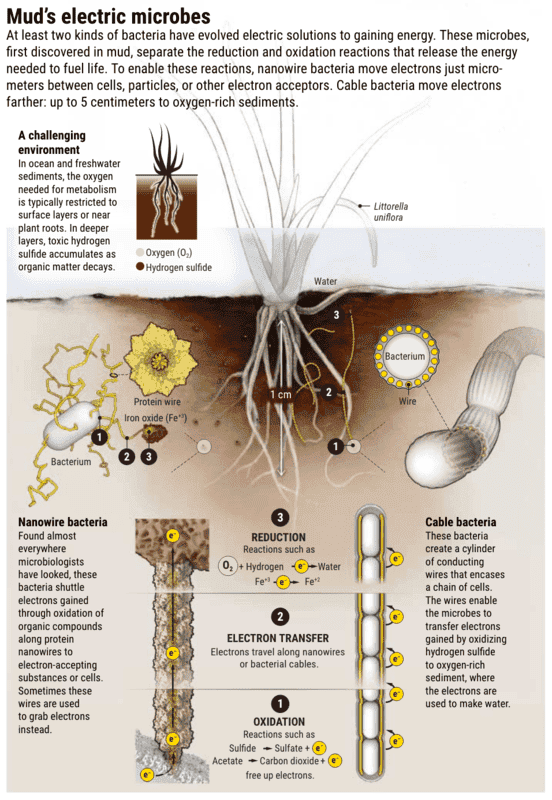
Their chemical abilities expand the possibilities of the ecology (as a set of biological reactions, in an area, using available energy) to make use of these, otherwise under-utilized, environmental energy sources.
I remain curious about how the bacteria through out the length of the cable get benefit from being part of the cable where they just appear to passing the electrons along the chain.
The bacteria conduct electricity through either small nano-filaments sticking out from individual cells or in cables formed of protein "wires" around a string of bacteria.
Their chemical abilities expand the possibilities of the ecology (as a set of biological reactions, in an area, using available energy) to make use of these, otherwise under-utilized, environmental energy sources.
I remain curious about how the bacteria through out the length of the cable get benefit from being part of the cable where they just appear to passing the electrons along the chain.
Last edited: