vanhees71 said:
Sure, there was very quick progress after Einstein's 1905 paper(s). The first was Planck (1906), who put the point-particle mechanics right (using the action functional). The full mathematical understanding came with Minkowski (1908).
Nevertheless, Einstein's writings are amazing not only in their ingenious physics content but also masterpieces in scientific prose. In Einstein's 1905 paper are only minor errors, although of course one indeed could have said some things in a much simpler way, but as should be clear, the full geometric framework was only given 2 years later by Minkowski. Also the physical arguments in terms of the operational definition of space and time and the corresponding construction of inertial reference frames is well worth to be carefully studied. One understands the physics content better than from simply introducing Minkowski space as a pseudo-Euclidean affine point manifold with the Lorentzian fundamental form and then derive the symmetry group (proper orthchronous Poincare group), which is from a mathematical point of view the most economic and simple way to find the transformations between inertial frames of reference.
Einstein certainly had the physical intuition behind many aspects of special relativity.
Minkowski recognized a geometrical structure underlying Einstein's approach, which turns out to be the best structure [thus far].
From then onward, many contributed to filling in the gaps in understanding and interpreting the results,
as well as uncovering new results that neither Einstein nor Minkowski recognized.
MNemteanu said:
However the modern introductions use the t and x coordinates and that diagonal axis x' (i.e. t'=0) which I find very confusing (and I see students getting confused too) since it sometimes uses plain geometry, sometimes says plain geometry does not apply in those coordinates. If you know some good introduction using parallel systems of coordinates (not diagonal x' / t'=0). let me know.
An appropriate quote:
"Anyone who studies relativity without understanding how to use simple space-time diagrams is as much inhibited as a student of functions of a complex variable who does not understand the Argand diagram." - J.L. Synge in Relativity: The Special Theory (1956), p. 63.
There are various levels of geometry:
"affine" allows you to make use of vectors and parallel lines;
"metric" allows you to assign "lengths" to segments along different directions, "angles" between rays, and notions of "perpendicular".
Euclidean, Minkowskian, and Galilean (PHY 101 x-vs-t diagram) all share the affine property.
(Adding vectors is the same process in all three cases.)
It's the "metric" aspect that differs among the three.
While possibly foreign and unfamiliar, the starting point is first determining what the "circle" is in the geometry,
then defining "perpendicular" as tangent to the circle (as Minkowski did)... this explains the tilt of the x'-axis.You might want to start with some books by Mermin, which start off with "diagrams of moving boxcars in an observer's space"...
then working towards "spacetime diagrams" (i.e. position-vs-time diagrams, appropriately interpreted).
https://www.amazon.com/dp/0881334200/?tag=pfamazon01-20
https://www.amazon.com/dp/B007AIXGF6/?tag=pfamazon01-20
For a while, I have wondered if Einstein reasoned with spacetime diagrams.
I think he did not because his writings show very few spacetime diagrams.
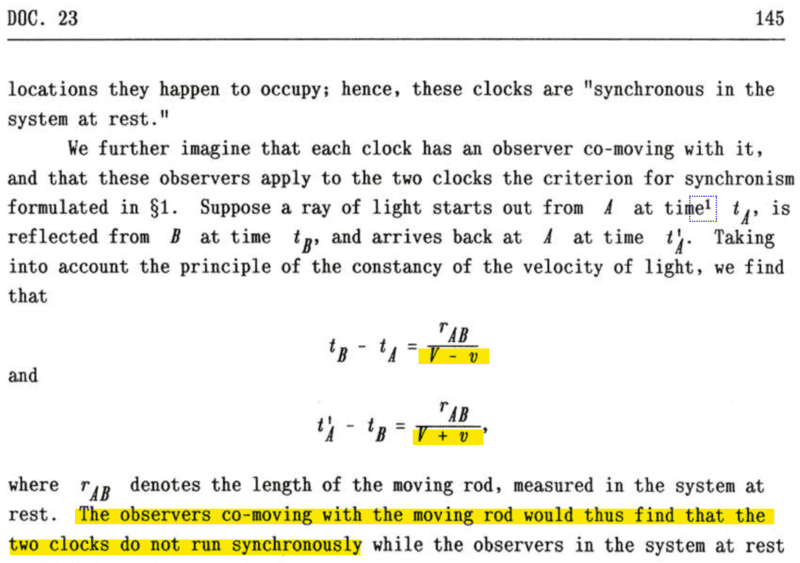 My understanding is that here Einstein says that the rod, the 2 observers and the 2 clocks are in the moving system, one observer & clock at each end of the rod. From their point of view they are not moving. They can very well be enclosed in an opaque box, no windows, the motion is uniform, so they can't tell if they move or not (relative to any other system). So they can apply the criterion of synchronism that was described in §1 for synchronization of not moving clocks. Does Einstein here say (so it seems to me) that these 2 observers see the ray of light moving with the speed V-v from A to B and with speed V+v from B to A?