Electron Diffraction and the DeBroglie Wavelength

Click For Summary
SUMMARY

This discussion focuses on the principles of electron diffraction in electron microscopy, specifically the derivation of the electron wavelength in a tunneling electron microscope. The key equation discussed is the relativistic energy-momentum relation, ##E^2=p^2c^2+m^2c^4##, which incorporates the rest energy of the electron, ##mc^2##, into the kinetic energy. The transition from the momentum equation ##p=\sqrt{2meV}## to the relativistic framework is clarified through the inclusion of the invariant mass of the electron, approximately 0.511 MeV. This foundational understanding is crucial for accurately interpreting electron behavior in high-energy physics applications.

PREREQUISITES
  • Understanding of relativistic physics concepts, particularly energy-momentum relations.
  • Familiarity with electron microscopy techniques and applications.
  • Knowledge of quantum mechanics, specifically wave-particle duality.
  • Basic grasp of Minkowski spacetime and four-vectors.
NEXT STEPS
  • Study the derivation of the de Broglie wavelength for electrons in quantum mechanics.
  • Explore the implications of relativistic effects in particle physics.
  • Learn about the principles of tunneling electron microscopy and its applications.
  • Investigate the role of invariant mass in relativistic energy calculations.
USEFUL FOR

This discussion is beneficial for physicists, materials scientists, and engineers involved in electron microscopy, as well as students seeking to deepen their understanding of quantum mechanics and relativistic physics.

Guest432
Messages
48
Reaction score
2
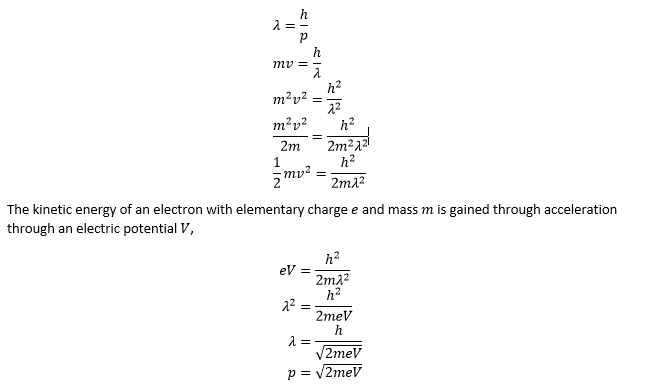
I've been reading up on electron diffraction for electron microscopy, and I have been trying to understand the proof for the wavelength of an electron in a tunneling electron microscope. The proof I have been trying to emulate begins as follows:
upload_2016-10-25_12-22-31.png


It then says that I must account for relativistic effects so, ##E^2=p^2c^2+m^2c^4## and manages to yield this term for momentum

How did it jump from ##p=\sqrt {2meV}## to that? (Note delta ##\Delta E = eV##)
 
Last edited:
Physics news on Phys.org
The energy is
$$E=\sqrt{p^2 c^2+m^2 c^4}=m c^2+e V.$$
The reason is that in relativity you always include the rest energy, ##mc^2## in the kinetic energy, because then ##(p^{\mu})=(E/c,\vec{p})## is a Minkowski four-vector. Note that here (and in contemporary physics always!) ##m## is the invariant mass of the particle, i.e., in this case for an electron ##mc^2 \simeq 0.511 \; \mathrm{MeV}##.
 
  • Like
Likes   Reactions: Guest432

Similar threads

  • · Replies 2 ·
Replies
2
Views
4K
  • · Replies 7 ·
Replies
7
Views
2K
  • · Replies 3 ·
Replies
3
Views
2K
  • · Replies 11 ·
Replies
11
Views
3K
  • · Replies 3 ·
Replies
3
Views
2K
  • · Replies 8 ·
Replies
8
Views
2K
  • · Replies 3 ·
Replies
3
Views
3K
  • · Replies 6 ·
Replies
6
Views
3K
  • · Replies 14 ·
Replies
14
Views
4K
  • · Replies 27 ·
Replies
27
Views
2K