Electron wave funtion harmonic oscillator

Click For Summary
SUMMARY

The discussion centers on the quantum harmonic oscillator, specifically addressing the behavior of the wave function as demonstrated in the Phet simulator and Wikipedia resources. Participants clarify that the variations in the wave function do not represent changes in frequency but rather spatial variations. The expectation value for the position remains constant, indicating that the wave functions C, D, E, and F are not moving but are solutions to the time-independent Schrödinger equation (TISE). The conversation emphasizes the distinction between quantum mechanics and classical mechanics in understanding these oscillations.

PREREQUISITES
  • Understanding of quantum mechanics principles
  • Familiarity with the Schrödinger equation (SE)
  • Knowledge of wave functions and probability density
  • Experience with quantum harmonic oscillators
NEXT STEPS
  • Study the implications of the time-independent Schrödinger equation (TISE) in quantum mechanics
  • Explore the concept of wave functions in quantum mechanics
  • Investigate the differences between classical and quantum harmonic oscillators
  • Utilize the Phet simulator for hands-on experience with quantum wave functions
USEFUL FOR

Students and professionals in physics, particularly those focusing on quantum mechanics, as well as educators seeking to explain the quantum harmonic oscillator and its implications.

jhonnyS
Messages
2
Reaction score
0
TL;DR
the electron wave function for a determined energy level, without superposition of states, decreases its frequency as the distance from the center increases. So the "oscilation" shouldn't be slower with distance from the center?
As we see in this Phet simulator, this is only the real part of the wave function, the frequency decreases with the potential, so lose energy as moves away the center.
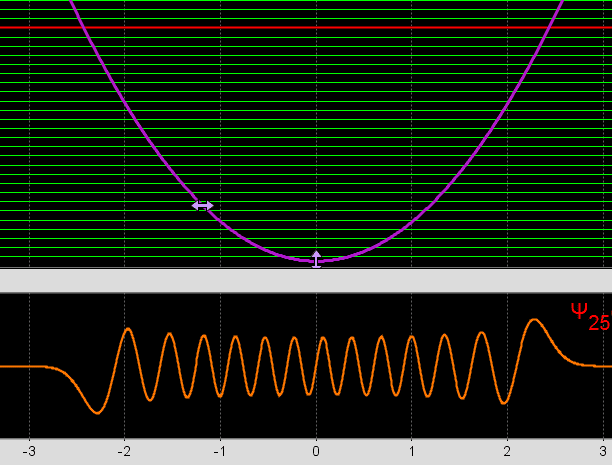
244048

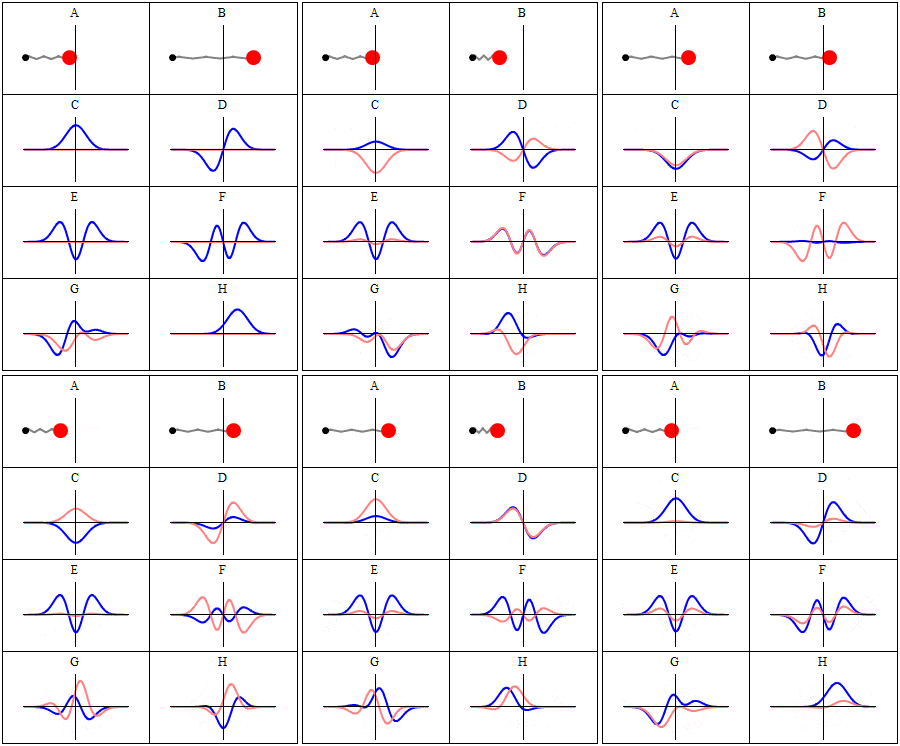
we se this real-imaginary animation in Wikipedia, wave C,D,E,F. Because with less energy, the frequency of quantum wave decreases, and the speed decreases too, the oscillation wouldn't be slower acording to frequency variation in image F for example? (the same way we see image D oscillating slower than F)
QuantumHarmonicOscillatorAnimation.gif

The desired response, without formulas, and without Schrödinger time independent ecuation, just explained

https://en.wikipedia.org/wiki/Quantum_harmonic_oscillator
thank you!

 
Physics news on Phys.org
Hello jhonny, ##\quad## :welcome: ##\quad## !

jhonnyS said:
and the speed decreases too
No. CDEF are not 'moving': they are solutions of the SE consisting of solutions of the TISE times ##e^{i\omega t}##. For those ##<x(t)>=0##: the expectation value for the position is zero (i.e. constant).
 
  • Like
Likes   Reactions: bhobba
jhonnyS said:
As we see in this Phet simulator
Your interpretation of the variations in the wave function as 'frequency' is wrong: those are (spatial) variations in the wave function, nothing else. ##\ \Psi^2\ ## is a probability density and that is fluctuating, unlike in a clssical harmonic oscillator.

Even if you hate formulas you can look at this difference between QM and classical
 

Similar threads

  • · Replies 11 ·
Replies
11
Views
2K
  • · Replies 3 ·
Replies
3
Views
2K
  • · Replies 8 ·
Replies
8
Views
2K
  • · Replies 14 ·
Replies
14
Views
3K
  • · Replies 7 ·
Replies
7
Views
2K
  • · Replies 9 ·
Replies
9
Views
4K
  • · Replies 11 ·
Replies
11
Views
3K
  • · Replies 1 ·
Replies
1
Views
2K
  • · Replies 16 ·
Replies
16
Views
2K
  • · Replies 36 ·
2
Replies
36
Views
9K