Funner
- 2
- 0
Hi there,
in electrospinning, a positive charge of around 10.000Volt is applied to a needle, where a viscous polymer is extruded. There is a grounded collector in a distance of 15mm and the established electrical field generates electrostatic forces and draws a thin polymer jet to the collector (polymer scaffolds with multiple fibres/layers are build and used for harvesting cells for Tissue Engineering).
So we are looking at ions immersed into the polymer around the needle, which are attracted to the grounded collector and thus, accelerate the polymer towards the grounded
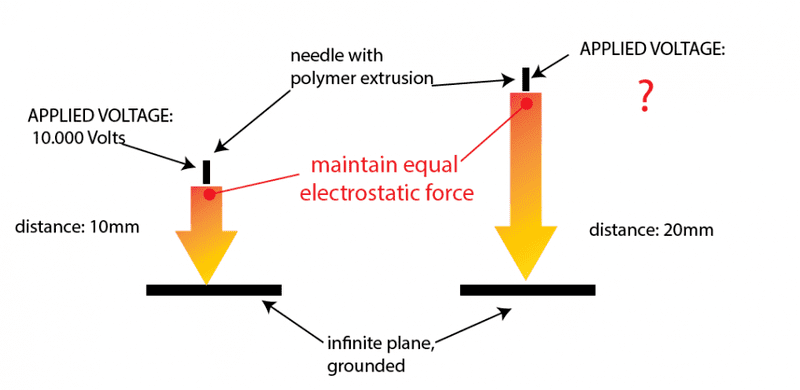
In a simplified form, we are looking at a point charge ( needle-tip) and an infinite plane ( collector) see picture.
I am aware of the inversely proportional relation of distance and charge, but my question is:
--> When I increase the distance between the needle and the collector (point-infinite plane) how do I need to increase the voltage accordingly (linear, squared,..??), to maintain constant electrostatic forces on the polymer?
--> for example: I double the distance to 30 mm now.. after the inv. prop. relation, this would mean that I have to apply 100.000V now (=10.000_squrt). This, however is not feasible, and not technically doable! There will be strong dialectic break-down at around 25KV. In reality, we do fabricate scaffolds at 30mm and need to apply around 20KV to get a nice polymer flow..
Help is very well appreciated!
f
in electrospinning, a positive charge of around 10.000Volt is applied to a needle, where a viscous polymer is extruded. There is a grounded collector in a distance of 15mm and the established electrical field generates electrostatic forces and draws a thin polymer jet to the collector (polymer scaffolds with multiple fibres/layers are build and used for harvesting cells for Tissue Engineering).
So we are looking at ions immersed into the polymer around the needle, which are attracted to the grounded collector and thus, accelerate the polymer towards the grounded
In a simplified form, we are looking at a point charge ( needle-tip) and an infinite plane ( collector) see picture.
I am aware of the inversely proportional relation of distance and charge, but my question is:
--> When I increase the distance between the needle and the collector (point-infinite plane) how do I need to increase the voltage accordingly (linear, squared,..??), to maintain constant electrostatic forces on the polymer?
--> for example: I double the distance to 30 mm now.. after the inv. prop. relation, this would mean that I have to apply 100.000V now (=10.000_squrt). This, however is not feasible, and not technically doable! There will be strong dialectic break-down at around 25KV. In reality, we do fabricate scaffolds at 30mm and need to apply around 20KV to get a nice polymer flow..
Help is very well appreciated!
f