Elementary Rate Law: Hydrogen Radical Termination Step

Click For Summary

Discussion Overview

The discussion revolves around the formulation of the elementary rate law for a hydrodealkylation reaction, specifically focusing on the termination step involving hydrogen radicals. Participants are exploring the implications of defining reaction rates with respect to hydrogen and the appropriate mathematical representation of the rate law.

Discussion Character

  • Technical explanation
  • Debate/contested

Main Points Raised

  • One participant proposes that the rate law for the hydrogen radical termination step could be expressed as ##r_{H \bullet} = -2k_{4}C_{H \bullet}^2##, suggesting that the factor of 2 is due to the rate constant k4 being defined with respect to hydrogen.
  • Another participant questions the relevance of distinguishing between hydrogen radicals in the context of the rate law formulation.
  • A different participant expresses confusion over the initial claim and agrees with the first participant's conclusion after reconsidering the problem statement, noting that the conventions in kinetics may have changed over time.
  • One participant suggests a simpler approach by writing the rate law as ##r_{H \bullet} = -k_{4}C_{H \bullet}^2##, indicating a preference for avoiding complexity and the possibility of adjusting definitions later if needed.

Areas of Agreement / Disagreement

Participants express differing views on the correct formulation of the rate law, with no consensus reached on whether the factor of 2 should be included in the rate expression.

Contextual Notes

There is uncertainty regarding the definitions of reaction rates and the conventions used in kinetics, which may influence the participants' interpretations and conclusions.

gfd43tg
Gold Member
Messages
948
Reaction score
48
Hello, I am having some confusion over elementary rate laws. This is a hydrodealkylation reaction.
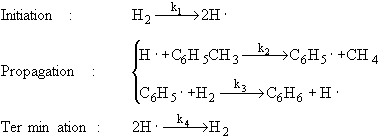
testb.13.gif


The specific reaction rates k1 and k4 are defined w.r.t. H2.

If I want to write the rate law for the hydrogen radical for the termination step, would the elementary rate law be ##r_{H \bullet} = -2k_{4}C_{H \bullet}^2## or ##r_{H \bullet} = -k_{4}C_{H \bullet}^2##. I think it is the former because of the part of k4 being with respect to hydrogen. If it was with respect to the hydrogen radical, then it would be the latter? Thanks
 
Last edited:
Chemistry news on Phys.org
Is one hydrogen radical distinguishable from another?
 
No, but I don't see how it relates to the rate law
 
Not only are you being confused, so am I --- I took off the wrong direction with how you came up with "-2k4CH⋅2, and thought you were making distinctions among hydrogen radicals.
Maylis said:
I think it is the former
And rereading the problem statement for the twentieth time, I'll agree, because ...

Maylis said:
The specific reaction rates k1 and k4 are defined w.r.t. H2.
, and this is the source of the confusion, I don't recall ever seeing a rate constant referred to the product. I'm a bit of a dinosaur, and conventions in kinetics may have evolved since I last had any use or interest for the field.
 
  • Like
Likes   Reactions: gfd43tg
I wouldn't worry about it. I would just write
Maylis said:
##r_{H \bullet} = -k_{4}C_{H \bullet}^2##.
myself, so as not to have to remember about the 2, and just get on with the problem.
It would be quite reasonable to have an equilibrium constant defined as K = [H.]2/[H2].
If it turns out later the other definition would have been more convenient, I can always change definition.
 

Similar threads

  • · Replies 7 ·
Replies
7
Views
3K
  • · Replies 6 ·
Replies
6
Views
2K
  • · Replies 1 ·
Replies
1
Views
2K
  • · Replies 4 ·
Replies
4
Views
3K
  • · Replies 8 ·
Replies
8
Views
4K
  • · Replies 15 ·
Replies
15
Views
3K
Replies
15
Views
4K
  • · Replies 4 ·
Replies
4
Views
2K
  • · Replies 3 ·
Replies
3
Views
3K
Replies
10
Views
5K