Ellipse Collisions: Resolving the Paradox

  • Context: Graduate 
  • Thread starter Thread starter nuclearhead
  • Start date Start date
  • Tags Tags
    Collisions Ellipse
Click For Summary

Discussion Overview

The discussion revolves around the paradox of colliding ellipses, potentially in three dimensions, and the implications of viewing these ellipses from different angles. Participants explore the nature of the forces involved during the collision, particularly focusing on whether the contact force should be applied through the centers of the ellipses or perpendicular to the surfaces at the point of contact. The conversation touches on the lack of established equations for colliding ellipses compared to colliding circles.

Discussion Character

  • Debate/contested
  • Conceptual clarification
  • Mathematical reasoning

Main Points Raised

  • One participant presents a paradox regarding the collision of ellipses, suggesting that viewing them from an angle transforms them into circles, which implies a different application of force.
  • Another participant asserts that if the surfaces are frictionless, the normal contact force must act perpendicular to the surfaces in contact.
  • A question is raised about the invariance of Newton's laws under scaling of coordinate axes, prompting further discussion on the implications of viewing angles.
  • Participants discuss the angle at which the ellipses might appear as circles and whether the lines representing force directions could coincide at that angle.
  • There is a contention about whether stretching the image of the ellipses would alter the nature of the surfaces and the corresponding normal force direction.
  • One participant questions the consistency of the contact force when the image is stretched, suggesting a potential flaw in their reasoning.
  • Another participant clarifies that changing the figure fundamentally alters the surfaces involved, impacting the direction of the normal force.

Areas of Agreement / Disagreement

Participants express differing views on the application of forces during the collision of ellipses, with no consensus reached on whether the contact force should be applied through the centers or perpendicular to the surfaces. The discussion remains unresolved regarding the implications of viewing angles and the nature of the forces involved.

Contextual Notes

The discussion highlights limitations in the understanding of the collision dynamics of ellipses, particularly in relation to frictionless surfaces and the effects of changing perspectives on force application. There are unresolved questions about the mathematical treatment of colliding ellipses compared to circles.

nuclearhead
Messages
73
Reaction score
2
I have a paradox here.

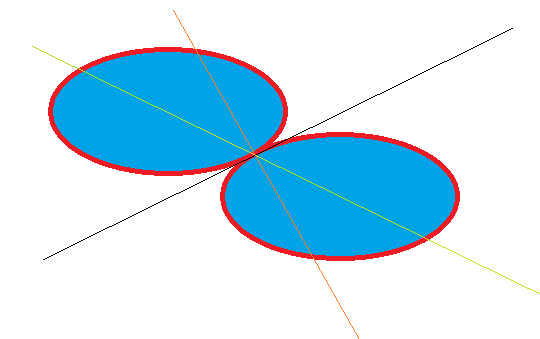
Look at this diagram of colliding ellipses (they might be elliptical prisms in 3D). Now if you stretch the image (for example looking at the image from an angle) it becomes two colliding circles. Therefore you would expect by that argument that the colliding force would be applied through the centres of the ellipses (yellow line).

But another argument says that looking close up at where the ellipses collide it is like two colliding planes and the force should be perpendicular to that (orange line). And this would cause the ellipses to rotate.

So which is right? And will the ellipses be rotating after the collision?
ellipses.png


I have not found any equations for colliding ellipses as there are with colliding circles.
 
Physics news on Phys.org
nuclearhead said:
the force should be perpendicular to that (orange line).
If the surfaces are friction-less.
 
A.T. said:
If the surfaces are friction-less.

But aren't the Newton's laws invariant under scaling of a coordinate axis?
 
nuclearhead said:
But aren't the Newton's laws invariant under scaling of a coordinate axis?
Yes they are.
Exactly at what angle do you expect to see these as circles? Is it not possible that at that angle these two lines (orange and yellow as you mentioned) coincide? (*Just a guess). It would be of great help if you can explain exactly what angle are you talking about?

Whenever there is a collision and the surfaces are frictionless, the normal contact force acts perpendicular to the surfaces in contact because if it is not; then there will be a component of the force in the tangential direction which is not possible as the surfaces are frictionless.
 
Vatsal Sanjay said:
Yes they are.
Exactly at what angle do you expect to see these as circles? Is it not possible that at that angle these two lines (orange and yellow as you mentioned) coincide? (*Just a guess). It would be of great help if you can explain exactly what angle are you talking about?

Whenever there is a collision and the surfaces are frictionless, the normal contact force acts perpendicular to the surfaces in contact because if it is not; then there will be a component of the force in the tangential direction which is not possible as the surfaces are frictionless.
That's what I mean. If you stretch the image so they are both circles, the orange line is no longer perpendicular.

Isn't that strange? I mean shouldn't contact force be the same if you stretched the image? Where has my logic gone wrong?
 
nuclearhead said:
If you stretch the image so they are both circles
Are you suggesting we change the figure? If you stretch or do something with you current surfaces, you will get "new" surfaces. In that case your eclipses are no longer eclipses. See there is a difference between rotating your current figure and looking at it at different angles and stretching or shrinking the figure to obtain new surface. In the latter case, the normal force will be perpendicular to the new tangent of the surface in contact.
 
nuclearhead said:
I mean shouldn't contact force be the same if you stretched the image?
If you stretch an incline horizontally, is the direction of a normal force on it still the same?
 

Similar threads

  • · Replies 9 ·
Replies
9
Views
4K
  • · Replies 11 ·
Replies
11
Views
3K
  • · Replies 49 ·
2
Replies
49
Views
6K
  • · Replies 35 ·
2
Replies
35
Views
5K
  • · Replies 3 ·
Replies
3
Views
3K
  • · Replies 15 ·
Replies
15
Views
2K
  • · Replies 20 ·
Replies
20
Views
3K
  • · Replies 3 ·
Replies
3
Views
2K
  • · Replies 6 ·
Replies
6
Views
3K
  • · Replies 24 ·
Replies
24
Views
4K