Undergrad Elliptic Function Rotation Problem

Click For Summary
The discussion revolves around creating orbital motion using elliptic functions, specifically focusing on a point rotating around the perimeter of an ellipse. The user has successfully plotted the motion but is experiencing an issue where the point rotates faster near the ambiguous foci rather than the true foci. A suggestion is made to refer to Landau's "Classical Mechanics," which provides equations for simulating Keplerian orbital motion in polar coordinates. The solution involves deriving the speed of the orbiting mass as a function of the angle, incorporating parameters like eccentricity and time. The goal is to reverse the motion so that the point moves faster near the origin and slower further away.
Sabertooth
Messages
29
Reaction score
2
TL;DR
I have made a rotating point on the perimeter of an ellipse. My problem is that the motion is reversed from the true foci.
Hi all:)
In my recent exploration of Elliptic Function, Curves and Motion I have come upon a handy equation for creating orbital motion.
Essentially I construct a trigonometric function and use the max distance to foci as the boundary for my motion on the x-plane.
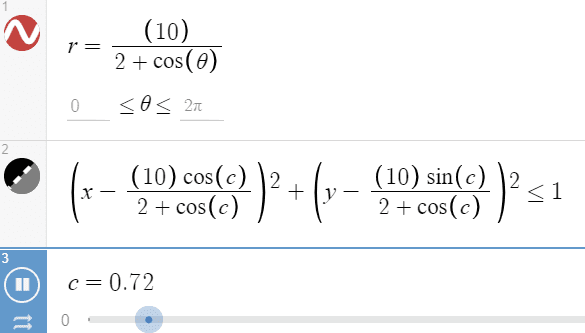
Desmos Orbit physicsforum2.png


When I plot a point rotating around the perimeter of my Ellipse I get my desired changing velocity depending on the distance to the foci; shown in this:
https://gyazo.com/9430d22ff4d6f38f2d5bcf381a06db76

However it appears that the point is rotating faster near the ambiguous foci and not the true foci. How can I reverse my function so that the point will move faster near my (0,0) coordinate and slower when it moves further away, instead of the opposite?
 

Attachments

  • desmos orbit pp.png
    desmos orbit pp.png
    9.1 KB · Views: 182
Mathematics news on Phys.org
Sabertooth said:
Summary:: I have made a rotating point on the perimeter of an ellipse. My problem is that the motion is reversed from the true foci.

Hi all:)
In my recent exploration of Elliptic Function, Curves and Motion I have come upon a handy equation for creating orbital motion.
Essentially I construct a trigonometric function and use the max distance to foci as the boundary for my motion on the x-plane.
View attachment 269515

When I plot a point rotating around the perimeter of my Ellipse I get my desired changing velocity depending on the distance to the foci; shown in this:
https://gyazo.com/9430d22ff4d6f38f2d5bcf381a06db76

However it appears that the point is rotating faster near the ambiguous foci and not the true foci. How can I reverse my function so that the point will move faster near my (0,0) coordinate and slower when it moves further away, instead of the opposite?
I am not quite clear on what you are trying to simulate with your program. However, if you want to simulate Kepler elliptical orbital motion, for example a comet orbiting the sun, then the book by Landau "Classical Mechanics" gives the solution to the problem in polar coordinates. I assume you have knowledge of calculus. Landau's solution uses polar coordinates show in the image:
elipse.jpg

where ##a## is the semi-major axis, ##b## is the semi-minor axis, ##r## is the distance from the center of the ellipse to a point on its perimeter, and ##\xi## is the angle between ##r## and the semi-minor axis.

Landau derives the equations for Kepler orbital motion to be:$$
r=a(1-e\cos(\xi))
$$
$$
t=\sqrt(\frac{ma^3}{\alpha})(\xi -e\sin(\xi) )
$$
where ##e## is the eccentricity of the ellipse, ##t## is time, ##m## is the reduced mass of the system of two masses and ##\alpha## is the strength of the potential field. Your problem, as I see it, is to find a function the describes the speed ##|v|## of the orbiting mass as a function of the angle ##\xi##. To this end I claim,
$$
|v|= \sqrt(\dot{\xi}^2 + \dot{r}^2 )
$$
where the dot above the variable indicates differentiation w.r.t time. We find,
$$
\dot{r}=e\dot{\xi}\sin(\xi)
$$
To find ##\dot{\xi}## we differentiate ##t## w.r.t ##\xi##,
$$
\frac{dt}{d\xi}= \sqrt(\frac{ma^3}{\alpha})(1-e\cos(\xi))
$$
and therefore,
$$
\dot{\xi}=\frac{1}{\sqrt(\frac{ma^3}{\alpha})(1-e\cos(\xi))}
$$
After some algebra we find the speed as a function of ##\xi##,
$$
|v|=\frac{\sqrt(1+e^2 \sin^2 (\xi))}{\sqrt(\frac{ma^3}{\alpha})(1-e\cos(\xi))}
$$
 
Here is a little puzzle from the book 100 Geometric Games by Pierre Berloquin. The side of a small square is one meter long and the side of a larger square one and a half meters long. One vertex of the large square is at the center of the small square. The side of the large square cuts two sides of the small square into one- third parts and two-thirds parts. What is the area where the squares overlap?

Similar threads

  • · Replies 2 ·
Replies
2
Views
1K
  • · Replies 2 ·
Replies
2
Views
2K
  • · Replies 2 ·
Replies
2
Views
3K
  • · Replies 1 ·
Replies
1
Views
4K
  • · Replies 18 ·
Replies
18
Views
2K
  • · Replies 5 ·
Replies
5
Views
7K
Replies
4
Views
3K
Replies
1
Views
2K
  • · Replies 17 ·
Replies
17
Views
2K
  • · Replies 11 ·
Replies
11
Views
3K