Calculating EMF in a Solenoid: Understanding the Relationship of Turns and EMF

  • Context: Undergrad 
  • Thread starter Thread starter Adesh
  • Start date Start date
  • Tags Tags
    Emf Solenoid
Click For Summary
SUMMARY

The total electromotive force (EMF) in a solenoid is calculated as the product of the number of turns (N) and the EMF per turn (e), resulting in a total EMF of N × e. This relationship is analogous to the total current flowing through the solenoid, which is expressed as N × I, where I is the current in each turn. The concept of "Amp-Turns" is crucial, as it represents the product of current and the number of turns, directly influencing the magnetic flux. Each turn generates its own EMF due to changing magnetic flux, and these voltages add up in series.

PREREQUISITES
  • Understanding of solenoid physics and electromagnetism
  • Familiarity with the concept of electromotive force (EMF)
  • Knowledge of Ampere's Law and magnetic flux
  • Basic principles of electric circuits and current flow
NEXT STEPS
  • Study the principles of electromagnetic induction and Faraday's Law
  • Learn about the calculation of magnetic flux in solenoids
  • Explore the concept of series circuits and voltage addition
  • Investigate the effects of resistance on current flow in solenoids
USEFUL FOR

Students of physics, electrical engineers, and anyone interested in the principles of electromagnetism and solenoid design.

Adesh
Messages
735
Reaction score
191
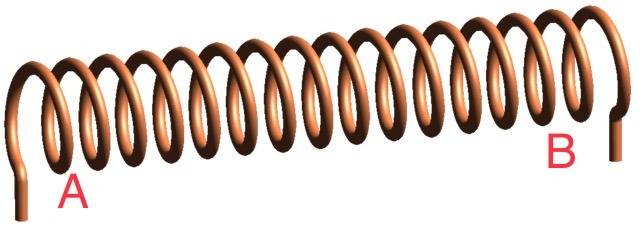
If I have a solenoid with N number of turns in total. And if I say that in each
551E5B25-9ABF-4E43-807C-D7779EEA6F96.jpeg

turn the EMF is equal to e then can I conclude that the total EMF in the solenoid i.e. from A to B is N \times e .
I’m asking this because whenever a current I flows in each turn of the solenoid then we always say that total current flowing through the solenoid is N \times I . So can we say this even for EMF .

Thank you.
 
Physics news on Phys.org
Adesh said:
the EMF is equal to e then can I conclude that the total EMF in the solenoid i.e. from A to B is N×e N \times e .
Yes.
Adesh said:
I’m asking this because whenever a current I flows in each turn of the solenoid then we always say that total current flowing through the solenoid is N×I N \times I .
No. The current is I. The number of "Amp-Turns" is NI.

Does that make sense?
 
  • Like
Likes   Reactions: vanhees71 and Adesh
berkeman said:
Yes.

No. The current is I. The number of "Amp-Turns" is NI.

Does that make sense?
“Amp-turns” means ?
 
berkeman said:
Yes.

No. The current is I. The number of "Amp-Turns" is NI.

Does that make sense?
Can you please explain why the EMF got added up?
Is it due to the total work done on a 1~C of charge will be N \times e as in each turn the work done is e ?
 
EMF is like a voltage. Since each turn has its own EMF or voltage generated by a changing flux through the coil, the little voltage sources are in series so they add up.

The same current flows through the whole coil, so it's all the same current. The flux is generated by the current multiplied by the number of turns, hence the concept of Amp-Turns.
 
  • Like
Likes   Reactions: Adesh
berkeman said:
EMF is like a voltage. Since each turn has its own EMF or voltage generated by a changing flux through the coil, the little voltage sources are in series so they add up.

The same current flows through the whole coil, so it's all the same current. The flux is generated by the current multiplied by the number of turns, hence the concept of Amp-Turns.
Thank you. I had a misconception that the current was N\times I. Thank you once again
 
  • Like
Likes   Reactions: berkeman
berkeman said:
EMF is like a voltage. Since each turn has its own EMF or voltage generated by a changing flux through the coil, the little voltage sources are in series so they add up.
We could also point out that, once the Field has built up to its final value, there is no Induced ('back') emf and the Resistance of the Coil is the only thing defines the current through it. The Potential drop across each turn is Total PD / N and the Current = V/R. Solenoids tend to have as low resistance as possible (thickest wire for the space available for your N turns) so the final current can be very high.
'Amp Turns' is a term that may not make sense at first but many turns with low current can produce the same flux as few turns with high current. The choice of N depends on available power supply and how hot the coil can be allowed to get (resistive heating).
 
  • Like
Likes   Reactions: sysprog, Adesh and berkeman
Adesh said:
Thank you. I had a misconception that the current was N\times I. Thank you once again
The current is of course constant along the wire (in DC). The reason is simply charge conservation. In the stationary case at any cross section of the wire the charge per unit of time flowing through must be the same. However, using Ampere's Law you have to count how many times this current runs through the area in the integral, and that's ##N## times, i.e., you have (in SI units)
$$\int_{\partial A} \mathrm{d} \vec{r} \cdot \vec{B}=\mu_{0} \int_A \mathrm{d}^2 \vec{f} \cdot \vec{j}=\mu_0 N I.$$
 
  • Like
Likes   Reactions: sysprog and Adesh
  • #10
Each turn is like a battery of so many V emf.
What happens when you hook up N batteries in series with equidirectional polarity?
 
  • Like
Likes   Reactions: Adesh

Similar threads

  • · Replies 5 ·
Replies
5
Views
630
  • · Replies 14 ·
Replies
14
Views
3K
  • · Replies 5 ·
Replies
5
Views
1K
Replies
1
Views
2K
Replies
9
Views
2K
  • · Replies 41 ·
2
Replies
41
Views
8K
  • · Replies 6 ·
Replies
6
Views
2K
  • · Replies 3 ·
Replies
3
Views
2K
  • · Replies 4 ·
Replies
4
Views
2K
  • · Replies 3 ·
Replies
3
Views
1K