Emf + Internal Resistance of Battery

Click For Summary
SUMMARY

The discussion focuses on calculating the electromotive force (emf) and internal resistance of a battery in a circuit involving resistors. The established values are an emf of 9V and an internal resistance of 0.5 ohms. Participants detail their methods for finding equivalent resistance, using V=IR to determine voltage across resistors, and setting up equations to solve for unknowns. Key insights include the importance of correctly applying circuit laws and the relationship between current and voltage in series and parallel configurations.

PREREQUISITES
  • Understanding of Ohm's Law (V=IR)
  • Knowledge of series and parallel resistor configurations
  • Familiarity with circuit analysis techniques
  • Ability to solve systems of equations
NEXT STEPS
  • Study the concept of equivalent resistance in complex circuits
  • Learn about Kirchhoff's Voltage Law (KVL) for circuit analysis
  • Explore methods for calculating internal resistance in batteries
  • Investigate real-world applications of emf in electrical engineering
USEFUL FOR

Electronics students, electrical engineers, and anyone involved in circuit design or analysis will benefit from this discussion, particularly those working with battery systems and resistor networks.

twiztidmxcn
Messages
43
Reaction score
0
These circuit questions seem to give me so many problems, this question in particular.

What are the emf and internal resistance of the battery in the figure below?
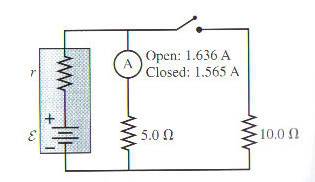
emfinternal.jpg


I have the answers, that emf is 9V and internal resistance is 0.5 ohms, however I'm having problems getting there.

What I did was first treat the two outside resistors as being in parallel and found their equivalent resistance

1 / R eq = 1 / R1 + 1 / R2 = 1/5 + 1/10, Req = 10/3

So then the internal resistance and that new Req are in series, so Req = r + 10/3 ohms.

Now, I come to my problem. I assumed that when the switch is open, all the current is running through the ammeter and the 5ohm resistor. Using V=IR, I solved for V and found it to be 7.825. Knowing that resistors in parallel have the same voltage, i knew that V1 = V2, so I1R1=I2R2, solved for I2 and found it to be 0.7825A.

Now having a current and the resistance of the outside resistor, i know that I = emf / R + r. I am stuck as to where to go now, how to find emf and r.

I also know that V = emf - IR. I tried to use this equation and the one above to solve down for emf or r using systems of equations but continually find myself cancelling both out with nothing to solve for. yes, it turns out emf does = emf.

Any help in the right direction would be awesome

thx
twiztidmxcn
 
Physics news on Phys.org
twiztidmxcn said:
These circuit questions seem to give me so many problems, this question in particular.

What are the emf and internal resistance of the battery in the figure below?

emfinternal.jpg


I have the answers, that emf is 9V and internal resistance is 0.5 ohms, however I'm having problems getting there.

What I did was first treat the two outside resistors as being in parallel and found their equivalent resistance

1 / R eq = 1 / R1 + 1 / R2 = 1/5 + 1/10, Req = 10/3

So then the internal resistance and that new Req are in series, so Req = r + 10/3 ohms.

Now, I come to my problem. I assumed that when the switch is open, all the current is running through the ammeter and the 5ohm resistor. Using V=IR, I solved for V and found it to be 7.825. Knowing that resistors in parallel have the same voltage, i knew that V1 = V2, so I1R1=I2R2, solved for I2 and found it to be 0.7825A.
This is confusing.. what R did you use? You are working with the switch open, right? Then R2 is not connected at all so you should not use the 10/3 you found earlier! The total resistance is 5 + r. Using the current given, you can find an equation relating the emf E and r.

But the best way to proceed is to use the following fact: the voltage across the battery is E- Ir and this is the voltage applied to the 5 ohms, E-I r = I R_1. This gives you one equation containing two unknowns: r and E.

Then repeat the process with the switch closed. As far as I can tell, you can actually solve the problem without ever using the value of ten ohms!

PAtrick
 
twiztidmxcn said:
These circuit questions seem to give me so many problems, this question in particular.

What are the emf and internal resistance of the battery in the figure below?

emfinternal.jpg


I have the answers, that emf is 9V and internal resistance is 0.5 ohms, however I'm having problems getting there.

What I did was first treat the two outside resistors as being in parallel and found their equivalent resistance

1 / R eq = 1 / R1 + 1 / R2 = 1/5 + 1/10, Req = 10/3

So then the internal resistance and that new Req are in series, so Req = r + 10/3 ohms.

Now, I come to my problem. I assumed that when the switch is open, all the current is running through the ammeter and the 5ohm resistor. Using V=IR, I solved for V and found it to be 7.825. Knowing that resistors in parallel have the same voltage, i knew that V1 = V2, so I1R1=I2R2, solved for I2 and found it to be 0.7825A.

Now having a current and the resistance of the outside resistor, i know that I = emf / R + r. I am stuck as to where to go now, how to find emf and r.

I also know that V = emf - IR. I tried to use this equation and the one above to solve down for emf or r using systems of equations but continually find myself cancelling both out with nothing to solve for. yes, it turns out emf does = emf.
The voltage across the 5 ohm resistor when the switch is open is IR = 1.636 x 5 = 8.18 V, so E + 1.636r = 8.18 V.

When the switch is closed, we know the voltage across the 10 ohm and 5 ohm resistor is the same so the current through the 5 ohm resistor will be twice the current through the 10 ohm. So the total current is 1.565 + .5 x 1.565 A. This is the current through the battery. What is the voltage across the 5 and 10 ohm resistor? What is the voltage drop across r?

So now you have two equations with two unknowns E and r. That should be solvable.

AM
 
Last edited:
nrqed said:
This is confusing.. what R did you use? You are working with the switch open, right? Then R2 is not connected at all so you should not use the 10/3 you found earlier! The total resistance is 5 + r. Using the current given, you can find an equation relating the emf E and r.

But the best way to proceed is to use the following fact: the voltage across the battery is E- Ir and this is the voltage applied to the 5 ohms, E-I r = I R_1. This gives you one equation containing two unknowns: r and E.

Then repeat the process with the switch closed. As far as I can tell, you can actually solve the problem without ever using the value of ten ohms!

PAtrick

Oops, my mistake: You *do* need the value of the 10 ohms. For the case of the close switch, you find the voltage across the 5 ohms using the current they give you and multiplying by 5. Then, this is equal to E- Ir (the voltage across the battery) but the current there is the total current. As Andrew mentioned, it is easy to find the total current flowing out of the battery. The current flowing through the 10 ohms will be half the current flowing through the 5 ohms. So the total current flowing out of the battery is 1.5 times the current they are giving you. So you end up with

When the switch is closed: E - 1.5 * I_g r = R_1 I_g wher I_g= is the current given to you in the question.

PAtrick
 
  • Like
Likes   Reactions: kamhogo
thx for the help

turns out i had most of what i needed, but had a couple numbers switched around and for some reason was just using systems of equations rather than doing actual math and not being a dumb ass
 

Similar threads

  • · Replies 18 ·
Replies
18
Views
3K
  • · Replies 105 ·
4
Replies
105
Views
12K
  • · Replies 3 ·
Replies
3
Views
2K
  • · Replies 11 ·
Replies
11
Views
2K
  • · Replies 12 ·
Replies
12
Views
6K
Replies
4
Views
2K
  • · Replies 24 ·
Replies
24
Views
5K
  • · Replies 8 ·
Replies
8
Views
13K
  • · Replies 7 ·
Replies
7
Views
2K
Replies
2
Views
1K