Mausam
- 27
- 3
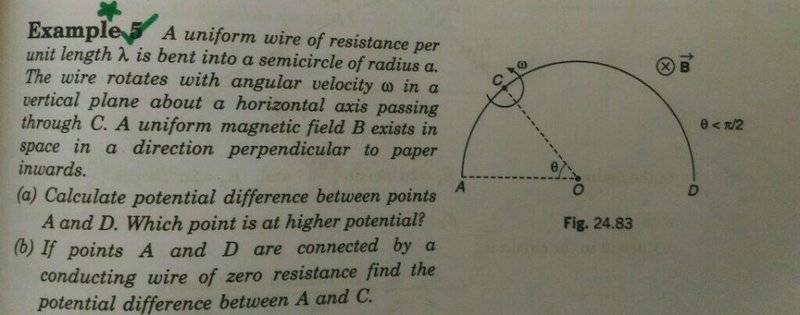
This is not a homework.i am not able to understand rotating motional emf .so could u please tell why could we use the effective length to calculate emf in this case .
Maybe that is an easier approach, but not the only one. It can also be solved using the straightforward calculus method. Is the answer given?Mausam said:so could u please tell why could we use the effective length to calculate emf in this case .
Thank you so much for your reply ,yes the answer is given, actually had a doubt that why can we use the effective length though the velocity of every point is different.i mean i am not able to prove that the shape doesn't matter ...so could u please help me prove it in this case ,i am able to prove it when there is no rotation. This is from DC PANDEYcnh1995 said:Is that problem from H C Verma?
Maybe that is an easier approach, but not the only one. It can also be solved using the straightforward calculus method. Is the answer given?
This effective length part can be proved using some calculus. Do you know how to set up a differential equation?Mausam said:Thank you so much for your reply ,yes the answer is given, actually had a doubt that why can we use the effective length though the velocity of every point is different.i mean i am not able to prove that the shape doesn't matter ...so could u please help me prove it in this case ,i am able to prove it when there is no rotation. This is from DC PANDEY
I have attached the solution if it helps
If possible can u please elaborate on itcnh1995 said:This effective length part can be proved using some calculus. Do you know how to set up a differential equation?
It's half(B)(w)L²cnh1995 said:Consider the section OCA only. Here, you want to show that arc-length AC is effectively equal to the straight line distance AC. What is the emf induced in the straight line AC if length AC=l?
