End Point Energy and Q value in beta decay

Click For Summary
SUMMARY

The discussion centers on the concept of endpoint energy in beta decay, specifically the relationship between the Q value and the maximum kinetic energy of the emitted electron. The Q value is defined as the difference between the total initial mass-energy and the total final mass-energy of the decay products. The endpoint energy, denoted as E0, is clarified to be E0 = Q + mec2, where me is the rest mass of the electron. This indicates that endpoint energy encompasses both the maximum kinetic energy and the rest mass energy of the electron, rather than being solely the maximum kinetic energy observed.

PREREQUISITES
  • Understanding of beta decay and its mechanisms.
  • Familiarity with the concepts of mass-energy equivalence and Q value.
  • Basic knowledge of particle kinematics and energy conservation principles.
  • Ability to interpret relativistic energy equations.
NEXT STEPS
  • Study the derivation of the Q value in beta decay processes.
  • Learn about the implications of mass-energy equivalence in particle physics.
  • Explore the concept of endpoint energy in greater detail through resources like Nucleonica.
  • Investigate the role of neutrinos in beta decay and their impact on energy calculations.
USEFUL FOR

Physicists, students of nuclear physics, and anyone interested in understanding the intricacies of beta decay and energy calculations in particle interactions.
avkr
Messages
10
Reaction score
0
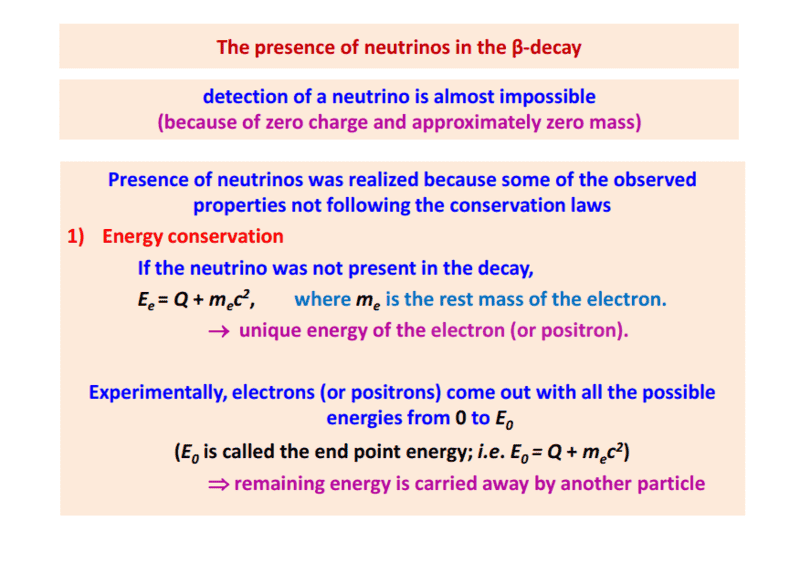
I know that Q value of a reaction is the difference between total initial mass-energy and total final mass-energy of all the products. Then shouldn't be this also the maximum kinetic energy and hence endpoint energy of an electron in beta decay. But what I have read endpoint energy ##E_0 = Q + m_e c^2 ## where ##m_e## is the rest mass of electron. I'm thinking ##Q=E_0##. What I'm thinking wrong?
Capture.PNG
 

Attachments

  • Capture.PNG
    Capture.PNG
    37.9 KB · Views: 4,280
Last edited:
Physics news on Phys.org
Please provide the reference where you read this.
 
Orodruin said:
Please provide the reference where you read this.

I have edited the question and attached the lecture slide I am reading.

I think I'm getting confused about the definition of endpoint energy. Is it the maximum kinetic energy of electron observed or the total relativistic energy of the beta particle.
 
Last edited:
This is still not a proper reference. Please refer to somewhere where we can check the entire source material.

If you let a particle of mass ##M## decay at rest in a two-body decay with product masses ##\mu## and ##m## with ##m < \mu < M## (which is essentially what you have for the beta decay if you look at the endpoint energy and ignore the neutrino mass), the resulting kinetic energy of the particle of mass ##m## will be
$$
T = Q\left( 1 - \frac{Q+2m}{2M}\right),
$$
where ##Q = M - \mu - m## (assuming I did the algebra correctly, this is a basic particle kinematics exercise). For ##Q,m \ll M## this expression becomes ##T \simeq Q##.
 
Orodruin said:
This is still not a proper reference. Please refer to somewhere where we can check the entire source material.

If you let a particle of mass ##M## decay at rest in a two-body decay with product masses ##\mu## and ##m## with ##m < \mu < M## (which is essentially what you have for the beta decay if you look at the endpoint energy and ignore the neutrino mass), the resulting kinetic energy of the particle of mass ##m## will be
$$
T = Q\left( 1 - \frac{Q+2m}{2M}\right),
$$
where ##Q = M - \mu - m## (assuming I did the algebra correctly, this is a basic particle kinematics exercise). For ##Q,m \ll M## this expression becomes ##T \simeq Q##.

Okay, but can you define exactly what endpoint energy is. In the article: https://www.nucleonica.com/wiki/index.php?title=Endpoint_energy, it says ##E_0 = Q + m_e c^2## which is "mass difference between the parent and daughter nuclides" for beta decay. So endpoint energy is not the maximum kinetic energy observed in an experiment but maximum kinetic energy + rest mass energy?
 
avkr said:
So endpoint energy is not the maximum kinetic energy observed in an experiment but maximum kinetic energy + rest mass energy?
That would be maximal total energy of the electron. You should make it clear which energy you refer to.
 
  • Like
Likes   Reactions: avkr
Orodruin said:
That would be maximal total energy of the electron. You should make it clear which energy you refer to.
got it. thanks!
 

Similar threads

  • · Replies 13 ·
Replies
13
Views
3K
  • · Replies 4 ·
Replies
4
Views
2K
  • · Replies 4 ·
Replies
4
Views
4K
  • · Replies 2 ·
Replies
2
Views
2K
  • · Replies 2 ·
Replies
2
Views
2K
  • · Replies 4 ·
Replies
4
Views
2K
  • · Replies 3 ·
Replies
3
Views
3K
  • · Replies 5 ·
Replies
5
Views
4K
  • · Replies 2 ·
Replies
2
Views
3K
  • · Replies 5 ·
Replies
5
Views
2K