Energy levels of helium/equation

Click For Summary
The discussion centers on the energy levels of helium and helium-like atoms, noting that while the equation for hydrogen-like atoms is established, helium's spectrum is more complex, resembling two hydrogen spectra. Participants clarify that an exact solution for helium cannot be easily derived, and empirical data is often referenced instead. The conversation suggests that while interpolating polynomials could theoretically fit experimental spectra, they would be impractical due to complexity. Instead, researchers typically rely on tables or computer simulations for accurate energy level calculations. Gordon W. F. Drake's work is highlighted as a significant resource for understanding helium's energy levels, although it requires advanced knowledge of quantum mechanics.
granpa
Messages
2,268
Reaction score
7
the equation for the energy levels of a hydrogen-like atom is:

e1fff0de782fe5dfb583088b40a82165.png


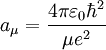
Note that aμ, is approximately equal to a0, (the Bohr radius). If the mass of the nucleus is infinite then μ = me, and aμ = a0
b17195a99c8dbe999ce3f8bc86a6e03a.png


but what is the equation for the energy levels of a helium or helium-like atom? I've heard that heliums spectrum is simply 2 hydrogen spectrums superimposed so it should be quite simple.
 
Last edited:
Physics news on Phys.org
as far as I know, you can't solve those system exactly. Only two-body systems can be
 
I'm not asking for a 'solution'. I'm asking what equation fits the empirically observed spectrum.
 
But that's what a solution is.
 
I'm not even going to touch that.
 
So what ARE you asking for then?
Are you asking if there is e.g. an interpolating polynomial (or more realistically; an expansion using some other bases; e.g. Lorentzians) that fits the shape of an experimental spectrum?

I doubt such a thing exist; it is of course possible to create but it would need to contain so many terms that it would be useless; it is much easier to look up the data in a table or just run a computer simulation.
 
In practice, as far as I know, people either look up the energy levels from a table or chart, OR they run computer simulations to calculate them.

For the simulations, you might do a search on Gordon W. F. Drake. He practically made a living from accurate calculations of helium, at least in the 1990's. Three references to his work are given here:

http://physics.nist.gov/PhysRefData/Handbook/Tables/heliumtable7.htm

EDIT: Understanding Drake's calculations in any detail pretty much requires grad-school level quantum mechanics.
 
Last edited:
thank you. that was extremely helpful.
 

Similar threads

  • Sticky
  • · Replies 2 ·
Replies
2
Views
10K
Replies
12
Views
962
  • · Replies 5 ·
Replies
5
Views
2K
  • · Replies 4 ·
Replies
4
Views
2K
  • · Replies 12 ·
Replies
12
Views
3K
  • · Replies 1 ·
Replies
1
Views
2K
  • · Replies 1 ·
Replies
1
Views
2K
  • · Replies 4 ·
Replies
4
Views
3K
  • · Replies 3 ·
Replies
3
Views
3K
  • · Replies 4 ·
Replies
4
Views
2K