Entanglement swapping and Bohmian mechanics

  • Level: Graduate 
  • Thread starter Thread starter Demystifier
  • Start date Start date
  • Featured
Join the discussion
Registration is free. Ask a follow-up in this thread, or start your own.
486 replies · 24K views
Matterwave said:
1. I wasn't asking if you are familiar with Peres or not, I am sure you are, I was asking about how you interpret the statements he made in that paper. If you would rather not or you are too busy, I understand.

2. Maybe you are confusing me for @Demystifier? I have never mentioned bits in a computer in any post in this thread that I can remember.

3. So I take it, you read this completely at face value and give it as the evidence for your statement:
1. Not too busy to answer you. :smile:

I simply think that there is a degree of mystery around "quantum nonlocality" that makes it necessary to paraphrase as best possible to express yourself. Peres and the others try their best to voice the science they are presenting, and specific sentences can be interpreted in somewhat different manners. But given the history of entanglement swapping, delayed choice, and the like: it's clear to me that entanglement in time is standard physics. So concerning Peres quotes you gave around "paradox": "there are no paradoxes, this is standard physics" is how I read Peres and Ma.


2. Sorry if I gave that impression.

What I am saying is that in oQM, the measurement apparatus - or its later expanding environment - is not entangled with photon B mid flight. After an interaction, the resultant objects decohere rapidly (if not instantaneously) into Product states. Some here dispute my statement.


3. No, the evidence for my statement: "Well, it’s an experimental fact that our photon B must be entangled to participate in a swap." is experiment. And yes, I presented that statement without explaining in more detail.

First, it's theory. You can agree or disagree with that assessment. But it is also experimental fact: PDC can produce either polarization entangled photon pairs or ones that are not (either set is entangled on other bases). Production of pairs that are not polarization entangled is substantially brighter than those that are. Therefore, the use of polarization entangled pairs for swapping implies they need to be entangled for the swap, else the team would use the brighter source. They don't state this explicitly in papers because they assume their audience already knows this.

In our example where we know Photon B is |+>: If you were to place a + oriented polarizer in B's path, it would prematurely end B's entanglement. Thereby preventing its use in a swap with Photon C. Now, as far as I know this specific test has never been published. Again, because it is common knowledge to experimenters.
 
Physics news on Phys.org
Morbert said:
1. The authors do not present this account as orthodox QM. They present it as an account. There are alternative accounts.


2. The significance of the Megidish paper is in the performance of the interesting experiment. Alternative, forward-in-time accounts of the experiment produce the same observed correlations.
1. Their papers stand as generally accepted orthodoxy. There is no need for them to consider Interpretations, none of which by definition are not orthodox.


2. Of course, every interpretation still standing makes these same identical claims. Basically: "It's obvious". But few papers have been presented that actually dissect swapping experiments. One that actually has: Mjelva (2024) has been discussed here in depth for MWI and also in general. As you might expect, I say it is fatally flawed. You can read my critique in that thread. I won't repeat it here.
 
Morbert said:
The sense in which @DrChinese means it is he believes oQM forecloses alternative ways to talk about the experiment, such as a forward-in-time account. It of course doesn't.

Not at all. All I'm saying about oQM is that it is generally accepted and silent on "extra" assumptions. That doesn't in any way mean Interpretations aren't relevant, or aren't important, or might not hold useful new science. If I thought that, I wouldn't be posting here. But oQM doesn't say some of the things some posters are saying it does, let's just call it for what it is.
 
@DrChinese Do you or do you not accept that oQM as applied to the Megedish experiment does not entail entanglement between particles 1 and 4? Do you or do you not accept that that requires an additional interpretational step not insisted upon by oQM?
 
DrChinese said:
1. Their papers stand as generally accepted orthodoxy. There is no need for them to consider Interpretations, none of which by definition are not orthodox.
As I pointed out in post #447, this is not entirely true. In Ma's paper, there are several places where it becomes evident that the authors are considering a ##\psi##-epistemic interpretation. For example, in the discussion, they explicitly say:

"Whether these two particles are entangled or separable has been decided after they have been measured. If
one viewed the quantum state as a real physical object, one could get the paradoxical situation that future actions seem to have an influence on past and already irrevocably recorded events. However, there is never a paradox if the quantum state is viewed as no more than a `catalogue of our knowledge'
"

DrChinese said:
Of course, every interpretation still standing makes these same identical claims. Basically: "It's obvious".
Since you are interested in how different interpretations can explain these types of experiments, I would like to point out that it is important to remember that the very idea that particles are entangled or not differs depending on interpretations. For a ##\psi##-epistemic interpretation (such as that considered by Zeillinger, Brukner and others), there is no problem in saying that the particles are entangled when their state is conditioned by the result of a measurement carried out in the future, while they are not if we only take into account their preparation in the past. However, for an interpretation like Bohmian mechanics, where there is a single wave function that is ontic and always evolves forward in time, a "true" entanglement requires that, at a given time, the state of the particles is non-separable, something that does not happen, for example, in the Megidish experiment, where the particles never co-existed.

DrChinese said:
But few papers have been presented that actually dissect swapping experiments. One that actually has: Mjelva (2024) has been discussed here in depth for MWI and also in general. As you might expect, I say it is fatally flawed. You can read my critique in that thread. I won't repeat it here.
If you look at it again, you'll realize that your criticism of Mjelva's work and in particular of what, if I remember correctly, you called "intermediate states" is analogous to the discussion we've had here about whether or not eq. (2) in Ma's paper is a mathematical representation of the state of the system before the BSM. In any case, it is not necessary for us to return to Mjelva's work, I just wanted to highlight this issue.

Lucas.
 
  • Like
Likes   Reactions: Motore and PeterDonis
Sambuco said:
1. The very idea that two system become entangled after they have been measured is interpretation-dependent.
So exactly what interpretation was Ma using when they state exactly the opposite:
“There, entanglement can be “produced a posteriori, after the entangled particles have been measured and may no longer exist.” In this work we report the first realization of Peres’ gedanken experiment.”

Sambuco said:
2. Furthermore, if by orthodox-QM we mean the textbook formulation (a wavefunction evolving forward-in-time), such a correlation does not necessarily represent genuine entanglement…
These are standard measures of genuine entanglement. You of course free to dismiss all experimental results that conclude opposite to your opinion.

I intentionally did not repeat your 1999 Cohen reference, as it does not represent generally accepted anything.
 
Morbert said:
@DrChinese Do you or do you not accept that oQM as applied to the Megedish experiment does not entail entanglement between particles 1 and 4? Do you or do you not accept that that requires an additional interpretational step not insisted upon by oQM?
Of course there is entanglement between photons 1 and 4. In the plain words of the authors:

“In addition, the non-locality of quantum
mechanics, as manifested by entanglement, does not apply only to particles with spatial separation, but also with temporal separation. Here we demonstrate these principles by generating and fully characterizing an entangled pair of photons that never coexisted. Using entanglement swapping between two temporally separated photon pairs we entangle one photon from the first pair (1) with another photon from the second pair (4).
”

I really don’t see where there’s any confusion in what is written. Nor do I see how it’s any different than how I write it. Orthodox QM - no interpretation required - because it is experimental fact:

Particles that have never coexisted or ever occupied a common light cone can be remotely entangled after the fact upon the free will decisions of the experiment.
 
Sambuco said:
1. However, for an interpretation like Bohmian mechanics, where there is a single wave function that is ontic and always evolves forward in time, a "true" entanglement requires that, at a given time, the state of the particles is non-separable, something that does not happen, for example, in the Megidish experiment, where the particles never co-existed.

2 If you look at it again, you'll realize that your criticism of Mjelva's work and in particular of what, if I remember correctly, you called "intermediate states" is analogous to the discussion we've had here about whether or not eq. (2) in Ma's paper is a mathematical representation of the state of the system before the BSM. In any case, it is not necessary for us to return to Mjelva's work, I just wanted to highlight this issue.

Lucas.
1. Seriously, you’re going with: it’s not ”True entanglement”? I am trying to imagine a scene where you are explaining this distinction to Megidish.

2. Yes, quite aware of that similarity.
:smile:
 
gentzen said:
Many of us are not convinced that DrChinese has those required good intuitions and technical fluency.
Ad hominem attacks… of all things, against someone asking questions?

And what are those questions about? Scientific advances of the last 20 years that some readers here are clearly not familiar with. That’s no issue to me, and certainly not a criticism. After all, during this time there have been well over 10,000 papers published on entanglement theory and experiment, and many variations upon that. Who can keep up with all that? That alone is more than a full-time job.

But this discussion clearly indicates that some are more up-to-date than others.
 
DrChinese said:
1. Not too busy to answer you. :smile:
Thanks :)

DrChinese said:
Peres and the others try their best to voice the science they are presenting, and specific sentences can be interpreted in somewhat different manners.
I think I understand what you are saying. I won't try to parrot it back, but I would agree with the bolded part.

DrChinese said:
So concerning Peres quotes you gave around "paradox": "there are no paradoxes, this is standard physics" is how I read Peres and Ma.
I agree that Peres does not find DCES at all paradoxical. I quoted him saying almost exactly this. I don't want to comment too much on Ma at this point as I have not read his paper end-to-end like I did with Peres. So Peres finds it non paradoxical.

Do you find DCES paradoxical? Or simply mysterious?

DrChinese said:
2. Sorry if I gave that impression.
No worries :)

DrChinese said:
What I am saying is that in oQM, the measurement apparatus - or its later expanding environment - is not entangled with photon B mid flight. After an interaction, the resultant objects decohere rapidly (if not instantaneously) into Product states. Some here dispute my statement.
I understand your claim. I don't agree that that's what decoherence says, but I am also no expert on decoherence, so I won't belabor this point. Zurek and Zeh are both on my reading list and I hope to get to them soon.

DrChinese said:
Production of pairs that are not polarization entangled is substantially brighter than those that are. Therefore, the use of polarization entangled pairs for swapping implies they need to be entangled for the swap, else the team would use the brighter source.
I'm trying to map this statement back to the DCES experiment. I believe here you are saying the initial state of AB and then CD have to be a polarization entangled state, is that right? Specifically, do you object to my use of the word "initial" here?
 
DrChinese said:
These are standard measures of genuine entanglement. You of course free to dismiss all experimental results that conclude opposite to your opinion.
Take it easy. Inhale, hold your breath, exhale. Read what I have to say, and you'll see that we don't disagree as much as you think :smile:

Before addressing the main point of the discussion, I would like to clarify that in posts #447 and #456, I was not presenting my own interpretation of the results of the DCES experiments. Rather, I was attempting to explain the differences between the various interpretations, as I believe that was what you were trying to understand. Personally, I prefer ##\psi##-epistemic interpretations à la Rovelli-Brukner-Zeilinger, which is the interpretation used by the authors of Ma's paper. So, for me, the entanglement they experimentally confirmed is just as "real" as any other. In other words, if the experimental results show a violation of Bell's inequalities, then entanglement exists.

DrChinese said:
Seriously, you’re going with: it’s not ”True entanglement”? I am trying to imagine a scene where you are explaining this distinction to Megidish.
I didn't mean what you think I meant! Let me put it another way. Remember, I am not saying that this is my interpretation of the results, rather, what I am trying to do is explain how Bohmian mechanics accounts for the DCES experiment. I'll divide my explanation into three parts for greater clarity.

1. You are surely well aware that, in Bohmian mechanics, particles possess a well-defined position at every instant in time and that the trajectory followed by each of the particles is determined by the wave function (the "pilot wave"). Given the role the wave function plays in Bohmian mechanics, it is evident that there is a single ontic wave function, that is there is a unique wave function that is "real" in the sense that it is responsible for guiding the particles. I am sure that you know all of that.

2. Now, when analyzing the DCES experiment, different wave functions come into play. On one hand, if we look at the initial state in which the system was prepared, particles 1 and 4 are not entangled at all. On the other hand, if we take into account the swap Victor performed with particles 2 and 3 and sort the measurement results for particles 1 and 4 based on the outcomes of that swap, we observe violations of Bell's inequalities and, consequently, entanglement between particles 1 and 4. This implies the existence of two different types of wave functions to describe what happens to particles 1 and 4: one determined by the initial preparation, where no entanglement exists, and another determined by the results of Victor's BSM measurement where there is entanglement. I’m also pretty sure you’re well aware of all this, since we’ve discussed it many times.

3. Now comes the part that has sparked controversy, and which I will try to explain more clearly this time. As we discussed earlier, in Bohmian mechanics only one of these wave functions is physically real, in the sense that it is the one guiding the particles. In the case of the DCES experiment, the wave function guiding the particles within the Bohmian interpretation is the one resulting from the initial preparation, which does not show entanglement between particles 1 and 4. Listen closely! I am not saying that entanglement between particles 1 and 4 does not exist in the sense described by the authors of the Ma paper (or the Megidish paper, it makes no difference). What I am trying to say is that, within the Bohmian interpretation, the physically real wave function (that is, the one guiding the particles) is the one in which there is no entanglement between particles 1 and 4.

Lucas.
 
DrChinese said:
I intentionally did not repeat your 1999 Cohen reference, as it does not represent generally accepted anything.
This is not relevant to our discussion, but I would like to say that I disagree. In fact, if you look at Ma’s paper (not the arXiv version, but the one published in the journal) you will see that the first paragraph, in describing the general idea behind the DCES experiment, acknowledges those who proposed it and cites two theoretical papers: Peres (2000) and... Cohen! (1999). As I said at the beginning, this isn't relevant to what we're discussing, but I wanted to mention it :smile:

Lucas.
 
DrChinese said:
Of course there is entanglement between photons 1 and 4.
Ad hominem attacks… of all things, against someone asking questions?
These are not ad hominem attacks.

While Megidish's interpretation of experimental results are consistent with oQM, it is not insisted upon by oQM. Everettian, statistical, Copenhagen, consistent histories, an operational forward-in-time application of the axioms of undergrad QM are all consistent with this experiment. It is also immediately clear that we can take the Everettian wavefunction as a pilot wave and see that BM is consistent with this experiment. These things have been demonstrated to you many times by many people. But unfortunately you're not willing to develop the technical proficiency needed to understand this. What you call ad hominem is instead the main reason the conversation is stuck.

Even by your own method of argumentation, you fall short. Find me a single quote from Megidish or Ma saying their interpretation is the only valid interpretation.

Normally I would have given up long ago but your misrepresentation of basic expressions in QM is a bad signal for newcomers, and so it's important to keep the heat on.
 
  • Like
Likes   Reactions: PeterDonis and Motore
Matterwave said:
1. Thanks :) ... I think I understand what you are saying. I won't try to parrot it back, but I would agree with the bolded part. ... I agree that Peres does not find DCES at all paradoxical. I quoted him saying almost exactly this. I don't want to comment too much on Ma at this point as I have not read his paper end-to-end like I did with Peres. So Peres finds it non paradoxical.


2. Do you find DCES paradoxical? Or simply mysterious?


3. I understand your claim. I don't agree that that's what decoherence says, but I am also no expert on decoherence, so I won't belabor this point. Zurek and Zeh are both on my reading list and I hope to get to them soon.


4. I'm trying to map this statement back to the DCES experiment. I believe here you are saying the initial state of AB and then CD have to be a polarization entangled state, is that right? Specifically, do you object to my use of the word "initial" here?
1. All agreed. :smile:


2. I'm going with "mysterious". When Aspect demonstrated violation of a Bell inequality in a lab in 1981, I don't believe he ever envisioned an experiment could be run showing violation of a Bell inequality between photons that have never even interacted. A lot has happened since, and I don't think each subsequent step was obvious along the way. So I'm gonna say there's more to learn. Hence, mysterious today.


3. I'm not well versed on decoherence theory. It's not much a factor in the experiments I tend to follow (basically never even mentioned). However, the usual comments I read about decoherence are that it is a) very fast, and b) faster still at room temperature.


4. Exactly as I would say it.

If you are not familiar with the specific technical issue, it's very interesting. For Type I polarization entanglement, you need 2 PDC crystals. One produces an |HH> stream. The other produces a |VV> stream. Their output cones are overlapped so that the source crystal (|HH> or |VV>) cannot be distinguished. It is this last attribute, indistinguishability, that leads to polarization basis entanglement. Type II PDC requires a trick (a variation) as well to achieve indistinguishability. That trick radically reduces the desired output. The Ma experiment uses that type. If you don't do the tricks, you still get more (i.e. brighter) entanglement - but not polarization entanglement. So if ongoing entanglement for our Photon B didn't remain mid flight, it wouldn't be able to participate in a swap operation.


5. Now the physical significance of this is as follows:

a) In Norsen's description of ordinary entangled pairs, his Fig. 6, he says there IS instantaneous physical collapse (sometimes qualified as "FAPP" by some Bohmians) ending any ongoing entanglement. (Some may disagree with my assessment here, read his words and decide for yourself). Specifically, he says the outcome of measurement of particle 1 determines immediately what happens to particle 2. There is no issue with this description for his example. (Of course the rub is that it might or might not work in swapping.)
b) But in delayed choice experiments such as Ma, Photon A is measured first. If that led to instantaneous physical collapse, then by definition B is changed and is no longer entangled. But such won't work for the more complex swap/BSM scenarios as I have already pointed out in 4.
c) Several have alternately claimed here that the entanglement "lives" in the Photon A measurement apparatus while B is midflight.

-DrC
 
Last edited:
Sambuco said:
1. Take it easy. Inhale, hold your breath, exhale.

2. In other words, if the experimental results show a violation of Bell's inequalities, then entanglement exists.

3. You are surely well aware that, in Bohmian mechanics, particles possess a well-defined position at every instant in time and that the trajectory followed by each of the particles is determined by the wave function (the "pilot wave"). Given the role the wave function plays in Bohmian mechanics, it is evident that there is a single ontic wave function, that is there is a unique wave function that is "real" in the sense that it is responsible for guiding the particles. I am sure that you know all of that.

Now, when analyzing the DCES experiment, different wave functions come into play. On one hand, if we look at the initial state in which the system was prepared, particles 1 and 4 are not entangled at all. On the other hand, if we take into account the swap Victor performed with particles 2 and 3 and sort the measurement results for particles 1 and 4 based on the outcomes of that swap, we observe violations of Bell's inequalities and, consequently, entanglement between particles 1 and 4. This implies the existence of two different types of wave functions to describe what happens to particles 1 and 4: one determined by the initial preparation, where no entanglement exists, and another determined by the results of Victor's BSM measurement where there is entanglement. I’m also pretty sure you’re well aware of all this, since we’ve discussed it many times.

4. Now comes the part that has sparked controversy, and which I will try to explain more clearly this time. As we discussed earlier, in Bohmian mechanics only one of these wave functions is physically real, in the sense that it is the one guiding the particles. In the case of the DCES experiment, the wave function guiding the particles within the Bohmian interpretation is the one resulting from the initial preparation, which does not show entanglement between particles 1 and 4. Listen closely! I am not saying that entanglement between particles 1 and 4 does not exist in the sense described by the authors of the Ma paper (or the Megidish paper, it makes no difference). What I am trying to say is that, within the Bohmian interpretation, the physically real wave function (that is, the one guiding the particles) is the one in which there is no entanglement between particles 1 and 4.

Lucas.
1. Ommmmmmmm... :smile:


2. Yes, well said.


3. Good.


4. I don't follow these distinctions. Clearly, 1 and 4 violate Bell inequalities IFF the experimenter later chooses to execute a swap. If she doesn't, no violations. By our agreed upon 2., this is entanglement.

It may be clear to you and others (and I am not asking for a defense of the Bohmian position), but honestly the division lines seem arbitrary to my eyes.
 
Sambuco said:
This is not relevant to our discussion, but I would like to say that I disagree. In fact, if you look at Ma’s paper (not the arXiv version, but the one published in the journal) you will see that the first paragraph, in describing the general idea behind the DCES experiment, acknowledges those who proposed it and cites two theoretical papers: Peres (2000) and... Cohen! (1999). As I said at the beginning, this isn't relevant to what we're discussing, but I wanted to mention it :smile:

Lucas.
I was previously aware of that specific citation; in fact I probably learned it from you in a previous thread. But when I checked, it appeared to relate to some different points Cohen makes that were not an issue to me. We each must make our own decisions as to what we think is worthwhile. One of the reasons we discuss here is precisely because we weight different papers differently - there is no single agreed authority to settle matters.

But thanks for pointing that out.
 
Morbert said:
1. These are not ad hominem attacks.


2. While Megidish's interpretation of experimental results are consistent with oQM, it is not insisted upon by oQM. ... Find me a single quote from Megidish or Ma saying their interpretation is the only valid interpretation.


3. Everettian, statistical, Copenhagen, consistent histories, an operational forward-in-time application of the axioms of undergrad QM are all consistent with this experiment. It is also immediately clear that we can take the Everettian wavefunction as a pilot wave and see that BM is consistent with this experiment. These things have been demonstrated to you many times by many people.


4. ...your misrepresentation of basic expressions in QM is a bad signal for newcomers, and so it's important to keep the heat on.
1. You must have a different definition of "ad hominem" than the typical usage. Saying I'm wrong on a point - which by the way I think you are terribly wrong on key points here - is completely different than calling me inadequate on some levels.

@gentzen (and not you): Many of us are not convinced that DrChinese has those required good intuitions and technical fluency.


2. I never said Ma or any paper says their "interpretation" is the only interpretation. In fact, they don't refer to their science as being an interpretation in the first place. What's to interpret? The facts are the facts. Some authors mention that there are different ways to interpret their experimental results. It is their experimental results I am asking to discuss in relation to the Bohmian theory/interpretation*.


3. This is a claim you make, and many others make as well. Amazingly, you say out loud that undergraduate QM is adequate to explain DCES in every single interpretation. Actually, what you are really saying is that oQM explains it. Not the specific interpretation, which is generally not discussed in depth. Even in graduate courses, interpretations are not dissected.

However, that claim is subject to questioning; and certainly not at all agreed to by all. In this thread, we are focused on the Bohmian description so I will not go off track to discuss other Interpretations.


4. Heat is fine. I live in Texas. Bring it on. :smile:


*(A side comment: is it a theory? Or is it an interpretation? Hopefully you see the humor here. BM/dBB certainly seems to be presented as a separate theory when that is convenient. Or an interpretation instead when that is more convenient. Not an issue either way to me personally.)
 
Motore said:
I think you are completely wrong here. From this paper:
https://arxiv.org/html/0905.4036v1

They mathematically show that the trajectories of particles 1 and 4 change contextually depending on how particles 2 and 3 interact with the macroscopic device. ... In Bohmian mechanics, you can't just leave out the apparatus. It's the actual physical evolution of the device's particles that chops up the pilot wave and forces those distant particles into their new entangled states.

I am studying the Huggett paper you reference. On second (or third) look, it is getting more interesting. I now see it is actually providing a great bit of relevant detail on Bohmian action during an entanglement swap. I will try to summarize my understanding in future posts as I proceed. In fact, a new thread might be a good place to discuss it if others see it as a useful point of reference.

a) Huggett: "We emphasize that in this state neither 1 nor 2 is entangled with 3 or 4, as can clearly be seen by the factorization of Ψ in (1.3). But now suppose that a measurement of the Bell state of 1 and 3 is carried out (i.e., a measurement to determine whether the Bell state of 1 and 3 is α1,3, β1,3, γ1,3 or δ1,3). As a result Ψ will be projected onto one of the four terms of (1.4), corresponding to the outcome: Ψ→{α1,3α2,4,β1,3β2,4,γ1,3γ2,4,δ1,3δ2,4}. But whatever the outcome, particles 2 and 4 will end up in a Bell state, and hence be entangled. The measurement of 1 and 3 alone induces the entanglement of 2 and 4; no interaction, either unitary or involving their measurement, occurs between 2 and 4."

b) Ma: "...if Victor subjects his photons 2 and 3 to a Bell-state measurement, they become entangled. Consequently photons 1 (Alice) and 4(Bob) also become entangled and entanglement swapping is achieved. This can be seen by rewriting Eq. (1) in the basis of Bell states of photons 2 and 3: |Ψ〉1234 = 1/2(|Ψ+〉14⨂|Ψ+〉23 − |Ψ−〉14⨂|Ψ−〉23 − |Φ+〉14⨂|Φ+〉23 + |Φ−〉14⨂|Φ−〉23) Note that after the entanglement swapping, photons 1&2(and 3&4) are not entangled with each other anymore, which manifests the monogamy of entanglement."

c) Megidish: "the resulting state can be reordered and written as|ψ−i0,τa,b ⊗ |ψ−iτ,2τa,b =12(|ψ+i0,2τa,b |ψ+iτ,τa,b−|ψ−i0,2τa,b |ψ−iτ,τa,b−|φ+i0,2τa,b |φ+iτ,τa,b+|φ−i0,2τa,b |φ−iτ,τa,b ). (3)When the two photons of time τ (photons 2 and 3) are projected onto any Bell state, the first and last photons (1and 4) collapse also into the same state and entanglement is swapped. The first and last photons, that did not share between them any correlations, become entangled."

In other words: All three of these are starting from almost identical descriptions of the underlying experimental process. This makes it more convenient to compare Huggett's Bohmian analysis with related experimental elements. One benefit of its age (17 years): It does not dissect the Delayed Choice version. This give us a chance to see if it works both for the "standard" swap (which it explains) and the delayed version (DCES) equally. Interestingly, the first sentence of the Huggett paper reads:

"One of the surprises that the study of quantum entanglement has revealed is that it is not necessary for systems to interact causally in order to evolve from an unentangled state into an entangled one." I think this is an enlightened observation.

-DrC


PS Thanks to @Matterwave as well for reminding me to go back for a second look.
 
Proof of the entanglement with the apparatus

Here I present the simplest proof that the photon B is entangled with the apparatus. The only assumption of the proof that potentially can be questioned is that the apparatus is described by QM. If that assumption is accepted, then entanglement can be proved logically.

Here is the proof, by a reductio ad absurdum:
Since B and the apparatus are described by QM, it follows that there is a density matrix ##\rho## describing B and the apparatus. The ##\rho## is either entangled or not. To prove that it is entangled, let us suppose the opposite and obtain a contradiction. If it is not entangled, then (by definition of entanglement) it has the product form
$$\rho=\rho_B \otimes \rho_{\rm appar}$$
The product form implies that there is no correlation between B and the apparatus. But from experiments we know that there is a correlation between B and the measurement outcome, so, since the measurement outcome is encoded in the state of the apparatus, it follows that there is a correlation between B and the apparatus. Hence ##\rho## in fact is not a product, which proves entanglement. Q.E.D.

So the only logical way to deny the entanglement with the apparatus is to deny that the apparatus can be described by QM. @DrChinese is it your position, that the apparatus is not described by QM? It is a legitimate position (Bohr thought that too), but then perhaps you have even more difficult problems to deal with.
 
  • Like
Likes   Reactions: PeterDonis, Sambuco and javisot
Demystifier said:
Proof of the entanglement with the apparatus

Here I present the simplest proof that the photon B is entangled with the apparatus. The only assumption of the proof that potentially can be questioned is that the apparatus is described by QM. If that assumption is accepted, then entanglement can be proved logically.

Here is the proof, by a reductio ad absurdum:
Since B and the apparatus are described by QM, it follows that there is a density matrix ##\rho## describing B and the apparatus. The ##\rho## is either entangled or not. To prove that it is entangled, let us suppose the opposite and obtain a contradiction. If it is not entangled, then (by definition of entanglement) it has the product form
$$\rho=\rho_B \otimes \rho_{\rm appar}$$
The product form implies that there is no correlation between B and the apparatus. But from experiments we know that there is a correlation between B and the measurement outcome, so, since the measurement outcome is encoded in the state of the apparatus, it follows that there is a correlation between B and the apparatus. Hence ##\rho## in fact is not a product, which proves entanglement. Q.E.D.

So the only logical way to deny the entanglement with the apparatus is to deny that the apparatus can be described by QM. @DrChinese is it your position, that the apparatus is not described by QM? It is a legitimate position (Bohr thought that too), but then perhaps you have even more difficult problems to deal with.
That is well put.

What is clear is that, in order to speak of entanglement between B and the apparatus, both must be describable by QM; however, the fact that both are described by QM does not imply that they are entangled. I cannot say that B and the apparatus are entangled if they have never interacted (something I can do in other cases, "entanglement between photons that have never coexisted").
 
Last edited:
Demystifier said:
If it is not entangled, then (by definition of entanglement) it has the product form
$$\rho=\rho_B \otimes \rho_{\rm appar}$$
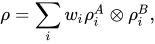
No, that is not how entanglement is defined for density matrices.
https://en.wikipedia.org/wiki/Quantum_entanglement#Ensembles
Extending the definition of separability from the pure case, we say that a mixed state is separable if it can be written as[76]: 131–132 

{\displaystyle \rho =\sum _{i}w_{i}\rho _{i}^{A}\otimes \rho _{i}^{B},}

where the wi are positively valued probabilities and the
{\displaystyle \rho _{i}^{A}}
s and
{\displaystyle \rho _{i}^{B}}
s are themselves mixed states (density operators) on the subsystems A and B respectively. In other words, a state is separable if it is a probability distribution over uncorrelated states, or product states.
 
gentzen said:
No, that is not how entanglement is defined for density matrices.
Technically you are right, but I assumed (not said, my bad) that the system B+apparatus is in the pure state. For pure states the definition I wrote is correct. The purity can be derived from assumptions (i) that the system B+apparatus is closed and (ii) that the state is pure initially. Those assumptions can be justified by specifying that by "apparatus" I mean everything in the universe except B. Of course, I should have said all that explicitly to be precise. But none of this is essential for my argument. The crux of the argument is the assumption that apparatus can be described by QM.
 
javisot said:
I cannot say that B and the apparatus are entangled if they have never interacted
You can have entanglement without mutual interaction, if you allow a change of the state by projection. Consider the non-entangled state
$$(|A_1\rangle + A_2\rangle)(|B_1\rangle + B_2\rangle) = |A_1\rangle|B_1\rangle + ...$$
The state describes a statistical ensemble of equally prepared systems. Now consider a postselected sub-ensemble, in which one removes all members from the initial ensemble for which particle A is found in state ##A_1## and particle B in state ##B_1##. This means that one projects out the first term on the right-hand side, retaining the 3 terms denoted by "...". The superposition containing those 3 terms is entangled, known under the name Hardy state.
 
Last edited:
  • Like
Likes   Reactions: Sambuco and javisot
Demystifier said:
Those assumptions can be justified by specifying that by "apparatus" I mean everything in the universe except B. Of course, I should have said all that explicitly to be precise. But none of this is essential for my argument. The crux of the argument is the assumption that apparatus can be described by QM.
As an instrumentalist, I don‘t like that idea of describing the universe by a wavefunction. So I agree that the apparatus can be described by QM, as long as we are really talking about the apparatus itself. When you want to include some of the environment in the apparatus, that is also fine for me. But „everything in the universe except B“ overstretches things for me.

In the end, my opinion is that trying to play tricks to avoid having to really deal with density matrices doesn‘t work. Even in BM, one can work with density matrices. And if you include spin, you can see that even in BM, they are the way to go for describing the state of subsystems.
 
DrChinese said:
1. You must have a different definition of "ad hominem" than the typical usage. Saying I'm wrong on a point - which by the way I think you are terribly wrong on key points here - is completely different than calling me inadequate on some levels.
A distinction without a difference. If you can't understand how equation (1) and (2) in Ma's paper are the same pre-measurement state/preparation, you can't understand anything that follows. Until you develop the skills needed to expand states (and this is indeed an undergraduate skill), the conversation is at an impasse.
 
  • Like
  • Skeptical
Likes   Reactions: DrChinese, Motore and PeterDonis
DrChinese said:
I don't follow these distinctions. Clearly, 1 and 4 violate Bell inequalities IFF the experimenter later chooses to execute a swap. If she doesn't, no violations. By our agreed upon 2., this is entanglement.
The distinction has to do with the fact that different quantum states can be associated with a same pair of particles, depending on what one considers to be the "preparation" of this pair. In the case of the entanglement swapping experiments, a separable quantum state can be associated with particles 1 and 4 if we consider the initial preparation but, at the same time, it is also possible to associate an entangled quantum state to them if what we consider as "preparation" is the measurement results given by the swap that Víctor decides to perform on photons 2 and 3. Now, this distinction is not important in those ##psi##-epistemic interpretations, such as the one used by the authors of Ma's work, but it is important for the explanation that Bohmian mechanics gives of these experiments because the wave function that guides the particles is one or the other depending on whether the entanglement swapping is delayed or not.

If Victor decides to make the swap before Alice and Bob measure photons 1 and 4 (non-delayed choice), this swap non-locally changes the trajectory of photons 1 and 4. However, when Victor's swap on photons 2 and 3 is carried out after Alice and Bob measure photons 1 and 4 (delayed-choice), then the entanglement that appears between photons 1 and 4 in each of the subsets determined by the result of the measurements of photons 2 and 3 does not cause a change in the trajectories of photons 1 and 4, because they were already measured. Due to this distinction, according to Bohmian mechanics, in the non-delayed case, entanglement is more "real" since it appears in the wave function that is guiding the particles. On the other hand, in the delayed case, the wave function that shows the entanglement is not the one that guides the particles, but rather one that results from the post-selection that is possible thanks to the swap that Victor carried out. In other words, the entanglement between photons 1 and 4 in the DCES case is not ontic, according to the Bohmian interpretation. this does not mean that there is no entanglement, only that it manifests itself in a wave function that is not the one that guides the particles and, therefore, does not produce a "real" physical change in the system.

An example that can help visualize what I am saying is Fankhauser's paper where he analyzes how Bohmian mechanics explains the delayed-choice quantum eraser (DCQE) experiment. Figures 4(b) and 4(c) show how the signal photon trajectories change depending on whether the idler photon arrives at detectors 1 or 2 before or after the signal photon arrives at the screen. In either case, quantum erasure allows us to observe interference in the measurements of the signal photon, although the microscopic explanation provided by Bohmian mechanics is different in both cases.

Lucas.
 
Demystifier said:
Proof of the entanglement with the apparatus

Here I present the simplest proof that the photon B is entangled with the apparatus. The only assumption of the proof that potentially can be questioned is that the apparatus is described by QM. If that assumption is accepted, then entanglement can be proved logically.

Here is the proof, by a reductio ad absurdum:
Since B and the apparatus are described by QM, it follows that there is a density matrix ##\rho## describing B and the apparatus. The ##\rho## is either entangled or not. To prove that it is entangled, let us suppose the opposite and obtain a contradiction. If it is not entangled, then (by definition of entanglement) it has the product form
$$\rho=\rho_B \otimes \rho_{\rm appar}$$
The product form implies that there is no correlation between B and the apparatus. But from experiments we know that there is a correlation between B and the measurement outcome, so, since the measurement outcome is encoded in the state of the apparatus, it follows that there is a correlation between B and the apparatus. Hence ##\rho## in fact is not a product, which proves entanglement. Q.E.D.

So the only logical way to deny the entanglement with the apparatus is to deny that the apparatus can be described by QM. @DrChinese is it your position, that the apparatus is not described by QM? It is a legitimate position (Bohr thought that too), but then perhaps you have even more difficult problems to deal with.
First, it doesn’t really matter what I think. You and some other Bohmians believe it, and that’s what matters here. I’m happy to accept this hypothesis.

Second, of course I don’t believe that the apparatus is entangled with photon B. They are “obviously” in a product state. No experiment is gonna show otherwise.

Assume Photon A is observed to be |- >. We already know photon B will be observed to be |+>. Exactly what spin State is the measurement apparatus now in, post measurement? Writing down an entangled state does not make it entangled.
 
Sambuco said:
The distinction has to do with the fact that different quantum states can be associated with a same pair of particles, depending on what one considers to be the "preparation" of this pair. In the case of the entanglement swapping experiments, a separable quantum state can be associated with particles 1 and 4 if we consider the initial preparation but, at the same time, it is also possible to associate an entangled quantum state to them if what we consider as "preparation" is the measurement results given by the swap that Víctor decides to perform on photons 2 and 3. Now, this distinction is not important in those ##psi##-epistemic interpretations, such as the one used by the authors of Ma's work, but it is important for the explanation that Bohmian mechanics gives of these experiments because the wave function that guides the particles is one or the other depending on whether the entanglement swapping is delayed or not.
I agree that 1 and 4 can be in different initial states in the way you describe. I’m not sure that helps, but if it does, great.
 
Morbert said:
A distinction without a difference. If you can't understand how equation (1) and (2) in Ma's paper are the same pre-measurement state/preparation, you can't understand anything that follows.
You may consider Huggett’s words below to echo my position precisely. I’m not sure if English is your first language or not, but tense is important here.

Huggett: "We emphasize that in this state neither 1 nor 2 is entangled with 3 or 4, as can clearly be seen by the factorization of Ψ in (1.3). But now suppose that a measurement of the Bell state of 1 and 3 is carried out (i.e., a measurement to determine whether the Bell state of 1 and 3 is α1,3, β1,3, γ1,3 or δ1,3). As a result Ψ will be projected onto one of the four terms of (1.4), corresponding to the outcome: Ψ→{α1,3α2,4,β1,3β2,4,γ1,3γ2,4,δ1,3δ2,4}. But whatever the outcome, particles 2 and 4 will end up in a Bell state, and hence be entangled. The measurement of 1 and 3 alone induces the entanglement of 2 and 4; no interaction, either unitary or involving their measurement, occurs between 2 and 4."

On the other hand, perhaps you believe Huggett’s understanding is no greater than mine - and inferior to yours. (Please note that the particle labeling here is slightly different than what we’ve been using all along.)

:smile: A little bit of humor, that has nothing to do with physics or this thread:

Bill Clinton and the meaning of “Is”