Entries in a direction cosine matrix as derivatives

Click For Summary
SUMMARY

The discussion centers on the relationship between the entries of a directional cosine matrix and their derivatives, specifically in the context of vector transformations in ℝ2. The transformation matrix is derived using trigonometric identities, such as $$ cos( \frac {\pi}{2} + \gamma) = -sin(\gamma) $$ and $$ cos(\frac {\pi}{2} - \gamma) = sin(\gamma) $$. It is established that these trigonometric identities can be intuitively understood through the lens of Taylor Series and matrix multiplication, reinforcing the connection between calculus and trigonometry in the context of rotation matrices.

PREREQUISITES
  • Understanding of directional cosine matrices
  • Familiarity with trigonometric identities
  • Basic knowledge of vector transformations in ℝ2
  • Concepts of Taylor Series in calculus
NEXT STEPS
  • Explore the derivation of rotation matrices in linear algebra
  • Study the relationship between trigonometric identities and Taylor Series
  • Learn about the geometric interpretation of rotation in ℝ2
  • Investigate advanced applications of directional cosine matrices in 3D transformations
USEFUL FOR

Mathematicians, physics students, engineers, and anyone interested in understanding the mathematical foundations of vector transformations and trigonometric identities.

maxhersch
Messages
20
Reaction score
0
This is a somewhat vague question that stems from the entries in a directional cosine matrix and I believe the answer will either be much simpler or much more complicated than I expect.

So consider the transformation of an arbitrary vector, v, in ℝ2 from one frame f = {x1 , x2} to a primed frame
f' =
{x'1 , x'2} which is related to the non-primed frame by a rotation of angle γ.

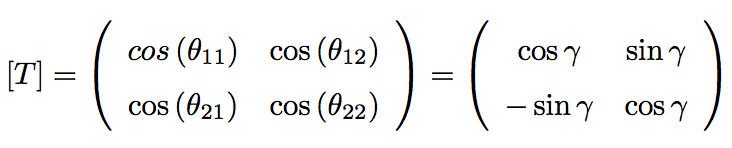
The transformation matrix will look like this:
6qK2No7.png


So this matrix can be derived from some simple trigonometric identities, specifically
$$ cos( \frac {\pi}{2} + \gamma) = -sin(\gamma) $$ and $$ cos(\frac {\pi}{2} - \gamma) = sin(\gamma) $$
So my question is perhaps more related to these identities than the matrix. Nonetheless, why are the entries in the 2nd column of the transformation matrix equivalent to the derivative of the entries in the 1st column? Is there some intuitive explanation, perhaps related to the trig identities? Regardless of how simple or complex the reasoning may be, I would appreciate some insight just for the sake of my curiosity. Thanks.
 
Physics news on Phys.org
maxhersch said:
The transformation matrix will look like this:
6qK2No7.png


So this matrix can be derived from some simple trigonometric identities, specifically
$$ cos( \frac {\pi}{2} + \gamma) = -sin(\gamma) $$ and $$ cos(\frac {\pi}{2} - \gamma) = sin(\gamma) $$
So my question is perhaps more related to these identities than the matrix

This may not be quite what you are looking for, but I'd point out that a decent chunk of what we call trig identities comes from symbol manipulation of Taylor Series of sine and cosine. Put differently, people use calculus to get these identities.

The idea, is that, if you are constructing your rotation matrices correctly, a lot of these trig identities must follow from simple matrix multiplication, which I find to be more intuitive, especially when people draw nice pictures to go along. Take a look at this video:

https://www.lem.ma/web/#/content/VQ7wysLCIGIM0Hd7

He shows how ##cos(\alpha +\beta) = cos(\alpha) cos(\beta) - sin(\alpha)sin(\beta)## (plus a similar identity for ##sin(\alpha + \beta)##) must follow if you've set up your rotation matrices correctly.

A different, perhaps less satisfying take, is to consider the converse -- if we set up the rotation matrix in another way, we'd be contradicting well know trig identities.

Hopefully this is close to what you are asking in your question.
 

Similar threads

  • · Replies 8 ·
Replies
8
Views
3K
  • · Replies 2 ·
Replies
2
Views
3K
  • · Replies 7 ·
Replies
7
Views
2K
  • · Replies 1 ·
Replies
1
Views
4K
  • · Replies 26 ·
Replies
26
Views
990
  • · Replies 2 ·
Replies
2
Views
2K
  • · Replies 8 ·
Replies
8
Views
3K
  • · Replies 20 ·
Replies
20
Views
3K
  • · Replies 1 ·
Replies
1
Views
7K
  • · Replies 17 ·
Replies
17
Views
7K