Entropy change during wet compression

Click For Summary
SUMMARY

The discussion centers on the paradox of entropy change during wet isentropic compression, specifically the transition from a mixture of vapor and water to superheated vapor. While the mathematical treatment indicates a zero change in entropy (ΔS=0) during adiabatic compression, the physical interpretation suggests an increase in disorder due to higher kinetic energy. The conversation highlights the balance between increasing temperature, which raises entropy, and decreasing volume, which lowers it, resulting in no net change in thermodynamic entropy.

PREREQUISITES
  • Understanding of thermodynamic principles, particularly the second law of thermodynamics.
  • Familiarity with the concepts of entropy and isentropic processes.
  • Knowledge of statistical physics and its relationship to thermodynamic entropy.
  • Basic grasp of gas laws and behavior during compression.
NEXT STEPS
  • Study the principles of isentropic processes in thermodynamics.
  • Explore the relationship between statistical entropy and thermodynamic entropy.
  • Learn about the effects of volume and temperature changes on gas behavior.
  • Investigate the implications of the second law of thermodynamics in various processes.
USEFUL FOR

Students and professionals in thermodynamics, mechanical engineers, and anyone interested in the principles of entropy and gas behavior during compression processes.

kulkajinkya
Messages
12
Reaction score
1
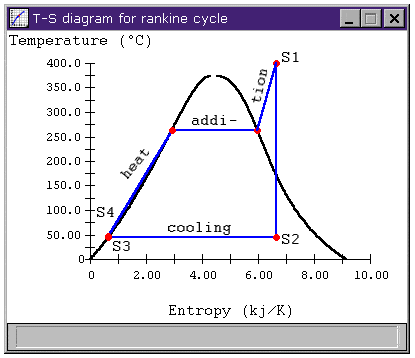
I have a quick question. Consider the process S2 to S1 in the figure below
rnkTs.gif.gif


Since this represents wet (isentropic) compression, mathematically we have ΔS=0 (assuming adiabatic compression). But if we consider the process in a physical way, we are going from a region of less disorder (mixture of vapour and water) to a state of more disorder (superheated vapour). Hence physically speaking entropy should increase since we are going to a highly disordered state from a low disorder state. So here is my paradox. How can the process have mathematically 0 change in entropy, but physically it does seem to increase?
 
Science news on Phys.org
But if we consider the process in a physical way, we are going from a region of less disorder (mixture of vapour and water) to a state of more disorder (superheated vapour)

If the compression is done slowly and without heat exchange, that the entropy is constant follows from the second law of thermodynamics. There is no connection to disorder in this theory.

This connection is a subject of statistical physics, where the statistical entropy is connected to disorder in a mathematical way. You have to quantify the disorder by a number which is proportional to the number of microstates of the system that are compatible with the macroscopic variables, like pressure and volume.

When you do that, you will find out that the "disorder" is proportional to the volume raised to power of N, where N is the number of molecules of the gas.

Now, in order to perform the transition to superheated vapour, we have to push the piston and thus shrink the volume V. This decreases the number of accessible microstates and hence "disorder". If the statistical entropy is to have the same value as the thermodynamic entropy, the decrease of the accessible states has to compensate exactly for the increase of them due to higher kinetic energy of the molecules.
 
I didn't get this line: 'If the compression is done slowly and without heat exchange, that the entropy is constant follows from the second law of thermodynamics. There is no connection to disorder in this theory'.
Will you please elaborate?
 
The above behavior of the entropy can be calculated in thermodynamics without any use of idea of "disorder", if entropy means "thermodynamic entropy". Thermodynamic entropy is a concept that does not depend on such statistical notions.
 
So essentially you mean to say that on one hand we are increasing disorder by increasing the temp, but simultaneously decreasing disorder by reducing the volume? Like balancing both of them and getting a 'net' result of an 'unchanged' disorder, right?
 
Just consider isentropic compression of a gas without a phase change. This corresponds to the portion of path S2 to S1, starting from the 100% saturated vapor location. The temperature is increasing, which acts to increase the entropy, but the volume is decreasing, which acts to decrease the entropy. The two effects cancel out so that there is no change in entropy. Are you still wondering why decreasing the volume of a gas acts to decrease its entropy?

Chet
 
Thank you people for the answers!
 

Similar threads

  • · Replies 1 ·
Replies
1
Views
2K
  • · Replies 12 ·
Replies
12
Views
3K
  • · Replies 3 ·
Replies
3
Views
3K
  • · Replies 22 ·
Replies
22
Views
6K
  • · Replies 15 ·
Replies
15
Views
3K
  • · Replies 60 ·
3
Replies
60
Views
10K
  • · Replies 1 ·
Replies
1
Views
1K
  • · Replies 57 ·
2
Replies
57
Views
8K
  • · Replies 2 ·
Replies
2
Views
2K
Replies
3
Views
2K