Entropy change when the number of particles decreases

Click For Summary
SUMMARY

The discussion centers on the calculation of entropy change when the number of particles decreases from ##N_1## to ##N_2=N_1/2##. The established solution indicates that the entropy decreases by $$\Delta S=-k\cdot N_1\cdot \ln{2}$$. The participant expresses confusion regarding the argument, particularly the assumption of non-interacting particles and the lack of knowledge about the number of microstates ##\Omega##. They argue that in a chemical reaction within an isolated container, the system's entropy would increase rather than decrease, challenging the exercise's validity.

PREREQUISITES
  • Understanding of the second law of thermodynamics
  • Familiarity with the concept of entropy and its mathematical representation
  • Knowledge of statistical mechanics, particularly microstates and macrostates
  • Basic principles of chemical reactions in thermodynamic systems
NEXT STEPS
  • Study the implications of the second law of thermodynamics in isolated systems
  • Explore the relationship between entropy and microstates in statistical mechanics
  • Learn about the effects of particle interactions on entropy changes
  • Investigate real-world examples of entropy changes in chemical reactions
USEFUL FOR

Students of thermodynamics, physicists, chemists, and anyone interested in the principles of entropy and its applications in physical systems.

greypilgrim
Messages
581
Reaction score
44
Hi.

I found following exercise in a high school textbook:
"Compute the entropy change in following process:"
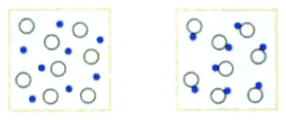
SCAN0015.png

The solution is
"The number of particles decreases from ##N_1## to ##N_2=N_1/2##. Hence the entropy decreases by
$$\Delta S=-k\cdot N_1\cdot \ln{2}\enspace ."$$

I can't quite follow the argument here. Assuming the particles in each picture are non-interacting and have the same number of microstates ##\Omega##, I get
$$S_1=N_1\cdot k\cdot \ln{\Omega}$$
$$S_2=N_2\cdot k\cdot \ln{\Omega}=\frac{N_1}{2}\cdot k\cdot \ln{\Omega}=\frac{S_1}{2}$$
from which I can see that the entropy decreases, but cannot compute the difference since I don't know ##\Omega##.
 
Science news on Phys.org
I have doubts that the exercise makes much sense. E.g. if this is meant to be a chemical reaction in an isolated container, the system will heat up and entropy will increase rather than decrease.
 

Similar threads

  • · Replies 2 ·
Replies
2
Views
2K
  • · Replies 9 ·
Replies
9
Views
3K
  • · Replies 7 ·
Replies
7
Views
1K
  • · Replies 22 ·
Replies
22
Views
3K
  • · Replies 19 ·
Replies
19
Views
3K
Replies
3
Views
2K
  • · Replies 1 ·
Replies
1
Views
2K
  • · Replies 1 ·
Replies
1
Views
2K
  • · Replies 3 ·
Replies
3
Views
685
  • · Replies 3 ·
Replies
3
Views
2K