Equation for modeling atomic spectra of all atoms

Click For Summary
SUMMARY

The discussion confirms that the equation for modeling atomic spectra, specifically E=h*v, is primarily applicable to hydrogen and Rydberg states. It emphasizes that no general expression exists for the energy levels of all atoms due to the complexity of multielectron interactions. The isotope shift is introduced as a factor affecting atomic spectra, which is influenced by the nuclear mass and can be calculated using the formula E_M = (M/(m_e+M)) * E_∞ * (1/n1² - 1/n2²). The conversation highlights the limitations of deriving a universal equation for atomic spectra across different elements.

PREREQUISITES
  • Understanding of quantum mechanics principles, particularly energy quantization.
  • Familiarity with Planck's constant and its role in energy-frequency relationships.
  • Knowledge of atomic structure, including electron configurations and energy levels.
  • Basic grasp of isotopes and their impact on atomic properties.
NEXT STEPS
  • Explore the concept of Rydberg states in greater detail.
  • Research the implications of isotope shifts on atomic spectra.
  • Study the complexities of multielectron atom interactions in quantum mechanics.
  • Investigate advanced models for atomic spectra beyond hydrogen, such as those for heavier elements.
USEFUL FOR

Physicists, quantum mechanics students, and researchers in atomic and molecular physics seeking to understand the limitations of current models for atomic spectra.

Xilus
Messages
27
Reaction score
0
I've seen the equation I think is just for hydrogen. is this just for hydrogen?
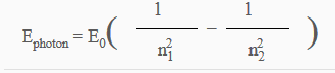
energy_hydrogen.png

of course this doesn't return the atomic spectra, it returns the energy.
So using E=h*v and Planck's constant. a simple factor of 1/h would return the frequency.
right? Energy is directly proportional to frequency.
and E0=13.6eV n1<n2 where both n1 and n2 are integers

Is there an equation that models atomic spectra of all atoms?
 
Physics news on Phys.org
Xilus said:
is this just for hydrogen?
Yes it's only for hydrogen, and approximately for the so-called Rydberg states.

Xilus said:
So using E=h*v and Planck's constant. a simple factor of 1/h would return the frequency.
right?
Yes.

Xilus said:
Is there an equation that models atomic spectra of all atoms?
As far as I know, no. We haven't derived the general expression for energy levels for all atoms.
 
is the spectra the same for all isotopes?
 
Xilus said:
is the spectra the same for all isotopes?
There is the so-called isotope shift which arise due to the fact that the nucleus is not completely at rest. It moves around by a very little amount which in turn disturbs the motion and hence wavefunction and energy levels of electrons. Different nuclear mass will have different effect on the wavefunction.
 
The formula for the isotope shift is quite simple. It's just a scaling by the reduced mass.
The energy is
$$E_M = \frac{M}{m_e+M} E_\infty \left(\frac{1}{n_1^2} - \frac{1}{n_2^2}\right)$$
where ##m_e## is the electron mass, ##M## is the nuclear mass, and ##E_\infty \approx 13.605693## eV
 
I think quantum mechanics brings in probabilities into physics ,so due to no determinism we cannot describe a general result for multielectron atoms.
 
That's not the reason we don't have a general result. The reason is that it's just too complicated for a simple analytical formula.
 

Similar threads

  • · Replies 11 ·
Replies
11
Views
2K
  • · Replies 3 ·
Replies
3
Views
5K
  • · Replies 20 ·
Replies
20
Views
17K
  • · Replies 25 ·
Replies
25
Views
8K
  • · Replies 4 ·
Replies
4
Views
2K
  • · Replies 18 ·
Replies
18
Views
3K
  • · Replies 3 ·
Replies
3
Views
4K
  • · Replies 9 ·
Replies
9
Views
3K
  • · Replies 38 ·
2
Replies
38
Views
6K
  • · Replies 1 ·
Replies
1
Views
2K