Estimate molarity from enthelpy, gibbs energy and entropy of formation

Click For Summary
SUMMARY

This discussion focuses on estimating the molarity of a saturated aqueous solution of strontium iodate, Sr(IO3)2, using thermodynamic data. The user attempts to apply the Van't Hoff equation and Gibbs energy equations to find the equilibrium constant and subsequently the molarity. Key equations discussed include ΔG = ΔH - TΔS and Kc = eΔGo/RT. The user encounters issues with negative temperature calculations, indicating potential errors in entropy or Gibbs energy values.

PREREQUISITES
  • Understanding of the Van't Hoff equation and its application
  • Knowledge of Gibbs free energy and its relation to equilibrium constants
  • Familiarity with thermodynamic concepts such as enthalpy (ΔH) and entropy (ΔS)
  • Basic chemical equilibrium principles and stoichiometry
NEXT STEPS
  • Review the Van't Hoff equation and its derivation for equilibrium constants
  • Study the relationship between Gibbs free energy, enthalpy, and entropy in chemical reactions
  • Investigate common pitfalls in calculating temperature from thermodynamic equations
  • Explore the implications of negative entropy and enthalpy values in reaction spontaneity
USEFUL FOR

Chemistry students, researchers in thermodynamics, and anyone involved in calculating solubility and equilibrium constants in aqueous solutions.

Telemachus
Messages
820
Reaction score
30
Hi there, I have to solve this problem:

Use the following data to estimate the molarity of a saturated aqueous solution of ##Sr(IO_3)_2##
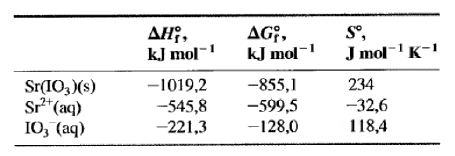
attachment.php?attachmentid=54225&stc=1&d=1356393140.png


So, I think I should use the Van't Hoff equation in some way, but I don't know how.
I also have:

##\Delta_r G=\Delta G^o+RT\ln K##

##K## is the equilibrium constant, and ##\Delta G^o## is the Gibbs energy of formation.

In equilibrium ##\Delta_r G=0## and the equation can be managed to get the Van't Hoff equation, which is:

##\ln K_1-\ln K_2=-\displaystyle\frac{\Delta H^o}{R} \left( \displaystyle\frac{1}{T_2}-\displaystyle\frac{1}{T_1} \right)##

I think that I should handle this equations to get the equilibrium constant in some way, and then the molarity. Another equation that may be useful is the definition of the Gibbs energy:

##\Delta G^o=\Delta H^o-T\Delta S^o##

The chemical equation involved I think should be:
##Sr(IO_3)_2(s)+H_2O(l) \rightleftharpoons Sr^{2+}(aq)+2IO_3^{-}##

And from it: ##K'=\displaystyle\frac{[Sr^{2+}][IO_3^{-}]^2}{[Sr(IO_3)_2]}##

The solid concentration remains constant, and then: ##K=[Sr^{2+}][IO_3^{-}]^2##

Can anybody help me to work this out?

Thanks.
 

Attachments

  • tabla.png
    tabla.png
    7.3 KB · Views: 1,674
Last edited:
Physics news on Phys.org
Ok. The chemical equation I set before was wrong. I wrote it hurried, because of christmass I had to dinner with my family and all that stuff.

Here is the correct chemical equation as I think it should be:
##Sr(IO_3)_2(s) \rightleftharpoons Sr^{2+}(aq)+2IO_3^{-}(aq)##

Alright, so I tried to solve this in the following manner. I am trying to find the equilibrium constant, I think that if I find it, then I will find the asked molarity.

So I thought of using that at equilibrium:
##K_c=e^{\displaystyle\frac{\Delta G^o}{RT}}##

So, I have to find the temperature at first. And for that I thought of using

##\Delta G=\Delta H-T\Delta S\rightarrow T=\displaystyle\frac{\Delta H-\Delta G}{\Delta S}## (1)

And then for the reaction I have:

##\Delta S=\sum \nu S^o(products)-\sum \nu S^o (reactants)##

nu stands for the stoichiometric coefficients. From the data in the table I get:

##\Delta S=-0.0.0298\frac{kJ}{mol K}##

Similarly: ##\Delta G=\sum \nu \Delta G_f^o(products)-\sum \nu \Delta G_f^o (reactants)=-0.4\frac{kJ}{mol}##

And: ##\Delta H=\sum \nu \Delta H_f^o(products)-\sum \nu \Delta H_f^o (reactants)=30.8\frac{kJ}{mol}##

Then, back to (1) I get:

##T=\frac{252.1-127.6}{-0.1482}K=-1020.13K##

And there is the problem, I'm getting a negative temperature. I don't know what I did wrong. Besides, at first I found a negative entropy, which implies not spontaneous reaction. And the enthalpy is positive, with means endothermic reaction, I think that is consistent. But I don't know why I get this negative temperature, which is obviously wrong.

Thanks for your attention :)
 
Last edited:

Similar threads

  • · Replies 4 ·
Replies
4
Views
2K
  • · Replies 1 ·
Replies
1
Views
2K
  • · Replies 2 ·
Replies
2
Views
2K
  • · Replies 4 ·
Replies
4
Views
3K
Replies
4
Views
2K
  • · Replies 3 ·
Replies
3
Views
3K
  • · Replies 9 ·
Replies
9
Views
3K
  • · Replies 1 ·
Replies
1
Views
3K
  • · Replies 3 ·
Replies
3
Views
3K
  • · Replies 1 ·
Replies
1
Views
2K