Evaluating Scattering Integral

  • Context: Undergrad 
  • Thread starter Thread starter Waxterzz
  • Start date Start date
  • Tags Tags
    Integral Scattering
Click For Summary

Discussion Overview

The discussion revolves around evaluating a scattering integral, with participants expressing confusion about the use of the Dirac delta function and the treatment of volume elements in the context of spherical coordinates. The conversation includes attempts to clarify mathematical steps and concepts related to integration in this specific scenario.

Discussion Character

  • Exploratory
  • Technical explanation
  • Debate/contested
  • Mathematical reasoning

Main Points Raised

  • Some participants suggest changing to spherical coordinates, indicating that the Dirac delta function will only affect the integral over r.
  • Others express confusion about the nature of dk' as a volume element, questioning its classification as a derivative of a vector.
  • There are multiple mentions of needing to integrate over k' first, with some participants unsure about the implications of the Dirac delta function in their equations.
  • One participant proposes using the cosine law to express the distance between vectors in terms of k, k', and theta to clarify the integrand.
  • Several participants express a lack of understanding and request step-by-step guidance on how to approach the problem.
  • There are repeated acknowledgments of confusion, with participants admitting to feeling lost in their calculations and reasoning.
  • One participant mentions needing to include a specific term related to the projection of k' on the z-axis in their evaluation of the integral.

Areas of Agreement / Disagreement

Participants generally express confusion and uncertainty about the mathematical concepts involved, with no clear consensus on how to proceed with the evaluation of the scattering integral. Multiple competing views and interpretations of the Dirac delta function and volume elements remain unresolved.

Contextual Notes

Limitations include unclear definitions of volume elements and the role of the Dirac delta function in the context of the integral. Participants have not reached a resolution on the mathematical steps necessary for evaluation.

Waxterzz
Messages
82
Reaction score
0
Hi,

I really don't have a clue to solve this.
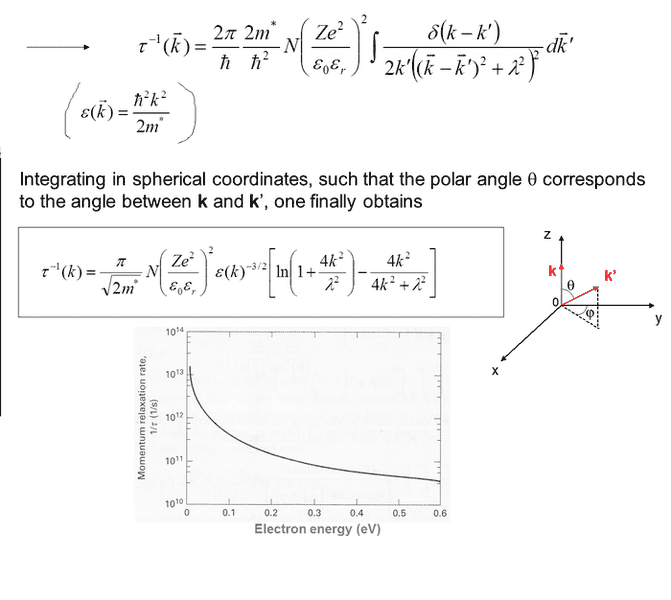
1SR45bL.png
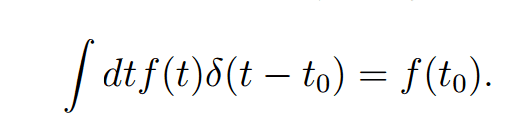
I tried something like the dirac function identity:
utoxnMx.png


But then I saw it's dk' not dk' and couldn't got it straight.

Can someone help me with this?
 
Physics news on Phys.org
As it is said, you have to change to spherical coordinates. The Dirac delta will then only affect the integral over r.
 
DrClaude said:
As it is said, you have to change to spherical coordinates. The Dirac delta will then only affect the integral over r.

I don't see it. dk' is not a volume element?
 
1a83c429226b2c6a2da143ae35a00751.png


dk' is a vector. Then I have an integral comprising of 3 terms each involving unit vectors.

I really don't have a clue.
 
Wait wait, I am extremely confused.

I just have to integrate over the k' first?
 
Mr
DrClaude said:
As it is said, you have to change to spherical coordinates. The Dirac delta will then only affect the integral over r.
6 hours and I still have no clue, can you please hold my hand and solve it with me. I mean, just say what I have to do, I will solve it, but give me instructions.

I mean what's the deal with the dirac function and the dk', it's supposed to be a volume element and the dirac term, why isn't it delta(k-k')
 
##d\vec{k}## is a volume element. Write it as a volume element in spherical coordinate. To make the integrand even more transparent, use the cosine law to express ##|\vec{k}-\vec{k'}|^2## in terms of ##k##, ##k'##, and ##\theta##.
 
blue_leaf77 said:
##d\vec{k}## is a volume element. Write it as a volume element in spherical coordinate. To make the integrand even more transparent, use the cosine law to express ##|\vec{k}-\vec{k'}|^2## in terms of ##k##, ##k'##, and ##\theta##.
mW21BmR.png


How come dk' is a volume element, it's the derivative of a vector. Most textbooks, the volume element is called a d tau or a dV

My head is a mess. It's like I completely forgot how to calculus.

Good news: I know I'm wrong.

Really don't see it
 
What happened to the Dirac delta? You should do the integral over k' first.
 
  • #10
Waxterzz said:
How come dk' is a volume element, it's the derivative of a vector. Most textbooks, the volume element is called a d tau or a dV
It's not a derivative, it is an infinitesimal vector element.
 
  • #11
DrClaude said:
It's not a derivative, it is an infinitesimal vector element.

It's been this the whole time?, with r being k'

eqn_vol_e.gif


Ps: After this I'm going to finally learn LaTeX
 
  • #12
Why did the Dirac delta disappear in the second equation from the last one?
 
  • #13
TEAEU8n.png
sv97Qux.png


This is what I got uptil now, but I have to leave.

Thanks for help, give me feedback if you want to, and I will post update when I'm back, probably tomorrow. Thanks for the patience anyway!
 
  • #14
DrClaude said:
It's not a derivative, it is an infinitesimal vector element.

blue_leaf77 said:
Why did the Dirac delta disappear in the second equation from the last one?

Hi,

Sorry for the late reply.

Hope this is somewhat more clear, because last post was a bit messy. Still haven't learned LaTex.

34XvfUc.png


Is this valid?

I couldn't evaluatie the last integral, because of the square.

Do I need to use partial fractions?

Thanks
 
  • #15
Hi myself,

I found out I need to include something like 1- ( stuff going in the z direction after k scattering) / (stuff that would go in z direction if there was no scattering at all), so 1 - k' projected on z axis /k = 1 - (k cos theta) / k

Yes, I'm a noob.

So I'll start over. :')
 

Similar threads

  • · Replies 2 ·
Replies
2
Views
3K
  • · Replies 2 ·
Replies
2
Views
2K
  • · Replies 1 ·
Replies
1
Views
4K
  • · Replies 4 ·
Replies
4
Views
3K
Replies
5
Views
2K
  • · Replies 1 ·
Replies
1
Views
3K
  • · Replies 1 ·
Replies
1
Views
2K
  • · Replies 8 ·
Replies
8
Views
2K
  • · Replies 3 ·
Replies
3
Views
2K
  • · Replies 8 ·
Replies
8
Views
3K