Even Functions, Symmetry, Inverse Functions

Join the discussion
Ask a follow-up here, or get your own question answered by working scientists, mathematicians and engineers — people, not an autocomplete.
Real named experts · corrections over time · the nuance an AI answer skips
6 replies · 3K views
confusedatmath
Messages
14
Reaction score
0
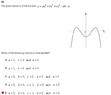
View attachment 1823

Can someone explain why the answer is D

a < 0 because it finishes downwards
e < O because the y-intercept is in the negatives.
b, & d = zero (but i don't get this)
c is supposedly > 0 (nor do i get this)

According to the solutions the graph is an even function, and symmetrical about the y-axis/x-axis. I haven't studied this, can someone please explain for values b,d,c.
 

Attachments
  • Screen Shot 2014-01-03 at 1.29.18 pm.png
    Screen Shot 2014-01-03 at 1.29.18 pm.png
    5.1 KB · Views: 151
Mathematics news on Phys.org
Looking at the graph, we can see it is reflected across the $y$-axis, meaning it is an even function, which means:

$$y(-x)=y(x)$$

This means the coefficients of the terms having an odd exponent on $x$ must be zero, i.e.:

$$b=d=0$$

This leaves us with:

$$y(x)=ax^4+cx^2+e$$

Now, we see that:

$$y(0)=e<0$$

We also see that as $x\to\pm\infty$ we have $$y(x)\to-\infty$$. This means the dominant term, that is, $ax^4\to-\infty$ which implies $a<0$. But in order to have $y(x)>0$ on the two shown intervals, we must have $0<c$.
 
is there an equation for symmetry in x-axis?
 
confusedatmath said:
is there an equation for symmetry in x-axis?

A function, by definition, cannot be symmetric across the $x$-axis. For any given input, a function can only have one output.
 
Hello, confusedatmath!

Can someone explain why the answer is D

a < 0 because it finishes downwards
e < O because the y-intercept is in the negatives.
b, & d = zero (but i don't get this)
c is supposedly > 0 (nor do i get this)
We have: .[tex]y \:=\:ax^4 + bx^3 + cx^2 + dx + e[/tex]

The graph is symmetric to the y-axis.

On the right, we have two x-intercepts, [tex]p[/tex] and [tex]q.[/tex]
On the left, we have two x-intercepts, [tex]\text{-}p[/tex] and [tex]\text{-}q.[/tex]

The function has the form:
. . [tex](x-p)(x+p)(x-q)(x+q) \:=\:x^4 - (p^2+q^2)x^2 + p^2q^2[/tex]

Since [tex]a[/tex] is negative, we have:
. . [tex]y \:=\:-\left[x^4-(p^2+q^2)x^2 + p^2q^2\right][/tex]
. . [tex]y \:=\:-x^4 + (p^2+q^2)x^2 - p^2q^2[/tex][tex]\begin{array}{cc}\text{Therefore:} & a\text{ neg.} \\ & b = 0 \\ & c\text{ pos.} \\ & d = 0 \\ & e\text{ neg.} \end{array}[/tex]
 
wow mindblown. :O that was such a cool way of solving it! THANK YOU (Inlove)
 
confusedatmath said:
is there an equation for symmetry in x-axis?
A non-function relation such as [tex]x^2+ y^2= 1[/tex] of [tex]x^2+ (y- 2)^2= 1[/tex], may be "symmetric about the x-axis". Just as the test for "symmetry about the y-axis" is f(x)= f(-x) (so that replacing x with -x does not change the equation) so the test for "symmetry about the x-axis" is that replacing y with -y does not change the equation.

Because [tex](-a)^2= a^2[/tex], in the first example above, [tex]x^2+ (-y)^2= x^2+ y^2= 1[/tex], the same as the original equation, so that is "symmetric about the x-axis". (Its graph is a circle about the origin.)

The second would give [tex]x^2+ (-y- 2)^2= x^2+ (-(y+ 1))^2= x^2+ (y+1)^2= 1[/tex] which is NOT the same as the original. The graph of [tex]x^2+ (y- 2)^2= 1[/tex] is a circle with center at (0, 2) so is symmetric about y= 2, NOT y= 0 which is the x-axis.