Undergrad Example of an Inseparable Polynomial .... Lovett, Page 371 ...

  • Thread starter Thread starter Math Amateur
  • Start date Start date
  • Tags Tags
    Example Polynomial
Click For Summary
The discussion centers on Example 7.7.4 from Stephen Lovett's "Abstract Algebra: Structures and Applications," specifically regarding inseparable polynomials and field extensions. The minimal polynomial is established as m(t) = t^3 - x, where t is an indeterminate in the polynomial ring over the field F_3(x), and x is a transcendental element. The example illustrates that the inseparability arises from the characteristic of the field being 3, which leads to the polynomial m(t) = t^3 - 3t^2√[3]{2} + 3t x^{2/3} - x equating to (t - √[3]{x})^3. The discussion clarifies the distinction between adjoining √[3]{x} and √[3]{2}, emphasizing that the latter does not create a proper extension since 2 is already in F_3. Overall, the example serves as a standard case for understanding inseparable field extensions in algebra.
Math Amateur
Gold Member
MHB
Messages
3,920
Reaction score
48
I am reading "Abstract Algebra: Structures and Applications" by Stephen Lovett ...

I am currently focused on Chapter 7: Field Extensions ... ...

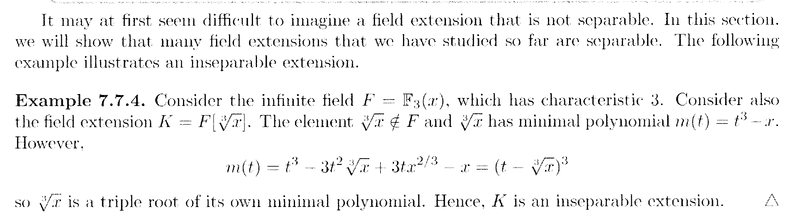
I need help with Example 7.7.4 on page 371 ...Example 7.7.4 reads as follows:
?temp_hash=385979292a0bb64e3c80730401d6092c.png


In the above text from Lovett we read the following:" ... ... The element ##\sqrt[3]{2} \notin F## and ##\sqrt[3]{2}## has minimal polynomial ...##m(t) = t^3 - x##.However,##m(t) = t^3 - 3t^2 \sqrt[3]{2} + 3t x^{ 2/3 } - x = (t - \sqrt[3]{2} )^3##... ... ... ... "
My questions are as follows:
Question 1

How does Lovett establish that the minimum polynomial is

##m(t) = t^3 - x##?Indeed, what exactly is ##t##? ... what is ##x##? Which fields/rings do ##t, x## belong to?[My apologies for asking basic questions ... but unsure of the nature of this example!]
Question 2How does Lovett establish that##m(t) = t^3 - 3t^2 \sqrt[3]{2} + 3t x^{ 2/3 } - x = (t - \sqrt[3]{2} )^3##
Help will be appreciated ...

Peter
[NOTE: I understand that the issues in this example are similar to those of other of my posts ... but ... for clarity and to avoid mixing/confusing conversational threads and issues I have decided to post this example separately ... ... ]
 

Attachments

  • Lovett - Example of an Insepable Extension ... Section 7.7, page 371 ... ....png
    Lovett - Example of an Insepable Extension ... Section 7.7, page 371 ... ....png
    19.5 KB · Views: 525
Physics news on Phys.org
Hi Peter,

this is the same example I quoted in your other post on the subject. Seems to be the standard example for an inseparable field extension.

First of all, as characteristic zero fields and finite fields are all separable, we need a prime characteristic, here ##p=3## and an infinite field. Therefore Lovett considers ##F_3## as ground field and ##F_3(x)## as field extension. Now you may consider ##x## as an indeterminate or a transcendental number over ##F_3##. It doesn't make a difference. (See my post here: https://www.physicsforums.com/threads/field-extensions-and-free-parameters.916207/#post-5778146)

Math Amateur said:
" ... ... The element ##\sqrt[3]{2} \notin F## and ##\sqrt[3]{2}## has minimal polynomial ...
No. He adjoins ##\sqrt[3]{x}##, not ##\sqrt[3]{2}##. This is an essential difference here!
##m(t) = t^3 - x##.
However,
##m(t) = t^3 - 3t^2 \sqrt[3]{2} + 3t x^{ 2/3 } - x = (t - \sqrt[3]{2} )^3##
... ... ... ... "
No. Again, he adjoins ##\sqrt[3]{x}##, not ##\sqrt[3]{2}##. This is an essential difference here!
My questions are as follows:

Question 1
How does Lovett establish that the minimum polynomial is
##m(t) = t^3 - x##?
Indeed, what exactly is ##t##? ... what is ##x##? Which fields/rings do ##t, x## belong to?
Set ##\alpha := \sqrt[3]{x} ##. What is the minimal polynomial of it over ##F_3(x)##? ## \alpha^3 =x ## so ##\alpha^3-x=0## and ##t^3-x## is the minimal polynomial, an element of ##F_3(x)[t]## where ##t## is the indeterminate, the variable of the polynomial ring. ##x## is already used as transcendental number, or if you like as another indeterminate, that constitutes the field ##F_3(x)##. However, ##\sqrt[3]{2}## does not, because ##2 \cdot 2 \cdot 2= 2## which means ##2 \in F_3## has a third root in ##F_3##, namely ##2## itself.
Question 2
How does Lovett establish that
##m(t) = t^3 - 3t^2 \sqrt[3]{2} + 3t x^{ 2/3 } - x = (t - \sqrt[3]{2} )^3##
No. Again, he adjoins ##\sqrt[3]{x}##, not ##\sqrt[3]{2}##. This is an essential difference here!
[NOTE: I understand that the issues in this example are similar to those of other of my posts ... but ... for clarity and to avoid mixing/confusing conversational threads and issues I have decided to post this example separately ... ... ]

I suggest to read the post I quoted. It is from today so should be new to you. Lovett simply needs two different variables: one as the indeterminate for a polynomial ring, the other as either an indeterminate of a quotient field ##F_3(x)## of the polynomial ring ##F_3[x]## or as transcendental number (over ##F_3##) if you like this better. It is the same. You can also simply take ##x:=\pi## which will work the same way.

Edit (ad question 2):

As a field extension is inseparable if and only if there is a ##p-##th root (here ##p=3##) of an element that does not lie in the field already, we have to consider polynomials of the kind ##t^3-x## where ##x## is that element. The polynomial equation holds, because ##3=0## in a field ##F_3(x)## of characteristic ##3##. This is called the Frobenius homomorphism. It is the a ring homomorphism ##a \mapsto a^p##. And since all terms in between are divisible by ##p##, we have ##(t-\sqrt[p]{x})^p=t^p-x##.
 
Last edited:
  • Like
Likes Math Amateur
fresh_42 said:
Hi Peter,

this is the same example I quoted in your other post on the subject. Seems to be the standard example for an inseparable field extension.

First of all, as characteristic zero fields and finite fields are all separable, we need a prime characteristic, here ##p=3## and an infinite field. Therefore Lovett considers ##F_3## as ground field and ##F_3(x)## as field extension. Now you may consider ##x## as an indeterminate or a transcendental number over ##F_3##. It doesn't make a difference. (See my post here: https://www.physicsforums.com/threads/field-extensions-and-free-parameters.916207/#post-5778146)No. He adjoins ##\sqrt[3]{x}##, not ##\sqrt[3]{2}##. This is an essential difference here!

No. Again, he adjoins ##\sqrt[3]{x}##, not ##\sqrt[3]{2}##. This is an essential difference here!

Set ##\alpha := \sqrt[3]{x} ##. What is the minimal polynomial of it over ##F_3(x)##? ## \alpha^3 =x ## so ##\alpha^3-x=0## and ##t^3-x## is the minimal polynomial, an element of ##F_3(x)[t]## where ##t## is the indeterminate, the variable of the polynomial ring. ##x## is already used as transcendental number, or if you like as another indeterminate, that constitutes the field ##F_3(x)##. However, ##\sqrt[3]{2}## does not, because ##2 \cdot 2 \cdot 2= 2## which means ##2 \in F_3## has a third root in ##F_3##, namely ##2## itself.

No. Again, he adjoins ##\sqrt[3]{x}##, not ##\sqrt[3]{2}##. This is an essential difference here!I suggest to read the post I quoted. It is from today so should be new to you. Lovett simply needs two different variables: one as the indeterminate for a polynomial ring, the other as either an indeterminate of a quotient field ##F_3(x)## of the polynomial ring ##F_3[x]## or as transcendental number (over ##F_3##) if you like this better. It is the same. You can also simply take ##x:=\pi## which will work the same way.

Edit (ad question 2):

As a field extension is inseparable if and only if there is a ##p-##th root (here ##p=3##) of an element that does not lie in the field already, we have to consider polynomials of the kind ##t^3-x## where ##x## is that element. The polynomial equation holds, because ##3=0## in a field ##F_3(x)## of characteristic ##3##. This is called the Frobenius homomorphism. It is the a ring homomorphism ##a \mapsto a^p##. And since all terms in between are divisible by ##p##, we have ##(t-\sqrt[p]{x})^p=t^p-x##.
Thanks fresh_42 ... still thinking over what you have said ...

By the way ... no idea why I wrote ##\sqrt[3]{2}## instead of ##\sqrt[3]{x}## ... was a "typo" ... I wrote out the post then typed it up ... wasn't paying attention when I typed it ... apologies ...

But ... what you have written is most helpful to me ... thanks for your support in my understanding of field extensions ...

Peter
 
Math Amateur said:
By the way ... no idea why I wrote ##\sqrt[3]{2}## instead of ##\sqrt[3]{x}## ... was a "typo" ... I wrote out the post then typed it up ... wasnt paying attention when I typed it ... apologies ...
No need for apologies, but here it changes the entire situation. ##F_3(x)## is the ground field in this example.

##F_3(x)(\sqrt[3]{x})## is inseparable (over ##F_3(x)##), because ##F_3(x)## doesn't contain a third root of ##x##.

##F_3(x)(\sqrt[3]{2}) = F_3(x)## because ##F_3(x) \supseteq F_3 \ni 2 = 1+1 \notin \{0,1\}## and ##2^3=2## which means ##\sqrt[3]{2}=2##. So in this case we wouldn't get a proper extension. We also have ##t^3-2 = (t-2)^3## so the "minimal polynomial" is ##t-2## which also shows that ##\sqrt[3]{2}=2## is the only third root of ##2##.
 
  • Like
Likes Math Amateur
I am studying the mathematical formalism behind non-commutative geometry approach to quantum gravity. I was reading about Hopf algebras and their Drinfeld twist with a specific example of the Moyal-Weyl twist defined as F=exp(-iλ/2θ^(μν)∂_μ⊗∂_ν) where λ is a constant parametar and θ antisymmetric constant tensor. {∂_μ} is the basis of the tangent vector space over the underlying spacetime Now, from my understanding the enveloping algebra which appears in the definition of the Hopf algebra...

Similar threads

Replies
2
Views
2K
  • · Replies 5 ·
Replies
5
Views
2K
  • · Replies 4 ·
Replies
4
Views
2K
  • · Replies 1 ·
Replies
1
Views
2K
  • · Replies 4 ·
Replies
4
Views
2K
  • · Replies 18 ·
Replies
18
Views
3K
  • · Replies 6 ·
Replies
6
Views
2K
  • · Replies 2 ·
Replies
2
Views
2K
  • · Replies 15 ·
Replies
15
Views
2K
  • · Replies 2 ·
Replies
2
Views
2K