Experimentalists : sample of gas from cylinder

  • Thread starter Thread starter rwooduk
  • Start date Start date
  • Tags Tags
    Cylinder Gas
Click For Summary
SUMMARY

The discussion focuses on the challenges of extracting gas samples from a cylinder into a gas chromatograph (GC) syringe without contamination from air. Users recommend using a round bottom flask with multiple inlets/outlets and a septum, evacuating the flask to a vacuum level of at least a few millitorr to minimize atmospheric contamination. The importance of using high-quality vacuum grease, such as Apiezon or Dow Corning, is emphasized to ensure airtight seals. Additionally, employing a TC gauge for accurate vacuum measurement is advised to achieve reliable gas sampling results.

PREREQUISITES
  • Understanding of gas chromatography (GC) principles
  • Familiarity with vacuum systems and pressure measurement
  • Knowledge of vacuum grease types and applications
  • Experience with laboratory glassware and gas sampling techniques
NEXT STEPS
  • Research the operation and calibration of gas chromatographs (GC)
  • Learn about vacuum system components, including roughing pumps and TC gauges
  • Study the effects of atmospheric contamination on gas analysis
  • Explore advanced gas sampling techniques to minimize contamination
USEFUL FOR

Experimental chemists, graduate students in chemistry or related fields, and laboratory technicians involved in gas analysis and sample preparation.

rwooduk
Messages
757
Reaction score
59
Hi, are there any experimentalists here? I have gas in a cylinder. I have just been taking samples of gas from a tube connected to the outlet, but air is getting in the syringe.

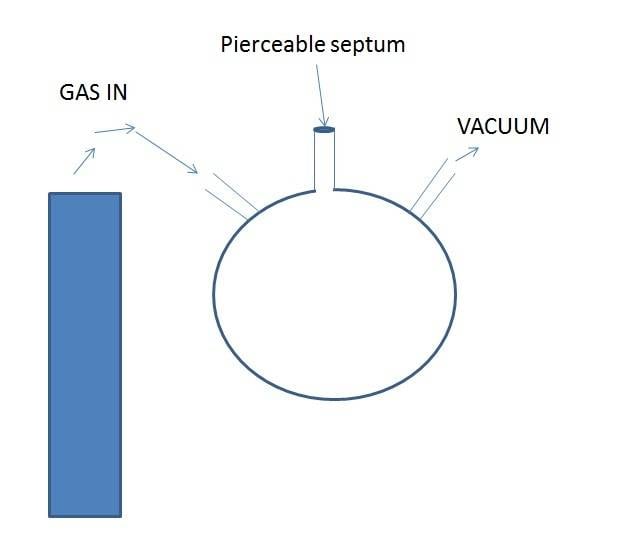
So I went over to chemistry and got a round bottom flask with 3 inlets / outlets and a septum, so its like this:
5RsqaIH.jpg


I evacuate the flask with the vacuum then flow the gas in, then after about a minute I pierce the septum with the GC syringe and take in some gas.

I am still getting air in the gas sample! Does anyone know a standard way of extracting gas from a cylinder (into a GC syringe) without air getting into it?

Any help would be really appreciated. I can order glassware etc etc but I don't know what specific equipment I need.
 
Chemistry news on Phys.org
There will be air in the syringe before you even take your sample . Even with the piston fully depressed there will be some air in the dead space and in the needle .

If you have ample supplies of test gas then suck gas in and vent to atmosphere or a collecting vessel several times before collecting the actual sample .You'll need some arrangement of lab grade valves to switch the flows .
 
Thanks for the reply. When I put the syringe through the septum I suck gas in then empty the syringe, would that not get rid of the air in the syringe?

I have a grease seal over the inlet and outlet valves so I am pretty sure air is not getting in there, the only thing that concerns me is the septum. Perhaps when I apply the vacuum air is sucking into the previously made holes?

Thanks again for the reply, and I welcome any more advice.
 
You also have to make sure you use vacuum grease like Apiezon or Dow Corning high vacuum grease. Also, you need to monitor the level of vacuum you are pulling out of the flask. You might think pumping to 1 torr would be ok but maybe you need to get to a few millitorr to reduce contamination. 1 atmosphere is 760 torr so at 1 torr you still have 1/760th of the contamination from atmosphere, which may contribute to analysis errors. Too bad you can't use some kind of laser analysis, that would obviate the need to extract gas at all, just beam the laser through the flask and read out the result. Not sure if that is a viable technology but worth a thought.
So no matter how many times you pre pump and such, the sample, if the flask itself is not pumped down sufficiently there will still be contamination from atmosphere so you may not be pumping enough. Like my example of pumping to 1 torr, that still leaves the possibility of 1.3 parts per thousand of air and moisture left in the mix. So you have to understand just how much contamination the analysis can tolerate to get the level of data required.

A TC gauge and a readout like the Hasting gauge readouts can be gotten on Ebay for around $200 and it can read fairly accurately down to a few millitorr, for roughing vacuum. You probably don't need to get really serious and use a cryo pump or diffusion pump or turbo pump which can run into big bucks.
You probably need a real roughing pump though, most of which can easily get down to 10 millitorr or so.
1 torr=1.3 parts per thousand. 1 milltorr, contamination now down to 1.3 parts per million so choose your weapon well!
 
  • Like
Likes   Reactions: rwooduk
litup said:
You also have to make sure you use vacuum grease like Apiezon or Dow Corning high vacuum grease. Also, you need to monitor the level of vacuum you are pulling out of the flask. You might think pumping to 1 torr would be ok but maybe you need to get to a few millitorr to reduce contamination. 1 atmosphere is 760 torr so at 1 torr you still have 1/760th of the contamination from atmosphere, which may contribute to analysis errors. Too bad you can't use some kind of laser analysis, that would obviate the need to extract gas at all, just beam the laser through the flask and read out the result. Not sure if that is a viable technology but worth a thought.
So no matter how many times you pre pump and such, the sample, if the flask itself is not pumped down sufficiently there will still be contamination from atmosphere so you may not be pumping enough. Like my example of pumping to 1 torr, that still leaves the possibility of 1.3 parts per thousand of air and moisture left in the mix. So you have to understand just how much contamination the analysis can tolerate to get the level of data required.

A TC gauge and a readout like the Hasting gauge readouts can be gotten on Ebay for around $200 and it can read fairly accurately down to a few millitorr, for roughing vacuum. You probably don't need to get really serious and use a cryo pump or diffusion pump or turbo pump which can run into big bucks.
You probably need a real roughing pump though, most of which can easily get down to 10 millitorr or so.
1 torr=1.3 parts per thousand. 1 milltorr, contamination now down to 1.3 parts per million so choose your weapon well!

Hi, Many thanks for the detailed reply! Yes I have ordered some vacuum grease also I have got a couple of taps from chemistry, so it's like this:
hiMV69F.jpg


I think the issue was that without the taps after turning off the vacuum the air was rushing back in! I will look into how to monitor the pressure / vacuum level in the flask, thanks! I can't use a laser as the sample needs to be injected into a gas chromatograph to calibrate the machine. Yes, a TC gauge sounds interesting, I will look into it! Thanks again!
 
Update, for those who have the same problem, this set up is working very well:

z3rBoi6.jpg


One goes to vacuum, other puts CO2 in.
 
  • Like
Likes   Reactions: Nidum
Do you have TC gauges yet to measure vacuum levels? What you show looks ok from vacuum standpoint. The little blue knobs looks like they are attached to valves, but are unfamiliar to me. Most of the valves I use are pneumaticvalves, air pressure activated, some for high vacuum are bellows valves and some needle valves.
 
litup said:
Do you have TC gauges yet to measure vacuum levels? What you show looks ok from vacuum standpoint. The little blue knobs looks like they are attached to valves, but are unfamiliar to me. Most of the valves I use are pneumaticvalves, air pressure activated, some for high vacuum are bellows valves and some needle valves.

To be honest we are low on funds and the above setup is working fine. We aren't really measuring the pressure levels (hence the film over the vessel incase it explodes / implodes) but its fairly safe, you just have to be careful when opening the blue taps (they are just air tight screw taps). The process is to close both taps, open vacuum (blue) tap, turn on vacuum, in less than 5 seconds the septum will become sucked in, close vacuum tap, turn off vacuum, turn on gas from cylinder, open (blue) gas VERY slightly and the septum blows up, close gas (blue) tap, turn off gas, repeat X 2... take sample from septum. It's not ideal, but when testing the gas by piercing the septum and injecting into the GC we are getting <1% air, in comparison to ~10-30% air just straight from a tube connected to the cylinder.
 
Big impovement for sure. 1% air would translate to a vacuum level of around 7 torr, close to the atmosphere of Mars:)

Is this a student project? What do/did you hope to learn?
 
  • #10
It's for my PhD we need to calibrate the GC for our samples, unfortunately no one knows how to use the thing so it's taking a long time. The research is based on sonochemistry. Thanks for the help!
 
  • #11
That's what science is all about, learn as you go:) Good luck! Sounds like your PhD is in secure hands.
 
  • Like
Likes   Reactions: rwooduk

Similar threads

  • · Replies 10 ·
Replies
10
Views
2K
Replies
7
Views
4K
  • · Replies 2 ·
Replies
2
Views
5K
  • · Replies 3 ·
Replies
3
Views
3K
  • · Replies 1 ·
Replies
1
Views
2K
  • · Replies 45 ·
2
Replies
45
Views
6K
  • · Replies 4 ·
Replies
4
Views
4K
  • · Replies 3 ·
Replies
3
Views
13K
  • · Replies 1 ·
Replies
1
Views
4K
  • · Replies 18 ·
Replies
18
Views
12K