High School Can We Measure Diffraction Intensity Using Huygens' Principle?

  • Thread starter Thread starter jaumzaum
  • Start date Start date
  • Tags Tags
    Huygens Principle
Click For Summary
Diffraction occurs more significantly when the slit size is comparable to the wavelength, affecting the wavefront's propagation. Lasers are collimated to minimize diffraction effects, resulting in a primarily parallel beam with minor energy lobes surrounding it. The intensity of light seen from a perpendicular plane to the beam is dominated by the central lobe, with diminishing intensity in the fringes. While diffraction does occur, it is minimal enough that the beam appears concentrated, and the aperture size plays a crucial role in this phenomenon. Understanding these principles can be aided by analogies to radio antennas and their diffraction patterns.
jaumzaum
Messages
433
Reaction score
33
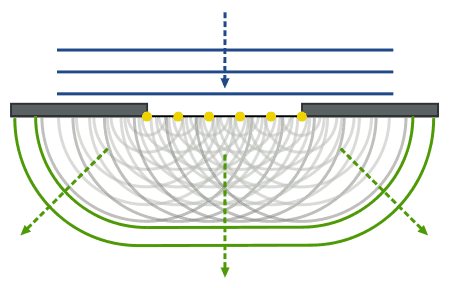
Hi. I was studying Huygens Principle and I learned that diffraction usually occurs more when the slit is comparable in size with the wavelength, and this image does not leave my head:
1595567399518.png


We can see that the "middle" part of the wavefront keeps traveling in the same direction, but the wavefront in the extremities starts to propagate as spheres. My question is, can we determine the intensity of some cross section of this "new" wavefront
A. in the middle
B. in the extremities

I'm having this questions because I was wondering why lasers are collimated, as the light leaves a small aperture. Is the aperture big enough so that no diffraction can be seen? But eventhough no diffraction can be seen, it still occur right? For example, if I am in a plane perpendicular to the beam, and the laser is in the vacuum, will I still be able to see the beam due to diffraction? What will be the intensity of the light seen?
 
Physics news on Phys.org
jaumzaum said:
For example, if I am in a plane perpendicular to the beam, and the laser is in the vacuum, will I still be able to see the beam due to diffraction?

No. You could just see the source.
 
jaumzaum said:
the light leaves a small aperture
Roughly how many wavelengths is the aperture? Is that actually a small number?
 
jaumzaum said:
Hi. I was studying Huygens Principle and I learned that diffraction usually occurs more when the slit is comparable in size with the wavelength, and this image does not leave my head:View attachment 266770

We can see that the "middle" part of the wavefront keeps traveling in the same direction, but the wavefront in the extremities starts to propagate as spheres. My question is, can we determine the intensity of some cross section of this "new" wavefront
A. in the middle
B. in the extremities

I'm having this questions because I was wondering why lasers are collimated, as the light leaves a small aperture. Is the aperture big enough so that no diffraction can be seen? But eventhough no diffraction can be seen, it still occur right? For example, if I am in a plane perpendicular to the beam, and the laser is in the vacuum, will I still be able to see the beam due to diffraction? What will be the intensity of the light seen?
This diagram is very misleading. The actual energy lying outside the central portion is very small. Close to the aperture we have a parallel beam, surrounded by some small blobs of energy. If you are a long way from the aperture, we see a central diverging beam surrounded with many lesser fringes. The first of these is roughly 1% of the intensity, the next 0.25% and then getting gradually less until when we get to 90 degrees from the beam the intensity is only 10^-5. If you look at the aperture from here I think you will see glowing edges, assuming your eye has a large aperture.
The laser beam diverges at small angle when measured at large distances and is surrounded by a succession of minor lobes as I have described. If the laser hits a screen we see the main lobe surrounded by circular fringes gradually fading away.
 
  • Like
Likes jaumzaum
jaumzaum said:
I'm having this questions because I was wondering why lasers are collimated, as the light leaves a small aperture. Is the aperture big enough so that no diffraction can be seen?
I think this may be the 'nub' of your question. You start with that (good) diagram of diffraction through a fairly wide slot. That assumes uniform illumination across the slot and this photo of a ripple tank shows the same effect well.
1595627595400.png

It's a rare example of a really good ripple tank image. Someone went to a fair bit of trouble to get it right and posted it in Wikipedia and it not only shows the shape of the wavefront but also the amplitude. Much stronger along the middle than where it spreads out at the sides.

Moving on to using a laser in the equivalent light demonstration, an unmodified beam from a laser would (as yo say) only illuminate the middle portion and the original beam would be virtually untouched by the aperture. To get the equivalent result with light as with the ripple tank produced, you would need to spread the pencil beam out and then focus it at infinity so that the edges of the widened laser beam spread well out beyond the aperture.

I will make my usual remark about how straightforward it can be to consider Radio Antennae when trying to understand diffraction. The diagram below shows the pattern of a row of four sources, co-phased and a crude version of the infinite number of Huygens sources. The pattern is bidirectional in this case but , of course, all the light ends up in the rough direction of the incident beam. A wider array (more elements) produces a narrower beam. Filling in the gaps between the elements to, say λ/4 or λ/8 etc gets closer and closer to the Huygens infinite set of sources.

broadside.jpg
 
Thread 'What is the pressure of trapped air inside this tube?'
As you can see from the picture, i have an uneven U-shaped tube, sealed at the short end. I fill the tube with water and i seal it. So the short side is filled with water and the long side ends up containg water and trapped air. Now the tube is sealed on both sides and i turn it in such a way that the traped air moves at the short side. Are my claims about pressure in senarios A & B correct? What is the pressure for all points in senario C? (My question is basically coming from watching...

Similar threads

Replies
12
Views
946
  • · Replies 2 ·
Replies
2
Views
1K
  • · Replies 9 ·
Replies
9
Views
10K
  • · Replies 8 ·
Replies
8
Views
5K
Replies
18
Views
5K
  • · Replies 17 ·
Replies
17
Views
3K
  • · Replies 2 ·
Replies
2
Views
2K
  • · Replies 5 ·
Replies
5
Views
2K
  • · Replies 2 ·
Replies
2
Views
2K
  • · Replies 15 ·
Replies
15
Views
6K