Sabertooth
- 29
- 2
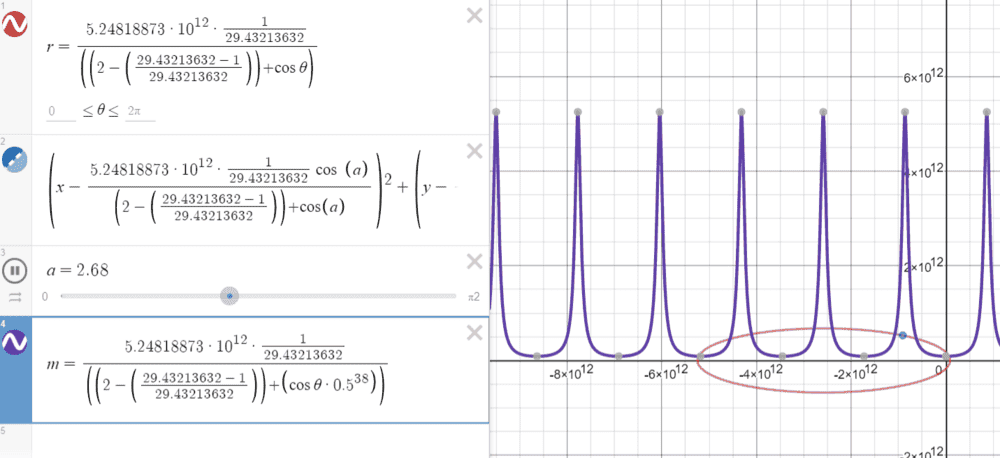
Hi everyone:) I have spend a couple of days trying to teach myself the math of orbital mechanics and have been able to generate a model of the orbital path of Haley's Comet, incorporating realistic distances and periods using Kepler's second law & ellipsoid functions.
This is a GIF of the motion picture I have modeled thus far: https://gyazo.com/ee22bf5beaf0be7189fe5c507c7b0714
The difficulty I'm having at the moment is finding the right function or expression to generate a graph of the true velocity of the satellite (Hailey's comet) as a function of time(period). As you can see the velocity is constantly changing as the distance between the foci and the satellite increases and decreases, and the velocity is proportional to that curve you see on the image overlapping the orbital path. (which depicts distance from foci).
What I need to do, is simultaneously graph the wave function of the true speed of the comet over each period.
Moreover, you may have noticed that the ellipse foci is reversed in some sense. The (0,0) value represent a foci, but it is the opposite foci that the comet is actually orbiting which might be inferred from the fact that the object moves faster as it gets further away from the (0,0) coordinate.
So my two main question were:
Does anyone know how I can properly generate the graph of the speed of the comet from this set of equations. a speed vs time graph?
Anyone with knowledge on how to rearrange the mathematical function so the foci is centered on the "right side of the Ellipse"? Still maintaining all the other features.
Would love some help with this:)
This is a GIF of the motion picture I have modeled thus far: https://gyazo.com/ee22bf5beaf0be7189fe5c507c7b0714
The difficulty I'm having at the moment is finding the right function or expression to generate a graph of the true velocity of the satellite (Hailey's comet) as a function of time(period). As you can see the velocity is constantly changing as the distance between the foci and the satellite increases and decreases, and the velocity is proportional to that curve you see on the image overlapping the orbital path. (which depicts distance from foci).
What I need to do, is simultaneously graph the wave function of the true speed of the comet over each period.
Moreover, you may have noticed that the ellipse foci is reversed in some sense. The (0,0) value represent a foci, but it is the opposite foci that the comet is actually orbiting which might be inferred from the fact that the object moves faster as it gets further away from the (0,0) coordinate.
So my two main question were:
Does anyone know how I can properly generate the graph of the speed of the comet from this set of equations. a speed vs time graph?
Anyone with knowledge on how to rearrange the mathematical function so the foci is centered on the "right side of the Ellipse"? Still maintaining all the other features.
Would love some help with this:)
Attachments
