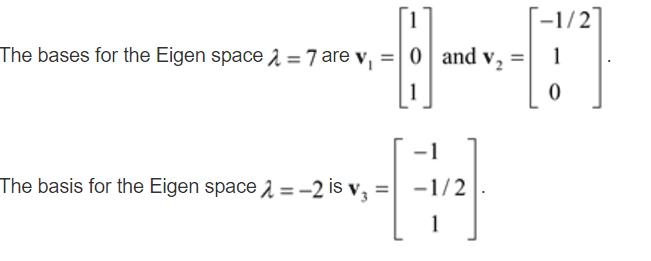
Extremely confused on finding eigenvectors

Click For Summary
To find eigenvectors, start by determining the eigenvalues, which are given as 7 and -2 for the matrix in question. The eigenvalues are found by setting the determinant of the matrix A minus cI to zero, leading to a cubic equation. Once the eigenvalues are identified, substitute each eigenvalue into the equation A - cI to find the corresponding eigenvectors, which form a basis for the nullspace. The matrix's symmetry guarantees three independent eigenvectors, even with repeated eigenvalues. Understanding determinants and solving homogeneous systems is essential in this process.
Jorge Cantu
Messages
1
Reaction score
0
Extremely confused on finding eigenvectors? Below I have a picture that gives the matrice and the eigenvectors. How did the solution find these eigenvectors??
i.e. the eigenvalues are 7 and -2
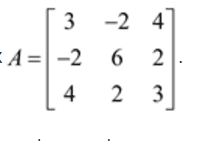
2liii68.png

2hxuk4y.png

IMAGE LINKS
http://tinypic.com/r/2liii68/9
http://tinypic.com/view.php?pic=2liii68&s=9#.VkY_YfmrSUk
 
Last edited by a moderator:
Physics news on Phys.org
an eigenvalue for a matrix A is a number c such that the matrix A-cI is singular. So to find them we set the determinant of that matrix equal to zero and solve the resulting cubic equation if we can. Then afterwards, we have the numbers c that work, and using each one in its turn we actually find the kernel vectors of the matrices A-cI. Remark: Since the matrix is symmetric about the main diagonal you are guranteed to have 3 independent eigenvectors, even if some of the eigenvalues are repeated. So you have to know how to take determinants, and then you have to know how to solve a homogeneous system.
 
Last edited by a moderator:
You can also see it in the equivalent sense that , for a matrix/operator A, an eigenvalue ##\lambda## is the set of solutions for ##\lambda ## to the equation :

## Ax= \lambda x ## (There may be no Real solutions or solutions over fields that are not algebraically closed. For Reals, this may be the case for square matrices of even dimension).

You can then expand , like Mathwonk said, the polinomyal ## Det(A- \lambda I )x =0 ## using , e.g., cofactor expansion and then find the roots , if any (when the base field is not algebraically closed.)

Once you find the eigenvalues, the eigenvectors are a basis for the nullspace of the above equation. Note that the collection of eigenvectors forms a subspace of the domain.
 
I am studying the mathematical formalism behind non-commutative geometry approach to quantum gravity. I was reading about Hopf algebras and their Drinfeld twist with a specific example of the Moyal-Weyl twist defined as F=exp(-iλ/2θ^(μν)∂_μ⊗∂_ν) where λ is a constant parametar and θ antisymmetric constant tensor. {∂_μ} is the basis of the tangent vector space over the underlying spacetime Now, from my understanding the enveloping algebra which appears in the definition of the Hopf algebra...

Similar threads

  • · Replies 2 ·
Replies
2
Views
3K
  • · Replies 7 ·
Replies
7
Views
10K
Replies
1
Views
1K
  • · Replies 13 ·
Replies
13
Views
3K
Replies
9
Views
2K
  • · Replies 7 ·
Replies
7
Views
2K
  • · Replies 7 ·
Replies
7
Views
3K
Replies
8
Views
2K
  • · Replies 4 ·
Replies
4
Views
6K
  • · Replies 18 ·
Replies
18
Views
3K