Chernobyl Fate of Chernobyl's vehicle graveyard

  • Thread starter Thread starter nikkkom
  • Start date Start date
  • Tags Tags
    Vehicle
Click For Summary
The discussion centers on the fate of vehicles in Chernobyl's vehicle graveyard, with participants debating whether they were sold for scrap metal or buried. Some believe that the disappearance of these vehicles is linked to corruption and profit motives, while others argue that they may have been removed for safety and remediation purposes. There are conflicting views on the levels of radioactivity in the area, with some participants expressing skepticism about the risks associated with handling the materials. The conversation also touches on the historical context of theft and vandalism in the region, as well as the ongoing monitoring of radiation levels. Overall, the fate of the vehicles remains uncertain, with various theories presented regarding their removal and the implications of radiation exposure.
  • #61
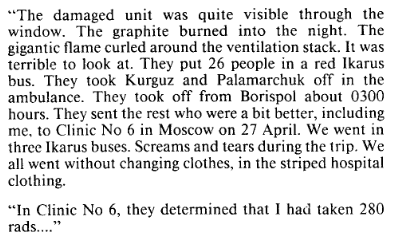
From Medvedev's book, a testimony of one of Unit-4 operators:

Untitled1.png

...
Untitled2.png
Now, some numbers.
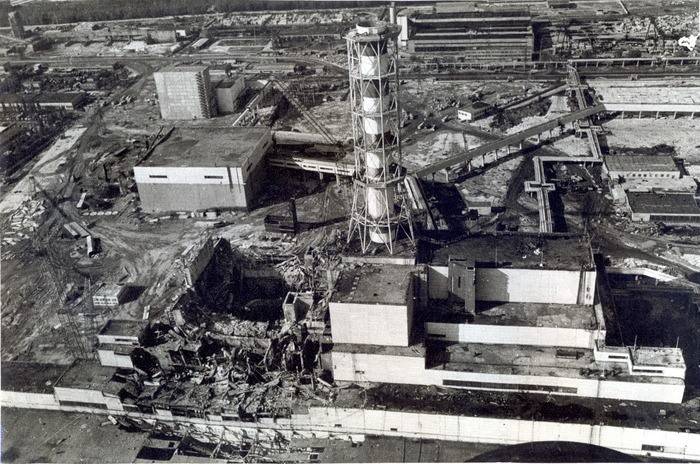
The roof of Unit-4 is 71 meters above ground level. Vent stack is additional ~80 meters:
smokestack.jpg


If "gigantic flame curled around the ventilation stack", then the flame was AT LEAST 100 meters high. The reactor and surrounding rooms have no materials which would classify as flammable (oil, wood, etc). This flame could only be generated by the burning core and graphite.
 
Engineering news on Phys.org
  • #62
In order to vaporize something you need a huge amount of energy , a nuclear bomb has this energy capacity so it vaporizes itself and stuff around it upon explosion , a nuclear reactor core doesn't have such a level of enrichment nor critical mass to achieve these conditions.

The blast at Chernobyl was huge no doubt , thick reinforced concrete walls and structures collapsed.
To me it seems most of what got out was either solid objects (fuel pellets, control rods, graphite core elements , some piping and everything else that got along the blast shockwave) then everything else was mostly smoke from the fire and dust.

Take for example the 9/11 when the twin towers fell there were large dust clouds created , also whenever a building falls even small few story ones much dust goes up, would you also say that the building vaporized itself? Or can we simply conclude that dry cement (the wtc towers had thin cement floor slabs to finish off each floors surface area) creates dust even when simply being drilled or scratched with a sandpaper not to mention total destruction upon a complete vertical collapse.All in all I doubt the core vaporized itself , it exploded yes maybe some tiny bits got vaporized but then after the explosion it lost it's critical mass and all that happened from then was a rather slow melting of the leftover steel and concrete due to a heat source creating huge temperatures.

Although I think it's hard to say the exact amounts of C14 or other releases simply because at the moment nobody really gave much attention to it as everyone was too busy trying to contain as much as they can and save what can be saved.Also I don't get why you talk so much about core vaporization , any radioactivity release is just as bad , what would it matter , the smoke too contain particles as dust etc.P.S. Since you posted while I was writing , well you are right , since i was in such a unit myself I can say there really isn't anything that can burn with such a flame , everything is either metal or reinforced concrete.
I'm not an expert I don't know whether graphite can burn so much , maybe it can if it's surrounded by a large heat source that happens to be radioactive at the same time.
The few people who saw it that night also described bright flames and sparks shooting out.

Well maybe check out the "Windscale accident" which happened in 1957 in UK. They too had a graphite core reactor, a very simple design , it's only purpose was plutonium production.They too had the core "on fire" because some fuel rods overheated and melted themselves although If I recall the core itself didin;t catch fire.Well the total power also wasn't so high but well who knows.

I don't want to dismiss the eyewitness account but remember also that eyewitness account is the most contradictionary evidence there is especially when the eyewitness himself has gone through something as severe and traumatizing both mentally and physically as a nuclear reactor explosion when you are it's operating crew.
the firefighters also said back then that they picked up the glowing graphite and fuel elements ejected and throw them to one another because they didin't know what it was but they were attracted to it because of it's strange glow, now after 30 years those who survived which are few , tell a different story , they now say they actually knew that it was half molten uranium rods they were holding in their hands.
Now which case you believe more? From my experience and knowledge I definitely can say that they knew nothing of how dangerous the things were that night nor that they handpicked live uranium for fun, because if they would have known they would have never went anywhere near that place.
So much for eyewitness accounts.
 
Last edited:
  • Like
Likes weirdoguy
  • #63
Salvador said:
In order to vaporize something you need a huge amount of energy , a nuclear bomb has this energy capacity so it vaporizes itself and stuff around it upon explosion , a nuclear reactor core doesn't have such a level of enrichment nor critical mass to achieve these conditions.

Any functioning reactor most definitely can go critical. It _does_ go critical in order to work. In order to increase its power, it even goes (very slightly) supercritical.

Chernobyl reactor went supercritical and way beyond its design power - estimated power during excursion in above 30GWt.

Now, what is a typical power density in a power reactor? My google-fu says it's up to 50kW per kilogram of fuel. Higher power is desirable, but with power densities higher than this it's difficult to remove heat fast enough to keep fuel rods from melting.

Chernobyl core briefly, for 10-20 seconds, jumped to about half a megawatt of generated power (heat) per kilogram of fuel. You sure this is not enough to melt and vaporize stuff? (Half a megawatt is about 250 electric kitchen kettles.)
 
  • #64
Salvador said:
since i was in such a unit myself I can say there really isn't anything that can burn with such a flame , everything is either metal or reinforced concrete.
I'm not an expert I don't know whether graphite can burn so much , maybe it can if it's surrounded by a large heat source that happens to be radioactive at the same time.
Graphite is carbon, basically purified coal. Wikipedia says it's difficult to ignite .

www.theenergycollective.com/charlesbarton/55702/did-graphite-chernobyl-reactor-burn
The Chernobyl release must be viewed as resulting from both very high temperatures in the core rubble, extensive mechanical disruption and dispersal of core material and the large draft “chimney effect” that followed the total disruption of that particular reactor configuration.

in other words, fuel plus oxygen plus heat = fire
The design configuration excludes the oxygen and removes the heat. Destroy that configuration and Mother Nature takes over.
 
  • Like
Likes 1oldman2
  • #65
nice sum up Jim. I have always wondered is the graphite used for early reactors and also RBMK designs the very same graphite used in pencils? Sounds a bit funny but the words are the same and seems to me the material should also.
@nikkkom are you sure your given time scale of the super output power at unit 4 is correct? 10-20 seconds is quite some time for a 30GWt output, even from a 3000MW thermal reactor design...
The reactors super critical state was very short because upon the first explosion which was steam rupturing pipes the whole reactor just fell apart and with that the whole power surge was gone.
 
  • #66
Salvador said:
The reactors super critical state was very short because upon the first explosion which was steam rupturing pipes the whole reactor just fell apart and with that the whole power surge was gone.

Flash boiling and steam rupture of the piping did not stop the excursion - rather, power could start to climb even faster. RBMK had negative void coefficient, remember? - neutrons were moderated primarily by graphite, not by water. Water was absorbing some neutrons.

When flash boiling started, pipes ruptured and disconnected above and below the reactor and steam escaped above and below, core was left in a hot, dry and still supercritical state.
 
  • #67
Salvador said:
I have always wondered is the graphite used for early reactors
One book i read about Manhattan Project's Chicago pile describes Enrico Fermi sawing up commercial graphite blocks on a Sears table saw..
https://en.wikipedia.org/wiki/Chicago_Pile-1
Fermi and Szilard met with representatives of National Carbon Company, who manufactured the graphite, and Szilard made another important discovery. By quizzing them about impurities in their graphite, he found that it contained boron, a neutron absorber. He then had graphite manufacturers produce boron-free graphite.[27] Had he not done so, they might have concluded, as the Germans did, that graphite was unsuitable for use as a neutron moderator.[28]
Sounds like a practical guy.
 
  • #68
interesting stuff thanks Jim for pointing out.
So I guess the answer to my pencil question is almost yes.I could gather a gazillion pencils and use them as a moderator.As for what you said @nikkkom , first of all RBMK had POSITIVE void coefficient , not negative.The less dense the coolant the higher the chain reaction.
Secondly from what i remember after the steam explosion the reactor lid and much of the structure just went completely bananas , it disintegrated with a very brute force so no further power excursion was possible since the fuel elements now were thrown around the reactor hall , many were even outside the building and most were thrown into a pile that formed the central lava which then melted the core leftovers and slowly sank down into the basement levels until cooled down and stayed there, and lies there till this day.

As for the fire being as high as the smoke stack , well I don't know
read the text in the lowermost part of the paper under "further information"

http://www.world-nuclear.org/inform...l-accident-appendix-1-sequence-of-events.aspx
the smoke stack together with the reactor building would be some 50 stories high in terms of typical office buildings so what your saying is that there was something there which burned with a flame as high as a average skyscraper.Maybe the eyewtiness saw the devastation and upon the lethal doses he was receiving couldn't see everything clearly , also it was night outside.
 
Last edited:
  • #69
Salvador said:
As for what you said @nikkkom , first of all RBMK had POSITIVE void coefficient , not negative.The less dense the coolant the higher the chain reaction.

Correct.

Secondly from what i remember after the steam explosion the reactor lid and much of the structure just went completely bananas, it disintegrated with a very brute force so no further power excursion was possible since the fuel elements now were thrown around the reactor hall

There is a way to know more: *read about it more*, do not simply invent a scenario which looks plausible to you.

Unit-4 explosion was investigated. Perevozchenko saw the moment when reactor power excursion started - he saw how reactor channel top assemblies (the circular ring of small squares in the reactor hall) started vibrating and "jumping" (moving vertically up and down a bit).

Then, several witnesses reported hearing SRVs triggering (it is a quite loud bang) - this indicates steam overpressure in the reactor.

Then, analysis of the ruins indicates that a large explosion happened in the reactor hall, i.e. in a large room above the reactor. From this it is inferred that top piping was torn off by rising steam pressure, and steam with steam/zircon reaction products, hydrogen and oxygen, filled the hall.

It is not known whether there were two hydrogen explosions (one in the hall and one in the reactor) or one. Witnesses' accounts on the numbers of explosions differ. (Additional complication is that most inexperienced people can classify SRV triggering sound as an "explosion").

Last, and largest explosion is assumed to be a hydrogen explosion, not steam explosion. Flash boiling is assumed to not destroy the reactor.
 
  • #70
well it is hard to tell , yes nikkkom I know how the reactor hall looks like and also I stood myself on the very cube shaped metal tops beneath which lies the various detectors and ends of the control rods, fuel assemblies etc.
One of the reasons I wanted to have an in depth visit inside an RBMK was because of Chernobyl , the other reason was pure fascination by science.

Frankly does every small detail matter here ? The general idea is that the chain reaction got out of hand which produces heat , heat increased so rapidly that some parts of the core could not withstand the heat/pressure so they broke as they did everything got even worse and more out of hand and the end is well we know the reactor disintegrated with a huge blast and also took much of it;s building with it.Surely there were many more steps by the seconds inbetween the final destruction and the tops shaking moment but I'm talking generally here , yet the question about the huge fire is still open.

I don't doubt the many facts you have presented as I know them myself and everyone can read them but I think with some information you are overreacting or speculating.
 
  • #71
petrov.png


"The flame was higher than the stack"
 
  • Like
Likes mheslep
  • #72
Baffling as to why someone would approach a reactor accident within a 100 meters unless they were emergency response.
 
  • #73
Not sure about the eyewitness from nikkkoms post but the emergency teams were just as unprotected as he was.If I'm correct all of the firefighters from that night died within weeks.And I bet their death was slow and painful.No one actually knew what the heck just had happened.maybe just the reactor crew and even they were probably in a state of shock.But from the other side the firefighters had no time to prepare anyways even if someone told them that this is a kamikaze mission.
the fire was raging and they had no time , it might have easily burnt up unit 3 which was separated by a thick wall from unit 4, imagine the fallout then if both RBMK units went up in smoke.
It's somehow a miracle that only unit 4 got obliterated , I wonder would the blast have been any stronger or the reactor lid thrown sideways instead of right up things could have went differently.
But I assume the fire and the flames must have been gigantic in size because many people came out in the night and watched towards the reactor as it burned through the night , after all the city was only 3km away so the scenery was probably worth a million action movies, sadly most of the watchers got quite lethal doses of radiation.
 
Last edited:
  • #74
Salvador said:
...
If the flame really was that high it deserves to be in the guiness world records as the highest man made flame ever or even highest natural flame ever , ...
170 M a record? Forest fires throw up flames 200M. And then there are the man made fires n chemical explosions.
http://www.tandfonline.com/doi/abs/10.1080/00049158.1984.10676001?journalCode=tfor20
http://www.bbc.com/news/world-asia-china-33924501

The two explosions, seconds apart, caused a fireball visible from space and a shockwave that damaged buildings within a 2km radius (1.5 miles). The second of the blasts was the equivalent of 21 tonnes of TNT.
 
  • #75
I guess I had a weak idea of height comparisons in my head but 170m seemed rather huge , well i haven't seen a large fire in my life so it's hard to imagine a forest fire being 60 stories above the actual forest because 200m is about a 50/60 story building, and that's pretty damn high for a flame originating from a pile of loosely packed wood.

I remember reading about the China chemical explosions , although never though about the flame height but seems they were massive.
Well thanks for pointing out.
 
  • #76
Salvador said:
I guess I had a weak idea of height comparisons in my head but 170m seemed rather huge , well i haven't seen a large fire in my life so it's hard to imagine a forest fire being 60 stories above the actual forest because 200m is about a 50/60 story building, and that's pretty damn high for a flame originating from a pile of loosely packed wood...
Tens of thousands of tons of loosely packed wood burning simultaneously, and an unlimited supply of oxygen.

Back on topic, a graphite fire would be difficult to sustain given the temperatures required, but a multi GW run away RBMK obviously was capable of doing so, and there were many tons of graphite.
 
  • #77
Probably so , a reactor having 1693 uranium fuel channels , all of which had no neutron moderation at the end except for the very graphite they were still partially sitting in must have made a heat source large enough to melt any substance known to man and burn things that normally don't burn , which is the only way to explain a flame that reaches beyond the reactor chimney given that the chimney itself is on top of the roof.
Also explains how reinforced concrete and metal together with everything else formed a lava which melted through layers of concrete to finally cool down both in itself and with the vast cooling efforts by the emergency teams.
 
  • #78
mheslep said:
Back on topic, a graphite fire would be difficult to sustain given the temperatures required, but a multi GW run away RBMK obviously was capable of doing so, and there were many tons of graphite.

Graphite is only difficult to ignite. When it's already burning, it burns about as easily as coal.

Coal is easier to light because it has some volatiles in it.
 
  • Like
Likes jim hardy
  • #79
Back on topic - fate of Chernobyl's vehicle graveyard.

Ukrainian Facebook today gave me one answer. Yuriy Kvatkovsky. He was the head of Kiev regional police department. And despite his modest public servant salary, he owns a house of more than 300 m^2, a flat, 2 hectares of land, and other real estate. His family owns seven cars.

Articles with allegations that he made money to buy all this exactly on the subject we discuss here (plundering radioactive "resources" from the Zone):

http://prokurorska-pravda.today/news/prokuroryi-peschanyih-karerov-zamglavyi-gpu-guzyir-zamenil-danilenko-na-meste-kryishi-dlya-nezakonnyih-dobyitchikov-peska--prochie-pesochnyie-zakonniki/

http://politrada.com/news/mentovski...yatkovskiy-stal-prokurorom-luganskoy-oblasti/

Photo:
zzzz13412153_1069605469781592_5440984146060204662_o.jpg
 
  • #80
For the mostly western audience reading and participating in this forums, such actions would seem criminal and wrong but for you and also me who have endured many different regimes and been part of the most ambitious plan, I'd say in history of mankind, this is no wonder.Things like these have happened in my country too , only we kind of moved forward faster than Ukraine , joined the EU etc.Not to say that EU is only paradise ofcorse not , but there have been changes in thinking in the last quarter of a century.

Actually corruption happens in pretty much all the world even developed western countries , the only difference is that in places like US and elsewhere those who want to earn some huge illegal dollars atleast go through some legal procedures and have much more backpressure for their actions , in eastern parts of the world there is a lack of this backpressure because those countries haven't gone through hundreds of years of democracy building or maybe their mentality differs.As for the scrap metal , first of all I don't think this man or any other got all his money from it , it's not that worthy if you have ever been involved with metals you would know.
Also even if they took it they had to clean it , because metal circles around and you can;t simply hide an elephant in a room.Sooner or later the radioactivity would show up along the chain of scrap metal in it;'s way to the oven and then further into fabrication.And the metal is so highly radioactive any even the crudest dosimeter would go crazy if being near those scrap.
 
  • #81
> Ukrainian Facebook today gave me one answer. Yuriy Kvatkovsky. He was the head of Kiev regional police department.

blogs.lb.ua/sergiy_bondar/338077_novi_priznachennya_starih_prokuroriv.html

Ukrainian internet brings more hilarious details about this guy. When his superior's position became vacant, he summoned his subordinates and said that he is surely to be promoted to that position, and if they want to retain theirs, they need to pay. They did. Subsequently he _was not_ promoted, but moved to a different position in a different region of the country, but refused to return the money - he denied ever receiving them.

Life of a corrupt official is hard and unpredictable :D :D :D
 
  • #82
nikkkom said:
Graphite is only difficult to ignite. When it's already burning, it burns about as easily as coal.
Just a side note: (clean) graphite/coal burns with just a really small flame, especially if there is enough O2 around (just check about blacksmith forges ). That high plume ('flame') might have been more about overheated dust and debris than (by definition) real flame.

Forest fire is different: there is always a shortage of O2, there is always more dust and it's never clean coal/graphite but more a mixture of flammable gases.
 
  • #83
Fresh investigation into mass woodcutting operations

 
  • #85
Also beyond many public beliefs , one must understand that all before Ukraine became a country for the first time after the breakup of the USSR , the 4 years after the Chernobyl accident were still under soviet authority and the soviets did quite a big job in terms of fighting the consequences.

I recently found one old video were the army destroyed most of the vehicles used in cleanup and all the buses and transport used to empty the city of people etc.
so most of the so called Chernobyl graveyard of transport was already dealt with back in the days of the USSR.

 
  • #86
Salvador said:
so most of the so called Chernobyl graveyard of transport was already dealt with back in the days of the USSR.

Not true. The graveyard existed as of 2012. Vehicles disappeared sometime in 2012-2013.
 
  • #87
it was the graveyard of only those vehicles that were used on the very reactor , building the containment etc, all the other vehicles like ambulances personal cars and buses used to evacuate the city were demolished and buried.
 
  • #88
Salvador said:
... the soviets did quite a big job in terms of fighting the consequences.
Yes, and the Soviets did quite a big job of creating the disaster.
 
  • #89
mheslep said:
Yes, and the Soviets did quite a big job of creating the disaster.
What i remember most vividly is evening TV news in initial days
Soviets denied anything wrong
One of the Scandinavian countries said in effect "That's hogwash, we have fresh fission fragments falling from the sky so don't tell us there's nothing wrong."
 
  • #90
Yes, I recall similarly. I think the bizarre, Alice-down-the-rabbit-hole denial around Chernobyl was the trigger that started the avalanche, the collapse of the Soviets. I don't mean the accident itself per se, but rather the double speak culture involved in the intentional design of a positive feedback reactor, the operation, and the subsequent denial.
 

Similar threads

  • · Replies 4 ·
Replies
4
Views
3K
  • · Replies 19 ·
Replies
19
Views
3K
  • · Replies 20 ·
Replies
20
Views
3K
  • · Replies 11 ·
Replies
11
Views
4K
  • · Replies 9 ·
Replies
9
Views
6K
Replies
1
Views
2K
  • · Replies 66 ·
3
Replies
66
Views
21K
Replies
17
Views
3K
  • · Replies 23 ·
Replies
23
Views
5K
  • · Replies 6 ·
Replies
6
Views
5K