Faulty DeWalt Battery charger for power tools

Click For Summary
SUMMARY

The forum discussion centers around issues with faulty DeWalt battery chargers, specifically models that exhibit a fault warning or fail to charge batteries. Users suggest troubleshooting steps, including checking the output voltage with a multimeter and inspecting for moisture-related corrosion inside the charger. The conversation highlights the importance of proper storage to prevent water exposure and discusses the potential for customer service assistance from DeWalt. Ultimately, users recommend testing chargers with known good batteries to isolate the problem.

PREREQUISITES
  • Understanding of DeWalt battery charger models and their functions
  • Basic knowledge of multimeter usage for voltage testing
  • Familiarity with electrical components and potential corrosion issues
  • Experience with troubleshooting power tools and battery systems
NEXT STEPS
  • Research how to use a multimeter to test battery charger output voltage
  • Learn about common moisture-related issues in electrical devices
  • Explore DeWalt customer service options for warranty and repair inquiries
  • Investigate the differences between NiCd and Li-ion batteries for power tools
USEFUL FOR

This discussion is beneficial for DIY enthusiasts, power tool users, and technicians troubleshooting DeWalt battery chargers and seeking to understand maintenance and repair options.

DaveC426913
Gold Member
2025 Award
Messages
24,258
Reaction score
8,385
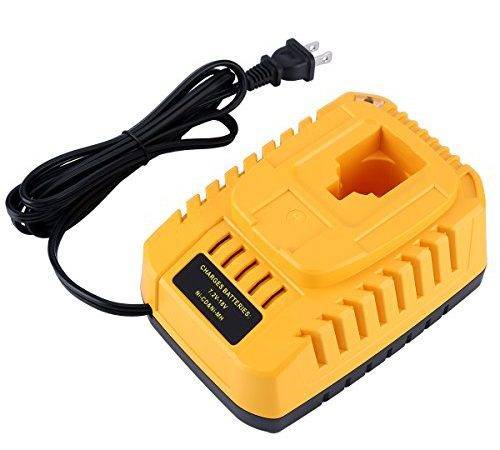
I've replaced the charger for my DeWalt tools several times, and now I may have to go out and get a fourth one.

One of them flashes a fault warning (steady slow flash), the other two do not light up at all.

Now, I do not take care of my tools. All three of these chargers may have been exposed to a light spray from rain getting into the slot where the terminals are (the chargers are protected, but wind carries mist). The terminals are not rusted; they look shiny.

The charging slot has a "drain" hole in the bottom, and the terminals are raised above the bottom, almost as if it's designed to prevent water from getting at the terminals.

I'm using the battery, so it's not entirely dead.

I find it hard to believe that a relatively simple device (it's just a transformer) could fail so easily.

Can anyone suggest some checks I might do to see if anyone of these chargers can be resuscitated?
51GGuiW4JYL-500x450.jpg
 
Physics news on Phys.org
One question Dave, have you tried the "charged" batteries with more than one tool? I assume you have but had to ask.
 
I only have the one tool. I've been using my drill for the last week on the same charge, but it finally ran down (not all the way).
I've tried charging it with all three chargers and I get a little action out of it, but it's not actually charging.

So I don't think the drill is the problem. It is behaving fine.
 
I'll bet one of your neighbors has a Dewalt charger. See if they can charge one of your batteries.
 
  • Like
Likes   Reactions: berkeman
anorlunda said:
I'll bet one of your neighbors has a Dewalt charger. See if they can charge one of your batteries.
Ugh. The thought of asking my crazy neighbor for anything...

But seriously, I'm pretty certain the batteries are fine. I've been using them for a year with no trouble - until the charger gets a little misty.
 
DaveC426913 said:
Now, I do not take care of my tools. All three of these chargers may have been exposed to a light spray from rain getting into the slot where the terminals are (the chargers are protected, but wind carries mist). The terminals are not rusted; they look shiny.
If moisture was able to get into where the terminals are, maybe it could also get into the guts of the charger, and corrode some of the connections or components inside. It might be useful to connect a voltmeter to the thing and see what voltage it's putting out. If the charger isn't working correctly, I would see what things look like inside.
Also, I wouldn't leave it anywhere it could get wet.
 
Mark makes a good point. Can you take it apart and check for moisture-related corrosion/damage or it it one of those things where the instruction manual says something like "this excellent device can only be broken into by a qualified special person with a three-pronged framis, which if you have one do not use it or the device will probably explode and kill your entire family, including the goats" ?
 
DaveC426913 said:
I'm using the battery, so it's not entirely dead.
DaveC426913 said:
But seriously, I'm pretty certain the batteries are fine.
Singular or plural? Both of my batteries slowly died over the years, so I bought new ones from Amazon recently and all is good now. My battery charger has never been left out in the rain, though...

Maybe borrow a compatible battery from your crazy neighbor to see if it works more normally in your charger(s)?
 
  • Like
Likes   Reactions: Wrichik Basu
Mark44 said:
If moisture was able to get into where the terminals are, maybe it could also get into the guts of the charger, and corrode some of the connections or components inside. It might be useful to connect a voltmeter to the thing and see what voltage it's putting out. If the charger isn't working correctly, I would see what things look like inside.
I will have to. But I swear it's not that bad.

Mark44 said:
Also, I wouldn't leave it anywhere it could get wet.
That's crazy talk.

berkeman said:
Singular or plural? Both of my batteries slowly died over the years, so I bought new ones from Amazon recently and all is good now. My battery charger has never been left out in the rain, though...

Maybe borrow a compatible battery from your crazy neighbor to see if it works more normally in your charger(s)?
I already have some newer(ish) batteries. That's what I've been using. But I'll try that to rule out one factor.So the gist that I'm getting is that there isn't some 'I got wet!' fuse in these things.
 
  • #10
DaveC426913 said:
So the gist that I'm getting is that there isn't some 'I got wet!' fuse in these things.
Well, no. They weren't designed to work underwater...
 
  • #11
DaveC426913 said:
Can anyone suggest some checks I might do to see if anyone of these chargers can be resuscitated?
The best is to check whether the output terminals are giving the proper voltage, with a multimeter or voltmeter.

If you get no reading (0 V), then a fuse has perhaps tripped. Otherwise you have to check each and every component to see if they are working.
 
  • #12
Aww, come on. Google finds over 400 000 'dewalt charger schematic' (they make a LOT of different ones!) 'dewalt charger service manual' finds 1 970 000 hits.

The label in your photo shows that one is good for a wide range of different batteries; which probably means it has a rather smart IC in it that also senses what battery is inserted.

That said, first step is substitute the charger, then substitute the battery. (cuts the search universe in half. 😁)
 
  • Like
Likes   Reactions: krater
  • #13
Wrichik Basu said:
The best is to check whether the output terminals are giving the proper voltage, with a multimeter or voltmeter.

If you get no reading (0 V), then a fuse has perhaps tripped. Otherwise you have to check each and every component to see if they are working.
I'm not all that familiar with charger circuits, but I don't know if a no-load voltage check will work. It may be that the charger needs to sense a battery before it applies a charging voltage. I think that my 12V lead-acid battery charger (small one for motorcycles) behaves like that.
 
  • #14
DeWalt is a quality product. Have you considered their customer service. You could recite you sorry history with multiple chargers. You might get tips from them, or you might get a free charger.
 
  • #15
He might want to leave out the "underwater" part though... 😉
 
  • Like
  • Haha
Likes   Reactions: DaveC426913 and anorlunda
  • #16
berkeman said:
I'm not all that familiar with charger circuits, but I don't know if a no-load voltage check will work. It may be that the charger needs to sense a battery before it applies a charging voltage. I think that my 12V lead-acid battery charger (small one for motorcycles) behaves like that.
what he said (very small).jpg
 
  • Like
Likes   Reactions: berkeman
  • #17
berkeman said:
I'm not all that familiar with charger circuits, but I don't know if a no-load voltage check will work. It may be that the charger needs to sense a battery before it applies a charging voltage. I think that my 12V lead-acid battery charger (small one for motorcycles) behaves like that.
Many chargers behave like that. Trickle chargers for vehicle batteries are examples, as you have said.

But I don't think it would be difficult to connect the battery to the charger via two words wires, such that the charger terminals are still accessible by the probes. Once the charger senses the battery, the multimeter can be used.

If the battery is in good condition, but the charger cannot sense it, then there can be a chance that the sensing circuit is faulty.

Edit: fixed typo.
 
  • #18
Wrichik Basu said:
But I don't think it would be difficult to connect the battery to the charger via two words ...
So, would these be cuss-words or what? :smile:
 
  • Haha
Likes   Reactions: DaveC426913
  • #19
phinds said:
So, would these be cuss-words or what? :smile:
Typo, wires.
 
  • #20
NiCd? Maybe time to jump on the Li-ion band wagon. NiCd and NiMH base power tools never really lived up to the "power" part, always found them lacking and very short lived in terms of charge so never bother with cordless. Then I tried a friends Milwaukee M18Fuel tools, was quite impressed and been replacing all my corded tools with Dewalt XR brushless, nothing wrong with the red, I'm just a little OCD in that respect, so already having some black and yellow, couldn't go change color scheme now!

Difference between NiCd tools of yesterday and the Li-ion+brushless is night and day, the brushless recip I have gives my corded one a solid run for its money.
 
  • #21
berkeman said:
I'm not all that familiar with charger circuits, but I don't know if a no-load voltage check will work. It may be that the charger needs to sense a battery before it applies a charging voltage. I think that my 12V lead-acid battery charger (small one for motorcycles) behaves like that.
They do work like that. I watched a DIY video of a DeWalt charger not charging an extremely dead battery and it did exactly that. His trick was to give the dead battery a goose from another battery. Just enough so the charger could sense it.

anorlunda said:
DeWalt is a quality product. Have you considered their customer service. You could recite you sorry history with multiple chargers. You might get tips from them, or you might get a free charger.
Alas, that would be pretty dishonest. There isn't really a slippery slope here, where I could blame it on something else and simply neglect to mention the water exposure. I'd have to outright lie.
 
  • Like
Likes   Reactions: berkeman
  • #22
You don't have to lie to ask questions. They should have better answers than PF.
 
  • #23
anorlunda said:
You don't have to lie to ask questions. They should have better answers than PF.
Sure, but the first question they're going to ask is: Are you storing them properly and keeping them dry?
And I'll have to say "Well..."
And then they'll say "Great. Anything else we can help you with today?"

That's what I mean by no slippery slope. There's really nothing to ask that doesn't immediately provoke the obvious question.
 
  • #24
DaveC426913 said:
Sure, but the first question they're going to ask is: Are you storing them properly and keeping them dry?
And I'll have to say "Well..."
And then they'll say "Great. Anything else we can help you with today?"

That's what I mean by no slippery slope. There's really nothing to ask that doesn't immediately provoke the obvious question.
Yeah, but that doesn't mean they won't have an answer (possibly preceded by, "Well, you're not supposed to DO that").
 
  • #25
DaveC426913 said:
Alas, that would be pretty dishonest. There isn't really a slippery slope here, where I could blame it on something else and simply neglect to mention the water exposure. I'd have to outright lie.
You don't have to lie. You can tell them, "Yes, it got wet. But can you tell me how I can repair it now?"

If you open the charger, a close look will tell you if the water has had bad effects - corrosion. If you can confirm that none of the components/soldering is corroded, you can surely ask the customer service how you can repair it.
 
  • #26
Wrichik Basu said:
You don't have to lie. You can tell them, "Yes, it got wet. But can you tell me how I can repair it now?"

If you open the charger, a close look will tell you if the water has had bad effects - corrosion. If you can confirm that none of the components/soldering is corroded, you can surely ask the customer service how you can repair it.
Not that I want to beat this to death, but I know how this must go:

"There are no user serviceable parts inside. We strongly recommend that you do not open the case, as fire, serious injury or death may occur."

They can't say anything else. If they were to offer even the slightest suggestion of how one might fix something inside a closed electrical device, they would be opening themselves up to legal liability.
 
  • Like
Likes   Reactions: krater, NTL2009, berkeman and 1 other person
  • #27
Wrichik Basu said:
If you can confirm that none of the components/soldering is corroded, you can surely ask the customer service how you can repair it.
That's not usually how Customer Service for appliances works, at least not in my experience. Usually you are asked to take it to an Authorized Repair Center (where they will tell you that it would just be cheaper to buy a new one in this case).

I used to service a lot of friends' TVs for free using SAM'S Photofacts schematics/repair manuals. It was great practice and experience, and it saved my friends a fair bit of money. Unfortunately, TV manufacturers and other appliance makers generally do not publish schematics and repair manuals any longer for the general public. It works better for them to only make those available to their "Authorized Service Centers"...
 
  • #28
Epilogue:

I wimped out. I happened to be at the store, so I just bought a new one.

I will be handing in my Man Card by end-of-day.

The sad news is: looking at how the new one is behaving is making me suspect that one of the originals was/is actually working fine. So now I have two.
 
  • #29
DaveC426913 said:
so I just bought a new one.
Makita sells chargers with every tool; try keeping them sorted one from another (voltage-wise) just with the screwdrivers/drills. In principle they're all "keyed" differently to avoid battery explosions and fires, but ...
 
  • #30
Bystander said:
Makita sells chargers with every tool; try keeping them sorted one from another (voltage-wise) just with the screwdrivers/drills. In principle they're all "keyed" differently to avoid battery explosions and fires, but ...
Sorry, I don't understand. All my chargers are 18V and DeWalt.

(Which won't last long since DeWalt is now pushing their 20V system.)
 

Similar threads

  • · Replies 10 ·
Replies
10
Views
2K
  • · Replies 5 ·
Replies
5
Views
2K
  • · Replies 12 ·
Replies
12
Views
6K
  • · Replies 3 ·
Replies
3
Views
3K
  • · Replies 39 ·
2
Replies
39
Views
15K
Replies
8
Views
9K
  • · Replies 21 ·
Replies
21
Views
7K
  • · Replies 3 ·
Replies
3
Views
2K
  • · Replies 5 ·
Replies
5
Views
5K
  • · Replies 1 ·
Replies
1
Views
2K