Drawing a Wheel Under Acceleration - RWD Car

Click For Summary
SUMMARY

This discussion focuses on the forces acting on a rear-wheel drive (RWD) car's wheel during acceleration. The friction force from the road acts to the right, while the reaction force from the car acts to the left, both equal in magnitude. The torque applied to the wheel is influenced by the angular acceleration and the wheel's angular inertia, with a non-zero inertia resulting in a net torque that accelerates the car. The conversation emphasizes the importance of accurately representing forces in a free body diagram, specifically excluding forces generated by the wheel itself.

PREREQUISITES
  • Understanding of Newton's laws of motion
  • Familiarity with torque and angular acceleration concepts
  • Knowledge of free body diagrams in physics
  • Basic principles of vehicle dynamics
NEXT STEPS
  • Study the principles of torque and angular inertia in detail
  • Learn about free body diagram construction and analysis
  • Explore the effects of rolling resistance and aerodynamic drag on vehicle performance
  • Investigate the dynamics of rear-wheel drive systems in automotive engineering
USEFUL FOR

Automotive engineers, physics students, and anyone interested in understanding the dynamics of vehicle acceleration and the forces acting on wheels.
PhysicsN_b
Messages
6
Reaction score
0
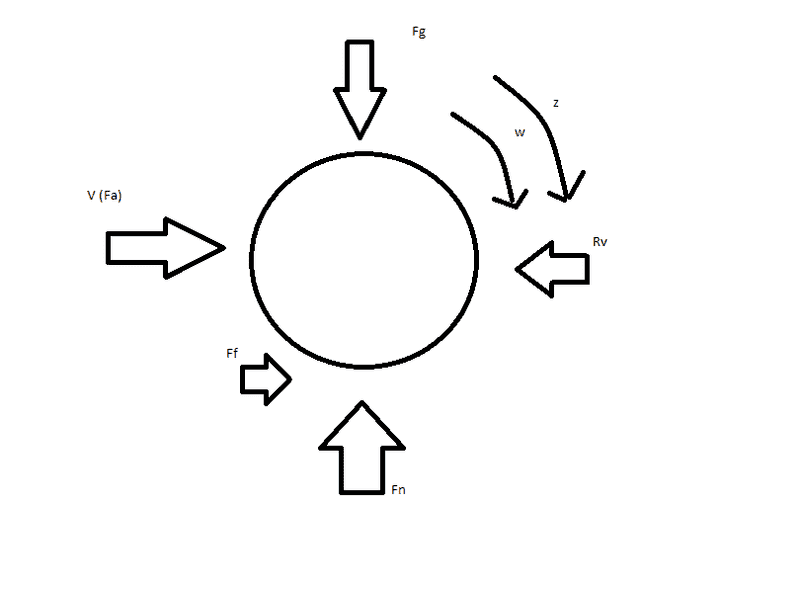
I drew up a quick picture in paint of a wheel under acceleration. This is the driving wheel of a RWD car. Am I missing any forces/drawn in the wrong direction?

FBDWheel.png


Thanks.
 
Physics news on Phys.org
Assuming all the forces are supposed to be external forces applied to the wheel, then friction force from the road to the tire would be to the right, and the reaction force of the car to acceleration, F = m a, would be to the left and same magnitude as friction force. You also have a clockwise torque force on the wheel from the rear axle (negative sign if using conventional angular math), almost all opposed by the counter clockwise torque related road force and car reaction force. The net torque on the wheel would correspond to the rate of angular acceleration of the wheel divided by it's angular inertia. If you assume that angular inertia of the wheel is zero, then net torque is zero.
 
Last edited:
Updated.

FBDWheel-2.png


Assume Rv to be the reaction force of the car on the wheel, and I labeled the angular acceleration z since I cannot due Greek letters in paint. This is correct now right?
 
There is no force V(Fa) acting on the wheel. Fg and Fn should have equal magnitude. Ff and Rv should have equal magnitude. Apparently you're not concerned about torques on the wheel.
 
I don't understand how I am not concerned with the torque applied on the wheel. If there is angular acceleration on the wheel, there has to be a torque applied. Also, the wheel has to be applying a forward force V(Fa) for the car to accelerate in speed correct, so at the axle there would be a forward force applied? I don't understand what I am missing.
 
PhysicsN_b said:
I don't understand how I am not concerned with the torque applied on the wheel. If there is angular acceleration on the wheel, there has to be a torque applied.
If your model uses a non-zero value for angular inertia of the wheel then there's a small net torque on the wheel, most of the torque ends up accelerating the car. If your model uses a zero value for angular inertia of the wheel, then there is no torque due to angular acceleration of a massless wheel, and all of the torque ends up accelerating the car.

PhysicsN_b said:
Also, the wheel has to be applying a forward force V(Fa) for the car to accelerate in speed correct, so at the axle there would be a forward force applied?
A free body diagram is supposed to show only the forces acting on the wheel, and not the forces generated by the wheel.
 
Okay. So the only thing I need to get rid of is V(Fa) and 'say' that z is non zero and it should be perfect to be an example of a driving/accelerating wheel?
 
PhysicsN_b said:
Okay. So the only thing I need to get rid of is V(Fa) and 'say' that z is non zero and it should be perfect to be an example of a driving/accelerating wheel?
Close enough. In the real world, there would be rolling resistance, aerodynamic drag, energy losses in the drive train, but for a typical physics problem, it's good enough.
 

Similar threads

  • · Replies 15 ·
Replies
15
Views
5K
  • · Replies 12 ·
Replies
12
Views
2K
  • · Replies 10 ·
Replies
10
Views
2K
  • · Replies 6 ·
Replies
6
Views
2K
  • · Replies 21 ·
Replies
21
Views
3K
  • · Replies 95 ·
4
Replies
95
Views
7K
  • · Replies 15 ·
Replies
15
Views
3K
  • · Replies 20 ·
Replies
20
Views
2K
  • · Replies 29 ·
Replies
29
Views
8K
  • · Replies 1 ·
Replies
1
Views
2K