Field Extensions - Lovett, Theorem 7.1.10 .... ....

  • Context: Undergrad 
  • Thread starter Thread starter Math Amateur
  • Start date Start date
  • Tags Tags
    Field Theorem
Click For Summary
SUMMARY

The discussion centers on the proof of Theorem 7.1.10 from "Abstract Algebra: Structures and Applications" by Stephen Lovett, specifically regarding the irreducibility of a polynomial \( p(x) \) in the context of field extensions. Participants clarify that while \( p(\alpha) = 0 \) implies \( p(x) \) has a linear factor \( x - \alpha \), this factorization occurs in the extended field \( F[\alpha][x] \) rather than in \( F[x] \). Thus, \( p(x) \) is irreducible in \( F[x] \) but reducible in \( F[\alpha][x] \), highlighting the importance of the underlying field in determining polynomial properties.

PREREQUISITES
  • Understanding of polynomial irreducibility in field theory
  • Familiarity with field extensions and their properties
  • Knowledge of polynomial division and its implications
  • Concept of minimal polynomials and their significance
NEXT STEPS
  • Study the concept of minimal polynomials in field extensions
  • Learn about polynomial division in the context of field theory
  • Examine the differences between irreducibility in \( F[x] \) and \( F[\alpha][x] \)
  • Explore examples of field extensions and their impact on polynomial properties
USEFUL FOR

Students of abstract algebra, mathematicians focusing on field theory, and anyone interested in the properties of polynomials in different field contexts.

Math Amateur
Gold Member
MHB
Messages
3,920
Reaction score
48
I am reading Abstract Algebra: Structures and Applications" by Stephen Lovett ...

I am currently focused on Chapter 7: Field Extensions ... ...

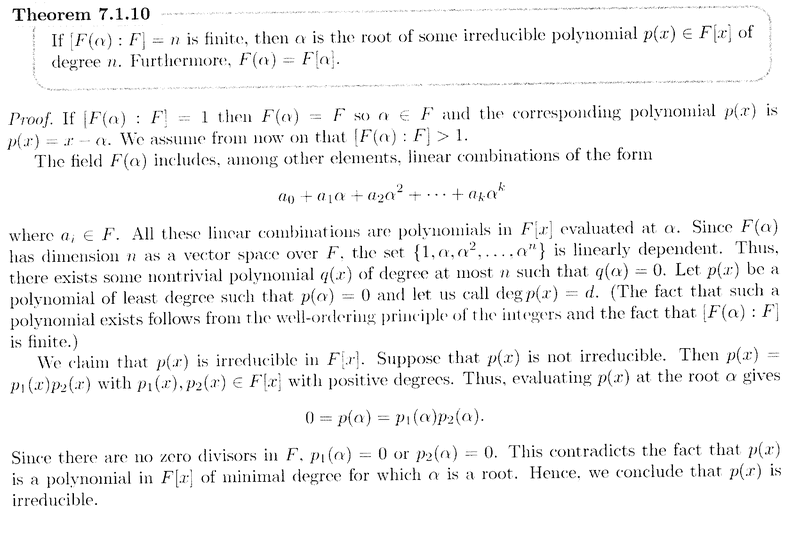
I need help with an aspect of the proof of Theorem 7.1.10 ...Theorem 7.1.10, and the start of its proof, reads as follows:
?temp_hash=341bba6a4651b35fcf7109b6afe7529c.png


In the above text from Lovett we read the following ...

" ... ... Let ##p(x)## be a polynomial of least degree such that ##p( \alpha ) = 0## ... ... "

Then Lovett goes on to prove that ##p(x)## is irreducible in ##F[x]## ... ...

... BUT ... I am confused by this since it is my understanding that if ##p( \alpha ) = 0## then ##p(x)## has a linear factor ##x - \alpha## in ##F[x]## and so is not irreducible ... ... ?Can someone please help clarify this issue ... ...

Peter
 

Attachments

  • Lovett - Theorem 7.1.10 and start of proof .....png
    Lovett - Theorem 7.1.10 and start of proof .....png
    47.6 KB · Views: 589
Physics news on Phys.org
You can use polynomial division here. One can always write ##p(x) = q(x) \cdot (x-\alpha) + s(x)## with ##\deg s(x) < \deg p(x)##.
Can you conclude the rest from here?
 
  • Like
Likes   Reactions: Math Amateur
fresh_42 said:
You can use polynomial division here. One can always write ##p(x) = q(x) \cdot (x-\alpha) + s(x)## with ##\deg s(x) < \deg p(x)##.
Can you conclude the rest from here?
If ##p(x) = q(x) \cdot (x-\alpha) + s(x)## and ##p( \alpha ) = 0## then we must have ##s( \alpha) = 0##

Given this ... I do not know how to square this with D&F Proposition 9, Section 9.4, page 307 which seems to imply that if ##p ( \alpha ) = 0## for ##\alpha \in F## then ##p(x)## has a linear factor ... and is therefore not irreducible ...

Peter
 
Math Amateur said:
If ##p(x) = q(x) \cdot (x-\alpha) + s(x)## and ##p( \alpha ) = 0## then we must have ##s( \alpha) = 0##

Given this ... I do not know how to square this with D&F Proposition 9, Section 9.4, page 307 which seems to imply that if ##p ( \alpha ) = 0## for ##\alpha \in F## then ##p(x)## has a linear factor ... and is therefore not irreducible ...

Peter
##p(x)## has been chosen to be a (non-zero) polynomial of minimal degree with ##p(\alpha)=0##. But now ##s(\alpha)=0## and ##\deg s(x) < \deg p(x)## which can only hold, if ##s(x) = 0##. Going back to the equation we have ##p(x) = q(x) \cdot (x-\alpha)## or ##(x-\alpha) \mid p(x)##.
 
  • Like
Likes   Reactions: Math Amateur
fresh_42 said:
##p(x)## has been chosen to be a (non-zero) polynomial of minimal degree with ##p(\alpha)=0##. But now ##s(\alpha)=0## and ##\deg s(x) < \deg p(x)## which can only hold, if ##s(x) = 0##. Going back to the equation we have ##p(x) = q(x) \cdot (x-\alpha)## or ##(x-\alpha) \mid p(x)##.
Well ... we seem to have shown that ##p(x)## is reducible as a consequence of ##p( \alpha ) = 0## ...

Exactly my problem with this ... :frown:

... hmmm ... how are we going to end up with ##p(x)## being irreducible when it has a linear factor ... ?

Sorry to be slow about this ...

Peter
 
The equation ##p(x)= q(x)\cdot (x-\alpha) + s(x)## doesn't exist in ##F[x]##, because ##\alpha \notin F##. It only exists in ##F[\alpha][x]##.
Lovett shows that ##p(x)\in F[x]## is irreducible, because ##\alpha## isn't available in ##F##. However, it is reducible in ##F[\alpha][x]\;\;\;\;## so the argument with the linear factor (which we have shown is true) only holds over ##F[\alpha]##. Irreducibility depends on the ring under consideration, or likewise on the coefficients which are available in the corresponding domain of scalars.

##p(x) \in F[x]## irreducible (Lovett's proof)
##p(x) \in F[\alpha][x]## reducible, by your argument with the linear factor ##x-\alpha##

Sorry for the confusion, which I think I might have caused, by proving your assertion with the linear factor, instead of recognizing, that there are two different rings involved here: ##F[\alpha][x]## and ##F[x]##, which makes the difference.
 
  • Like
Likes   Reactions: Math Amateur
fresh_42 said:
The equation ##p(x)= q(x)\cdot (x-\alpha) + s(x)## doesn't exist in ##F[x]##, because ##\alpha \notin F##. It only exists in ##F[\alpha][x]##.
Lovett shows that ##p(x)\in F[x]## is irreducible, because ##\alpha## isn't available in ##F##. However, it is reducible in ##F[\alpha][x]\;\;\;\;## so the argument with the linear factor (which we have shown is true) only holds over ##F[\alpha]##. Irreducibility depends on the ring under consideration, or likewise on the coefficients which are available in the corresponding domain of scalars.

##p(x) \in F[x]## irreducible (Lovett's proof)
##p(x) \in F[\alpha][x]## reducible, by your argument with the linear factor ##x-\alpha##

Sorry for the confusion, which I think I might have caused, by proving your assertion with the linear factor, instead of recognizing, that there are two different rings involved here: ##F[\alpha][x]## and ##F[x]##, which makes the difference.
Thanks so much for the help in clarifying things ... really has been most helpful ...

Peter
 

Similar threads

  • · Replies 2 ·
Replies
2
Views
2K
  • · Replies 6 ·
Replies
6
Views
1K
  • · Replies 18 ·
Replies
18
Views
3K
  • · Replies 1 ·
Replies
1
Views
2K
  • · Replies 4 ·
Replies
4
Views
2K
  • · Replies 12 ·
Replies
12
Views
3K
  • · Replies 15 ·
Replies
15
Views
2K
  • · Replies 2 ·
Replies
2
Views
2K
  • · Replies 2 ·
Replies
2
Views
2K
  • · Replies 5 ·
Replies
5
Views
2K