Find all resistor values in the Wheatstone bridge

Click For Summary
SUMMARY

The discussion centers on designing a thermometer using a Wheatstone bridge, specifically determining resistor values when only the middle resistor and voltage are known. The user, Syle1, is working with an NTC thermistor (Rx) with a temperature range of 0 to 50 °C and a standard 9V battery. The solution involves calculating appropriate resistor values to ensure the circuit operates efficiently without excessive current draw, particularly considering the low resistance of the thermistor at higher temperatures. The key takeaway is to establish a reasonable total current draw to determine suitable resistor values for the Wheatstone bridge configuration.

PREREQUISITES
  • Understanding of Wheatstone bridge circuits
  • Knowledge of NTC thermistors and their resistance-temperature characteristics
  • Familiarity with Kirchhoff's laws and Ohm's law
  • Basic circuit design principles, including current draw calculations
NEXT STEPS
  • Research how to calculate resistor values for a Wheatstone bridge with known voltage and one resistor
  • Learn about NTC thermistor characteristics and their application in temperature sensing
  • Investigate methods for optimizing current draw in battery-operated circuits
  • Explore practical examples of Wheatstone bridge applications in sensor design
USEFUL FOR

Electronics enthusiasts, physics students, and engineers involved in sensor design and circuit optimization, particularly those working with temperature measurement systems.

Syle1
Messages
2
Reaction score
0
Hi, I've got a small physics problem : build an thermometer using the Wheatstone bridge, only knowing the voltage and the middle resistor of the bridge.
I need help for the resistors values ; I've finished the rest, which is the relation between temperature and the resistors and the voltage.

I don't know how the find proper resistor values.

1. Homework Statement


Drew this : https://imgur.com/a/ESBuG
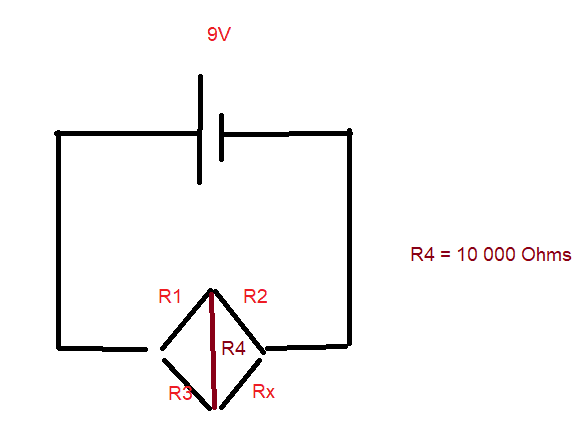
TdvaPPY.png


Homework Equations


Kirchhoff equations, Ohms law. Don't think more is needed?

The Attempt at a Solution


[/B]
Solved my initial problem (thermometer) by arbitrarily choosing R1 R2 R3 = 100 ohms, but it just seems so silly. I need to prove one way or another resistors values, or prove that I can arbitrarily choose them. (and which resistor range?)

Saw videos about solving the bridge knowing all the resistors, which I can do, but here we don't have them. So I have no idea ahah.Thanks a lot if you can help me through this, I'll owe you one !

Syle
 

Attachments

  • TdvaPPY.png
    TdvaPPY.png
    2.9 KB · Views: 1,397
Physics news on Phys.org
Hi Syle1,

Welcome to Physics Forums!

You should think of any other design data or goals that might be pertinent. For example, presuming that Rx represents the temperature sensing device (thermistor?), do you know the range of resistance values it can take on over the desired temperature range? What would be a good potential difference to have across that part when its at the middle of its range?

How about total current draw for the circuit; is it battery operated? Larger resistor values will lower the total current draw...
 
gneill said:
Hi Syle1,

Welcome to Physics Forums!

You should think of any other design data or goals that might be pertinent. For example, presuming that Rx represents the temperature sensing device (thermistor?), do you know the range of resistance values it can take on over the desired temperature range? What would be a good potential difference to have across that part when its at the middle of its range?

How about total current draw for the circuit; is it battery operated? Larger resistor values will lower the total current draw...
You understood perfectly my problem!

I think I started the wrong way ; instead of starting from the resistors values and then the relation between temperature and resistors, maybe I should start from the relation.

Lets get started, following your tracks.

1) Temperature range is fpr my greenhouse, so ideally the NTC thermistor Rx would be [ 0 ; 50 ] °C. (and that's a really big range)
Heres a simple resistance vs temperature table found on google, for NTC thermistors of course : http://www.weissinstruments.com/sg_userfiles/NTC_Chart.pdf

2) No clue how to find the potential difference showed on the voltmeter in the middle of the bridge when Rx is at 10k Ohms. (middle of my range, found on link)

3) As English isn't my main language, when you mean total current draw, do you mean V or I ? If its V, then yes it is battery operated. Standard 9V 1.2 Ah battery. If its I, no idea as we don't have equivalent resistance

Feel like going somewhere, thanks a lot !
 
Syle1 said:
You understood perfectly my problem!

I think I started the wrong way ; instead of starting from the resistors values and then the relation between temperature and resistors, maybe I should start from the relation.

Lets get started, following your tracks.

1) Temperature range is fpr my greenhouse, so ideally the NTC thermistor Rx would be [ 0 ; 50 ] °C. (and that's a really big range)
Heres a simple resistance vs temperature table found on google, for NTC thermistors of course : http://www.weissinstruments.com/sg_userfiles/NTC_Chart.pdf
Okay...
2) No clue how to find the potential difference showed on the voltmeter in the middle of the bridge when Rx is at 10k Ohms. (middle of my range, found on link)

3) As English isn't my main language, when you mean total current draw, do you mean V or I ? If its V, then yes it is battery operated. Standard 9V 1.2 Ah battery. If its I, no idea as we don't have equivalent resistance
I meant the current, ##I##, that the 9 V battery needs to supply to power the circuit.

Looks like the middle of the desired temperature range (25 C) would have Rx at about 10 Ohms. That's a pretty small value for one leg of a bridge if your aim was to have the associated bridge node be at half the supply voltage at that value for Rx (you would need to choose R3 to be 10 Ohms also, and then that side of the bridge would only present 20 Ohms to the battery as a load, which would draw a lot of current, about 450 mA, and would mean a pretty short battery life for your 1.2 Ah battery).

Perhaps a better strategy would be to start with a reasonable total current draw based on how long you think the circuit should be able to operate on one 1.2 Ah battery. That will set the magnitude of the total resistance that each side of the bridge should have. Your lowest sensor resistance will be about 4 Ohms at 50 C, so R3 plus 4 Ohms should have the desired total resistance for a side (or, if you happen to know the operating temperature that the unit will be subjected to for the most time, use the Rx value associated with that value for your figuring). The resistors that make up the other side of the bridge can generally be chosen to be larger in sum so as to draw less current: their function, essentially, is to set a reference voltage against which the "bridge" measures the junction of the side with the sensor.

It'll then be up to the mysterious "10 k" bridge element to detect and present the resulting voltage range suitably.

Anyways, see what you can come up with regarding a "reasonable" total current for the circuit, then see what value R2 would have to have so that that side of the bridge (R2 + Rx) draws half or less than that value.
 

Similar threads

  • · Replies 7 ·
Replies
7
Views
2K
  • · Replies 1 ·
Replies
1
Views
2K
  • · Replies 8 ·
Replies
8
Views
4K
  • · Replies 30 ·
2
Replies
30
Views
3K
  • · Replies 2 ·
Replies
2
Views
2K
  • · Replies 2 ·
Replies
2
Views
6K
  • · Replies 77 ·
3
Replies
77
Views
6K
Replies
2
Views
932
  • · Replies 10 ·
Replies
10
Views
4K