Find Power in 7k Resistor from Potential Divider

Click For Summary

Discussion Overview

The discussion revolves around calculating the power dissipated in a 7 kΩ resistor within a potential divider circuit, specifically when the output voltage (Vout) is not connected to any additional circuitry. Participants explore different methods for calculating power and express confusion regarding the application of Ohm's law and the voltage divider formula.

Discussion Character

  • Technical explanation
  • Mathematical reasoning
  • Debate/contested

Main Points Raised

  • One participant states that to find the power in the 7 kΩ resistor, they are unsure how to proceed without using Vout, suggesting a calculation of current based on total resistance.
  • Another participant proposes two methods for calculating power: one using branch current and the other using the voltage divider formula, asserting that both methods yield identical results.
  • A participant questions the meaning of "Vin" in the context of the calculations and emphasizes the need to use the voltage across the 7 kΩ resistor.
  • Some participants calculate the total current in the series circuit and derive power using the formula P = R * I^2, expressing uncertainty about the correctness of their results.
  • There is a discussion about the confusion arising from the use of scientific notation in power calculations, with participants questioning the rationale behind different expressions of power.

Areas of Agreement / Disagreement

Participants express various methods and calculations for determining power, but there is no consensus on the correct approach or final answer. Confusion persists regarding the application of formulas and the interpretation of results.

Contextual Notes

Some calculations depend on assumptions about the circuit configuration and the definitions of voltage and current. There are unresolved questions about the correct application of Ohm's law and the voltage divider formula.

luigihs
Messages
86
Reaction score
0
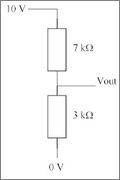
With Vout not connected to any additional circuitry, what power is dissipated in the 7 k resistor?
voltage_divider.jpg
So I am trying to get the power in 7k resistor I know the formula if I need to get Vout but in the question it says that the vout is not connected to any additional circuitry so I assume that I don't have to use the Vout so is Vin / resistor in this case 10 / 7 = 1.42 <-- but this is the resistance how I am suppose to get the power?

Im assuming this from the potential divider I = Vin / R1 + R2 . Now Ohms laws say that V = I x R so if I get the total resistance between 7 + 3 = 10 divided by the voltage 10 / 10 = 1 but I still stuck because I am getting the total voltage I want only the power in 7k I am confused help me thanks!
 
Physics news on Phys.org
Method A)

Calculate branch current : I = Vin / Rtotal. Current in R1 and R2 is the same. Power dissipated in each resistor is Px = Rx * I^2

Method B)

Calculate voltage drop across R1 or R2 using the voltage divider formula.

VR2 = Vin * R2/(R1+R2).

Power dissipated in resistor R2 is P2 = V2^2/R2.

These two methods give identical results.

Vout not connected simply means that no current flows from the Vout node to an external circuitry. In practice, you would use such circuit to scale input voltage to a CMOS chip with ~1uA input current. Voltage Vout would then be a little bit lower.
 
hi luigihs! :smile:
luigihs said:
... is Vin / resistor in this case 10 / 7 = 1.42 <--

what's "Vin"? :confused:

you need to use the voltage across the 7Ω resistor
Im assuming this from the potential divider I = Vin / R1 + R2 . Now Ohms laws say that V = I x R so if I get the total resistance between 7 + 3 = 10 divided by the voltage 10 / 10 = 1 …

what is this supposed to be? :confused:
 
Ok so is series , 7 +3 = 10 I = 10/10 = 1 then Px =7 x 1^2 = 7 ? sounds weird is this the right answer ??
 
luigihs said:
Ok so is series , 7 +3 = 10 I = 10/10 = 1 then Px =7 x 1^2 = 7 ? sounds weird is this the right answer ??

Yes. The total power supplied by the supply is :

I = 10 / (7k + 3k) = 1 mA.

Psupply = Vin * I = 10 * 1mA = 10 mW.

P1 = 7 kOhm *1 mA*1 mA = 7e3 * 1e-6 W = 7e-3 W = 7 mW.
P2 = 3 mW.

Psupply = P1 + P2 (Power Conservation)

Voltage, current, and power quantities might look confusing provided one of them is 1, 10, 100, and so on. The other two quantities will then have either the same or reciprocal magnitude (disregarding the decimal point). Say, R = 1, V = 20 V -> I = 20 A.
 
P1 = 7 kOhm *1 mA*1 mA = 7e3 * 1e-6 W = 7e-3 W = 7 mW. <-- wait this confused is not just 7 x 1^2 or why you using 7e-3 ??
 
luigihs said:
P1 = 7 kOhm *1 mA*1 mA = 7e3 * 1e-6 W = 7e-3 W = 7 mW. <-- wait this confused is not just 7 x 1^2 or why you using 7e-3 ??

I would suggest to take a pen and a piece of paper and go through the calculations yourself. It will be a great investment for the future.
 

Similar threads

Replies
15
Views
3K
  • · Replies 25 ·
Replies
25
Views
5K
  • · Replies 8 ·
Replies
8
Views
3K
Replies
2
Views
3K
  • · Replies 1 ·
Replies
1
Views
2K
  • · Replies 1 ·
Replies
1
Views
2K
  • · Replies 2 ·
Replies
2
Views
4K
  • · Replies 6 ·
Replies
6
Views
3K
  • · Replies 16 ·
Replies
16
Views
4K
  • · Replies 3 ·
Replies
3
Views
2K