Find the Cartesian equation of a curve given the parametric equation

Join the discussion
Registration is free. Ask a follow-up in this thread, or start your own.
6 replies · 2K views
chwala
Gold Member
Messages
2,844
Reaction score
434
Homework Statement
Kindly see attached below
Relevant Equations
parametric equations
My interest on this question is solely on ##10.iii## only... i shared the whole question so as to give some background information.
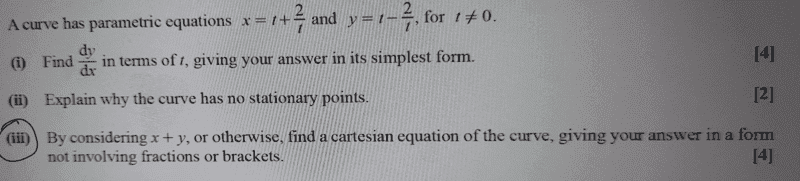
1626309434209.png

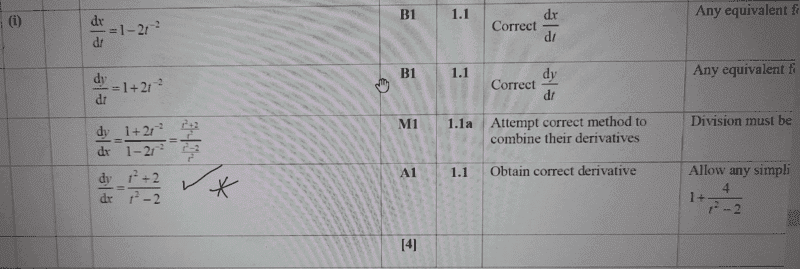
1626309486559.png


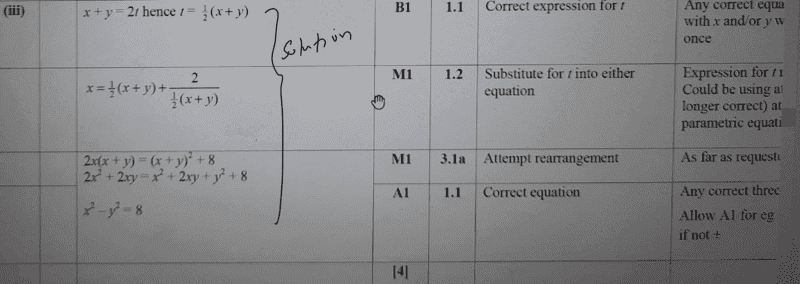
the solution to ##10.iii## here,
1626309538747.png


now my question is, what if one would approach the question like this,
##\frac {dy}{dx}=\frac{t^2+2}{t^2-2}##
we know that ##xt=t^2+2##
##yt=t^2-2##,
therefore, ##\frac {dy}{dx}=\frac{x}{y}##
it follows that, ##ydy=xdx## on integration, ##\frac {y^2}{2}+k=\frac {x^2}{2}##, or
##x^2-y^2=2k##, would this be correct? (...if a student was to answer using this approach in an exam i.e...)
I know that the ##k## value here is not assigned the required numeric value ##8##...
 
Last edited:
Physics news on Phys.org
Yes it would be correct. But you would have to find a way to find k, probably using the fact that $$x^2-y^2=(t+\frac{2}{t})^2-(t-\frac{2}{t})^2=...=8$$
 
  • Like
Likes   Reactions: chwala
Delta2 said:
Yes it would be correct. But you would have to find a way to find k, probably using the fact that $$x^2-y^2=(t+\frac{2}{t})^2-(t-\frac{2}{t})^2=...=8$$
which takes us back to the mark scheme method...going round in a circle...would the student get full marks for my approach or will he miss a mark for not having the ##k## value?
 
chwala said:
which takes us back to the mark scheme method...going round in a circle...would the student get full marks for my approach or will he miss a mark for not having the ##k## value?
I think he will miss some points for not having the ##k## value...something like 10%-25% of the total points.
 
Thanks delta... its a ##4## mark question, my quick guess is that a student would score ##3## marks...cheers mate.
 
If one has already seen that adding the two equations drops the reciprocal ##t## terms, then it should be obvious that subtracting the equations drops the ##t## terms:
##x+y=2t##
##x-y=\dfrac{4}{t}##
Multiplying the equations drops the ##t## dependence on the right
##(x+y)(x-y)=8.##
 
  • Like
Likes   Reactions: chwala and Delta2
kuruman said:
If one has already seen that adding the two equations drops the reciprocal ##t## terms, then it should be obvious that subtracting the equations drops the ##t## terms:
##x+y=2t##
##x-y=\dfrac{4}{t}##
Multiplying the equations drops the ##t## dependence on the right
##(x+y)(x-y)=8.##
nice kuruman,...looks like i can use your approach in solving simultaneous equations in the future...i did not realize one can multiply the expressions the way you've done. Brilliant mate!
 
  • Like
Likes   Reactions: kuruman