Find the center of mass of a lamina

Click For Summary

Homework Help Overview

The problem involves finding the center of mass of a lamina defined by the boundaries of two semicircles and portions of the x-axis, with density proportional to distance from the origin. The subject area includes calculus and physics concepts related to mass distribution and center of mass calculations.

Discussion Character

  • Exploratory, Conceptual clarification, Mathematical reasoning

Approaches and Questions Raised

  • Participants discuss the use of polar coordinates for circular shapes and consider strategies for handling composite objects by subtracting the smaller circle from the larger one. Questions about the mass of elemental sections and the relevance of area density are raised.

Discussion Status

Some participants have offered guidance on the approach to take, including the use of symmetry to simplify calculations. Multiple interpretations of the problem setup are being explored, but there is no explicit consensus on a single method or solution path.

Contextual Notes

Participants note the complexity of the lamina's boundaries and the implications of varying density, which may affect the calculations. There is an acknowledgment of the need for further clarification on certain assumptions regarding the density function.

paraboloid
Messages
17
Reaction score
0
The boundary of a lamina consists of the semicircles y=\sqrt{1-x^2} and y=\sqrt{4-x^2} together with the portions of the x-axis that join them. Find the center of mass of the lamina if the density at any point is proportional to its distance from the origin.

I drew a graph that looks like this
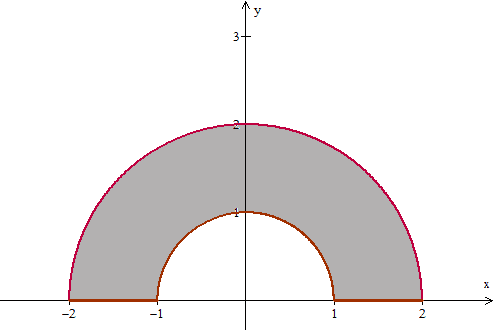
j8z4w2.png

I know that polar coordinates are a good tool to use for circle type questions like this, but I've never encountered something like this before.
If anyone could just step me in the right direction, that would be great,
Thanks
 

Attachments

Physics news on Phys.org
With composite objects like that, you can just consider the entire thing, and then subtract the smaller circle.

Your relevant equation should be

M \bar{y} = \int_M y dm

So start with a general circle of radius R.


If you consider an elemental section at an angle dθ, which has a mass dm and with length dr.

What is the mass of that element dm equal to ?

(I am assuming σ is the area density)
 
That is a very good strategy I overlooked. Thanks so much.
 
To add a small bit to what rock.freak667 said, you don't need to solve for M_{\bar{x}}, since the x-coordinate of the center of mass will be somewhere along the y-axis (by the symmetry of the object and the density).
 

Similar threads

Replies
1
Views
2K
  • · Replies 4 ·
Replies
4
Views
2K
  • · Replies 10 ·
Replies
10
Views
5K
  • · Replies 2 ·
Replies
2
Views
3K
  • · Replies 8 ·
Replies
8
Views
3K
Replies
3
Views
2K
  • · Replies 5 ·
Replies
5
Views
3K
  • · Replies 2 ·
Replies
2
Views
2K
Replies
5
Views
2K
  • · Replies 1 ·
Replies
1
Views
2K