Find the center of mass of a lamina

Click For Summary
SUMMARY

The discussion focuses on calculating the center of mass of a lamina defined by the semicircles \(y=\sqrt{1-x^2}\) and \(y=\sqrt{4-x^2}\), with density proportional to the distance from the origin. Participants suggest using polar coordinates for simplification and highlight the importance of the equation \(M \bar{y} = \int_M y \, dm\) for determining the center of mass. The strategy of treating the lamina as a composite object and subtracting the smaller semicircle from the larger is emphasized. The symmetry of the object allows for the conclusion that the x-coordinate of the center of mass lies along the y-axis.

PREREQUISITES
  • Understanding of polar coordinates in calculus
  • Familiarity with the concept of center of mass in physics
  • Knowledge of area density and its implications in mass calculations
  • Ability to perform integrals involving variable limits
NEXT STEPS
  • Study the application of polar coordinates in area calculations
  • Learn about the derivation and application of the center of mass formula
  • Explore composite shapes and their mass distribution techniques
  • Investigate the properties of symmetry in physical systems
USEFUL FOR

Students and professionals in mathematics, physics, and engineering who are involved in mechanics, particularly those focusing on center of mass calculations and integration techniques.

paraboloid
Messages
17
Reaction score
0
The boundary of a lamina consists of the semicircles y=\sqrt{1-x^2} and y=\sqrt{4-x^2} together with the portions of the x-axis that join them. Find the center of mass of the lamina if the density at any point is proportional to its distance from the origin.

I drew a graph that looks like this
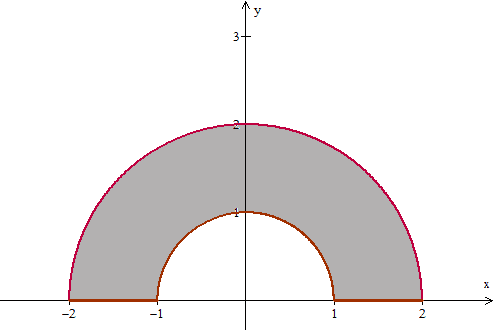
j8z4w2.png

I know that polar coordinates are a good tool to use for circle type questions like this, but I've never encountered something like this before.
If anyone could just step me in the right direction, that would be great,
Thanks
 

Attachments

Physics news on Phys.org
With composite objects like that, you can just consider the entire thing, and then subtract the smaller circle.

Your relevant equation should be

M \bar{y} = \int_M y dm

So start with a general circle of radius R.


If you consider an elemental section at an angle dθ, which has a mass dm and with length dr.

What is the mass of that element dm equal to ?

(I am assuming σ is the area density)
 
That is a very good strategy I overlooked. Thanks so much.
 
To add a small bit to what rock.freak667 said, you don't need to solve for M_{\bar{x}}, since the x-coordinate of the center of mass will be somewhere along the y-axis (by the symmetry of the object and the density).
 

Similar threads

Replies
1
Views
2K
  • · Replies 4 ·
Replies
4
Views
2K
  • · Replies 10 ·
Replies
10
Views
5K
  • · Replies 2 ·
Replies
2
Views
3K
  • · Replies 8 ·
Replies
8
Views
3K
Replies
3
Views
2K
  • · Replies 5 ·
Replies
5
Views
3K
  • · Replies 2 ·
Replies
2
Views
2K
Replies
5
Views
2K
  • · Replies 1 ·
Replies
1
Views
2K