Find the contraction of angles seen by an observer

Click For Summary

Homework Help Overview

The discussion revolves around a problem involving the contraction of angles as perceived by an observer, likely within the context of special relativity and geometric interpretations of triangles. Participants are examining the relationships between angles and lengths in different reference frames, particularly focusing on the implications of Lorentz contraction.

Discussion Character

  • Mixed

Approaches and Questions Raised

  • Participants explore various geometric interpretations, such as dropping perpendiculars to simplify the analysis of angle contraction. There is also discussion about the components of velocity and how they relate to the angles in the problem.

Discussion Status

The conversation is ongoing, with participants questioning the correctness of certain steps and calculations. Some have offered alternative approaches, while others express confusion about the relationships between angles and lengths, particularly in relation to the Lorentz transformation.

Contextual Notes

There are indications of confusion regarding the application of trigonometric functions in the context of Lorentz contraction, as well as the relationships between different angles and lengths in the problem setup. Participants are also grappling with the implications of their assumptions about the geometry involved.

guyvsdcsniper
Messages
264
Reaction score
37
Homework Statement
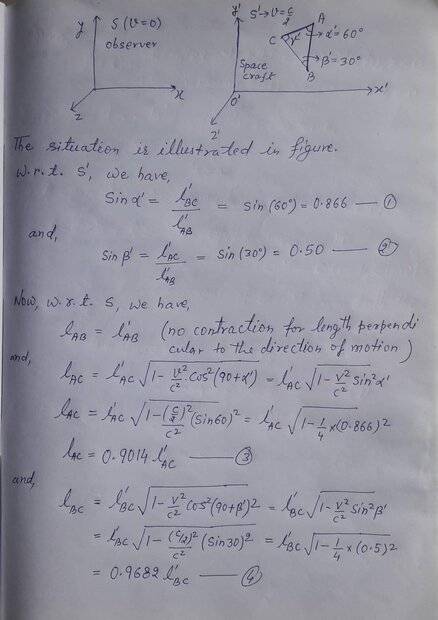
Three metal rods are joined to form a triangle so that the interior angles of the triangle are: 30◦, 60◦, and 90◦ The triangle is at rest in spacecraft so that is entirely in the x'y'-plane with it’s hypotenuse along the y'-axis. The spacecraft is moving away from a stationary observer in the x direction at speed c/2. . Determine the angles of the
triangle as measured by the stationary observer.
Relevant Equations
sqrt(1-v^2/c^2)
I am trying to follow the work to this question but am stumped at steps 3 and 4.

I am confused as to where the cos^2(90+θ) comes from? I can see it is used to invoke sin into the equation since we have that value. Is it because we are only measuring the x-component of the movement, so we need to find the sin equivalent of cos?

php1XtyY3.png
1643254698720_20220127_090349.jpeg
1643254712794_20220127_090428.jpeg
 
Physics news on Phys.org
Before I try to figure out the calculation posted, wouldn’t it be simpler to drop a perpendicular from C to AB, meeting it at D, and consider the contraction of CD?
Working that way I get ##\tan(\alpha)=3/2##, giving 56.3°.
 
  • Like
Likes   Reactions: guyvsdcsniper and TSny
It looks like the first page of the calculations finds the unprimed length ##l_{AC}## by Lorentz contracting the primed length ##l'_{AC}##. This is done by using the component of the relative velocity of the frames that is parallel to the side AC according to the primed frame: ##v \sin{\alpha'}##.

1643432869484.png

That seems to work!

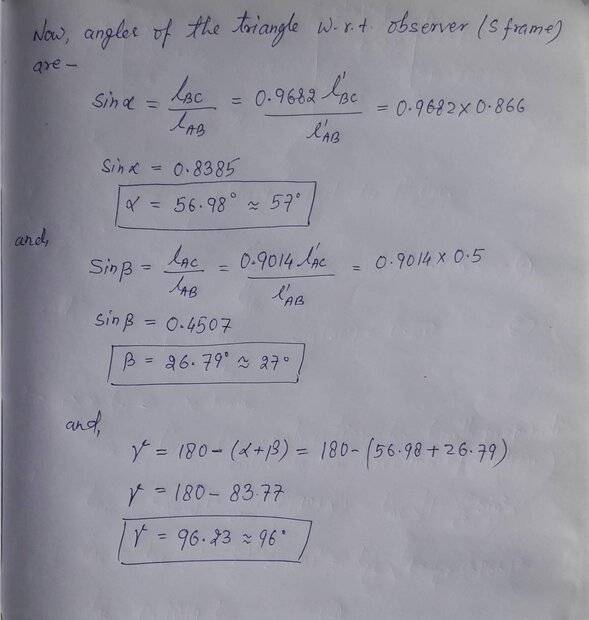
But, on the second page, we find

1643432616116.png


This is not correct, since the triangle ABC is not a right triangle in the unprimed frame.
 
  • Like
Likes   Reactions: guyvsdcsniper and haruspex
TSny said:
This is not correct, since the triangle ABC is not a right triangle in the unprimed frame.
2 minutes later, I arrive at the same conclusions.
 
haruspex said:
2 minutes later, I arrive at the same conclusions.
Was my assessment of why there was a cos^2(90+θ) correct? Since the last part of the solution provided is incorrect, how can I go about getting to the right answer?
 
quittingthecult said:
Was my assessment of why there was a cos^2(90+θ) correct?
As @TSny wrote in post #3, that comes from finding the component of v parallel to AC.
quittingthecult said:
how can I go about getting to the right answer?
As I wrote in post #2, by finding the contraction of AD instead.
 
haruspex said:
As @TSny wrote in post #3, that comes from finding the component of v parallel to AC.

As I wrote in post #2, by finding the contraction of AD instead.
Do you think you can provide a drawing of your explanation on post #2? I am having hard time visualizing it and understanding how the angles would be effected.
 
quittingthecult said:
Do you think you can provide a drawing of your explanation on post #2? I am having hard time visualizing it and understanding how the angles would be effected.
Draw the right angled triangle ABC' and drop a perpendicular from C' to meet AB at D. Under the contraction, we can leave A, B where they are and contract C'D to CD.
Express ##\tan(\alpha)## in terms of AD, CD. Similarly ##\tan(\alpha')##.
 
  • Like
Likes   Reactions: PeroK
haruspex said:
Draw the right angled triangle ABC' and drop a perpendicular from C' to meet AB at D. Under the contraction, we can leave A, B where they are and contract C'D to CD.
Express ##\tan(\alpha)## in terms of AD, CD. Similarly ##\tan(\alpha')##.
Ok this is my interpretation of your description. So doing this allow me to measure just the x-direction of the triangle moving?
IMG_8278.JPG
 
  • #10
quittingthecult said:
Ok this is my interpretation of your description. So doing this allow me to measure just the x-direction of the triangle moving?
View attachment 296242
Yes. The distances ##AD## and ##BD## are the same in both frames and ##CD## is contracted in the frame of the "stationary" observer.

It might be worth calculating ##\gamma## as a square root before you go plugging in numbers to several decimal places.
 
  • #11
PeroK said:
Yes. The distances ##AD## and ##BD## are the same in both frames and ##CD## is contracted in the frame of the "stationary" observer.

It might be worth calculating ##\gamma## as a square root before you go plugging in numbers to several decimal places.
im a little confused on what comes next. so I have to apply the lorentz transform for length contraction. How does tan come into the lorentz transform. With how it was solved on the work I provided, they took a sin of the 30 and 60 degree angles. Here I just have tan
 
  • #12
quittingthecult said:
im a little confused on what comes next. so I have to apply the lorentz transform for length contraction. How does tan come into the lorentz transform. With how it was solved on the work I provided, they took a sin of the 30 and 60 degree angles. Here I just have tan
You have a triangle with known side lengths. You just calculate the angles.
 
  • #13
PeroK said:
You have a triangle with known side lengths. You just calculate the angles.
So I calculated the unprimed length of CD and I got 56.3 degrees.
Im confused on what length tan30 is associated with?
 
  • #14
quittingthecult said:
So I calculated the unprimed length of CD and I got 56.3 degrees.
Im confused on what length tan30 is associated with?
I don't know what that means.

You know ##|AD|##, ##|BD|## and ##|CD'|##. You know that ##|CD| = |CD'|/\gamma##. So, you calculate ##\alpha## and ##\beta## from that using basic trig.
 
  • #15
Or, get ##\tan \alpha## in terms of ##\tan \alpha'## etc.
 
  • #16
PeroK said:
Or, get ##\tan \alpha## in terms of ##\tan \alpha'## etc.
IThis is how I am interpreting the situation. Is this still not correct?
IMG_8281.JPG
 
  • #17
1643475770721.png

Why do you have a factor of ##\tan ^2 60^o## inside the Lorentz contraction factor?
 
  • #18
TSny said:
View attachment 296249
Why do you have a factor of ##\tan ^2 60^o## inside the Lorentz contraction factor?
I guess I was basing this off of what the original work had done. But thinking about it harder I can see why id doesn't make sense.

Im just not seeing what everyone else is seeing to conclude the problem.

Calculating Lcd=Lcd' \gamma I get .866. That should be the only length I need to calculate since the other two lengths are perpendicular.

Now that I have Lcd=lcd'(.866) what do I do. How do I calculate alpha and beta from this?
 
  • #19
How would you express ##\tan \alpha## in terms of ##L_{CD}## and ##L_{AD}##?
 
  • #20
Tan(α) = LAD/LCD .

If I know LCD=LCD'*√ 3/2, then I just need to find LAD?
 
  • #21
quittingthecult said:
Tan(α) = LAD/LCD .
This is not quite right.

quittingthecult said:
If I know LCD=LCD'*√ 3/2, then I just need to find LAD?

You don't need to find ##L_{AD}##. The idea is that you can express ##\tan \alpha## in terms of ##L_{CD}## and ##L_{AD}##. Likewise you can express ##\tan \alpha'## in terms of ##L_{C'D}## and ##L_{AD}##. Since you know the relation between ##L_{CD}## and ##L_{C'D}##, you should be able to see the relation between ##\tan \alpha## and ##\tan \alpha'## .
 
  • Like
Likes   Reactions: PeroK
  • #22
quittingthecult said:
Tan(α) = LAD/LCD .

If I know LCD=LCD'*√ 3/2, then I just need to find LAD?
First, the tangent is opposite over adjacent.

And ##\tan \alpha' = \frac{|C'D|}{|AD|}##.

That gives you a relationship between ##\tan \alpha## and ##\tan \alpha'##. With the same idea for ##\beta## and ##\beta'##.

PS Just saw the above post.
 
  • #23
PeroK said:
First, the tangent is opposite over adjacent.

And ##\tan \alpha' = \frac{|C'D|}{|AD|}##.

That gives you a relationship between ##\tan \alpha## and ##\tan \alpha'##. With the same idea for ##\beta## and ##\beta'##.

PS Just saw the above post.
So then ##\tan \alpha = \frac{|CD|}{|AD|}##?
 
  • #24
quittingthecult said:
and then I can say
##{|C'D|}={|CD|}## ?
That's the one length that changes! That's what's length contracted!
 
  • #25
PeroK said:
That's the one length that changes! That's what's length contracted!
Sorry I edited my post cause I realized that was wrong.

##\tan \alpha' = \frac{|C'D|}{|AD|}##. I can see that, i got this wrong on my earlier post because I was looking at the wrong angle.

I don't see how I can relate this to ##\tan \alpha##
 
  • #26
Well I guess If AD is the same in both frames, then I can say AD = C'D/ ##\tan \alpha'## and also AD = C'D/ ##\tan \alpha##

So then C'D/ ##\tan \alpha'## = C'D/ ##\tan \alpha## ?
 
  • #27
quittingthecult said:
Sorry I edited my post cause I realized that was wrong.

##\tan \alpha' = \frac{|C'D|}{|AD|}##. I can see that, i got this wrong on my earlier post because I was looking at the wrong angle.

I don't see how I can relate this to ##\tan \alpha##
##\tan \alpha' = \frac{|C'D|}{|AD|}##, ##\tan \alpha = \frac{|CD|}{|AD|}##, ##|C'D| = \gamma|CD|##
 
  • #28
quittingthecult said:
Well I guess If AD is the same in both frames, then I can say AD = C'D/ ##\tan \alpha'## and also AD = C'D/ ##\tan \alpha##

So then C'D/ ##\tan \alpha'## = C'D/ ##\tan \alpha## ?
?
 
  • #29
PeroK said:
?
Sorry, I guess I am just really struggling with this problem and the logic behind solving it.
 
  • #30
quittingthecult said:
Sorry, I guess I am just really struggling with this problem and the logic behind solving it.
Okay, but we've done all the work except solve it. There's not much left to do except a final step which gives the answer.

You're honestly saying that you cannot finish the job from here:

PeroK said:
##\tan \alpha' = \frac{|C'D|}{|AD|}##, ##\tan \alpha = \frac{|CD|}{|AD|}##, ##|C'D| = \gamma|CD|##
Note that ##C' \rightarrow C## is the only point on the triangle that changes from one frame to the the other. The line ##ADB## is unaffected by length contraction, as it is perpendicular to the direction of motion.
 

Similar threads

Replies
1
Views
1K
  • · Replies 26 ·
Replies
26
Views
3K
  • · Replies 15 ·
Replies
15
Views
1K
Replies
46
Views
6K
  • · Replies 29 ·
Replies
29
Views
4K
  • · Replies 2 ·
Replies
2
Views
2K
Replies
5
Views
2K
Replies
11
Views
3K
  • · Replies 10 ·
Replies
10
Views
2K
Replies
3
Views
1K