Find the magnitude of the electric force from 3 charges at vertices of a cube

Click For Summary

Homework Help Overview

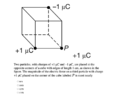
The discussion revolves around calculating the magnitude of the electric force resulting from three charges placed at the vertices of a cube. The charges include +1 μC and -1 μC, and the setup involves analyzing forces exerted on a point charge located at one of the cube's corners.

Discussion Character

  • Mixed

Approaches and Questions Raised

  • Participants explore the application of Coulomb's law to determine the forces between the charges. There are attempts to resolve the components of the forces acting on the charge at point P, with some questioning the correctness of the vector components and their directions. Others raise concerns about the distances used in calculations and the implications of charge placement.

Discussion Status

The discussion is ongoing, with participants providing insights and corrections regarding the calculations and assumptions made. Some have pointed out potential errors in the original calculations, while others are clarifying the relationships between the forces involved. There is a recognition of the need to consider the geometry of the cube and the directions of the forces.

Contextual Notes

Participants note discrepancies in the values used for Coulomb's constant and the distances between charges, which may affect the calculations. The problem constraints include the significant figures of the data provided, which influence the final results.

paulimerci
Messages
287
Reaction score
47
Homework Statement
Question is posted below.
Relevant Equations
Coulomb law F_e = kq1q2/r^2
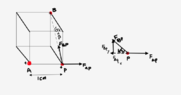
There are three charges with +1 μC and −1 μC, are placed at the opposite corners of a cube with edges of length 1 cm, and the distance from P to B is 1cm 2. I labeled them as A, P, and B, which is shown in the diagram below. Since we need to find the magnitude of the charge at point P and the charge at point P is +1 μC, it exerts an attractive force on point B and a repulsive force on point A. I've indicated the FBD below. Using Coulomb's law, we get
Fe=kq1q2r2
∑Fx=FBPcos45+FAP
∑Fx=91

∑Fy=FBPsin45
∑Fy=45.5N
Using Pythagorean we get,
Resultant magnitude of electric force = 101.7N
I did something wrong here. Can anyone point out where I made the mistake?
Thank you!
 

Attachments
  • Screenshot 2023-05-17 at 6.27.29 PM.png
    Screenshot 2023-05-17 at 6.27.29 PM.png
    8.4 KB · Views: 138
  • Screenshot 2023-05-17 at 6.18.31 PM.png
    Screenshot 2023-05-17 at 6.18.31 PM.png
    16.9 KB · Views: 162
Last edited:
Physics news on Phys.org
Are you sure that force ##\mathbf{F}_{BP}## has a nonzero x-component?
 
TSny said:
Are you sure that force ##\mathbf{F}_{BP}## has a nonzero x-component?
Does that mean F_BP cancels with F_AP since they are in opposite directions?
 
TSny said:
Are you sure that force ##\mathbf{F}_{BP}## has a nonzero x-component?
I got the answer, and I edited my answer in post #1.
 
paulimerci said:
Fe=kq1q2r2
∑Fx=FBPcos45+FAP
∑Fx=91
The equation ##\sum F_x = F_{BP}\cos 45^o + F_{AP}## is not correct.
Can you see that the vector ##\mathbf{F}_{BP}## is perpendicular to the vector ##\mathbf{F}_{AP}##?

paulimerci said:
∑Fy=FBPsin45
∑Fy=45.5N
##F_{BP}\sin 45^o \neq 45.5 N##. What value did you get for ##F_{BP}##?

Does the vector ##\mathbf{F}_{BP}## have a z-component as well as a y-component?
In your diagram, you didn't indicate the directions of the x, y, and z axes.
 
Last edited:
  • Like
Likes   Reactions: scottdave and MatinSAR
TSny said:
The equation ##\sum F_x = F_{BP}\cos 45^o + F_{AP}## is not correct.
Can you see that the vector ##\mathbf{F}_{BP}## is perpendicular to the vector ##\mathbf{F}_{AP}##.##F_{BP}\sin 45^o \neq 45.5 N##. What value did you get for ##F_{BP}##?

Does the vector ##\mathbf{F}_{BP}## have a z-component as well as a y-component?
In your diagram, you didn't indicate the directions of the x, y, and z axes.
Isn’t the ##F_{BP} sin45## perpendicular to the ##F_{AP}##?
F_BP sin 45 = 31.8N
 
The key is to realize that the vector ##\mathbf{F}_{BP}## is perpendicular ##\mathbf{F}_{AP}##.

1684380242711.png

If you see that the two vectors are perpendicular, then it should be easy to find the magnitude of their sum. You don't need to consider x, y, or z components.
 
  • Like
Likes   Reactions: scottdave, paulimerci, MatinSAR and 1 other person
TSny said:
The key is to realize that the vector ##\mathbf{F}_{BP}## is perpendicular ##\mathbf{F}_{AP}##.

View attachment 326712
If you see that the two vectors are perpendicular, then it should be easy to find the magnitude of their sum. You don't need to consider x, y, or z components.
Thanks for the diagram. I can't visualize F_BP perpendicular to F_AP.
 
paulimerci said:
Thanks for the diagram. I can't visualize F_BP perpendicular to F_AP.
##\mathbf{F}_{BP}## lies in the face of the cube that is shaded yellow.

The edge AP of the cube is perpendicular to the yellow face.

Imagine looking at the cube so that you are looking directly at the yellow face.
1684381043625.png

Imagine what the direction of ##\mathbf{F}_{AP}## would be in this picture.
 
  • Like
Likes   Reactions: scottdave, paulimerci, MatinSAR and 1 other person
  • #10
TSny said:
##\mathbf{F}_{BP}## lies in the face of the cube that is shaded yellow.

The edge AP of the cube is perpendicular to the yellow face.

Imagine looking at the cube so that you are looking directly at the yellow face.
View attachment 326713
Imagine what the direction of ##\mathbf{F}_{AP}## would be in this picture.
I think I understood what you said. So the magnitude of the electric force is 128N?
 
  • #11
paulimerci said:
I think I understood what you said. So the magnitude of the electric force is 128N?
Please show the calculation that gave you this result.

What value did you get for ##F_{AP}##?

What value did you get for ##F_{BP}##?
 
  • #12
TSny said:
Please show the calculation that gave you this result.

What value did you get for ##F_{AP}##?

What value did you get for ##F_{BP}##?
Ok.
##F_{AP} = 91N##
##F_{BP} = 91N##
Using Pythagorean, the net magnitude of electric force at point p is 128N.
 
  • #13
paulimerci said:
##F_{AP} = 91N##
I'm not sure how you got 91 N rather than 90 N. The value of Coulomb's constant is ##k = 8.99 \times 10^9## Nm2/C2.

paulimerci said:
##F_{BP} = 91N##
The distance between B and P is greater than the distance between A and P. So, shouldn't ##F_{BP}## be less than ##F_{AP}##?
 
  • Like
Likes   Reactions: scottdave and paulimerci
  • #14
TSny said:
I'm not sure how you got 91 N rather than 90 N. The value of Coulomb's constant is ##k = 8.99 \times 10^9## Nm2/C2.The distance between B and P is greater than the distance between A and P. So, shouldn't ##F_{BP}## be less than ##F_{AP}##?
Yes, the distance between B and P is greater than the distance between A and P. I took ##k = 9\times 10^9 Nm^2/C^2##
I did something wrong in calculating the distance.
##F_{BP} = 45.5 N ## and ##F_{AP} = 91N##.
Thereby the magnitude of electric force at point P is 102N.
 
  • #15
paulimerci said:
Yes, the distance between B and P is greater than the distance between A and P. I took ##k = 9\times 10^9 Nm^2/C^2##
I did something wrong in calculating the distance.
##F_{BP} = 45.5 N ## and ##F_{AP} = 91N##.
Thereby the magnitude of electric force at point P is 102N.
Using ##\displaystyle k = 9\times 10^9 \, \rm{Nm^2/C^2}## rather than ##\displaystyle 8.99\times 10^9 \, \rm{Nm^2/C^2}## will give ##F_{AP} = 90\, \rm N##
 
  • #16
SammyS said:
Using ##\displaystyle k = 9\times 10^9 \, \rm{Nm^2/C^2}## rather than ##\displaystyle 8.99\times 10^9 \, \rm{Nm^2/C^2}## will give ##F_{AP} = 90\, \rm N##
I'm sorry I used ## k= 9.1 \times 10^9 Nm^2/C^2## that's how I got the answer for ##F_{AP} = 91N ##
 
  • #17
paulimerci said:
##F_{BP} = 45.5 N ## and ##F_{AP} = 91N##.
Thereby the magnitude of electric force at point P is 102N.
OK. You have the solution. Using k = 9.0 x 10⁹ Nm2/C2 would give 101 N. But the data in the problem is stated to only one significant figure! Your answer is close enough to pick out the correct answer in the multiple choice.
 
  • Like
Likes   Reactions: scottdave, MatinSAR and paulimerci
  • #18
TSny said:
OK. You have the solution. Using k = 9.0 x 10⁹ Nm2/C2 would give 101 N. But the data in the problem is stated to only one significant figure! Your answer is close enough to pick out the correct answer in the multiple choice.
The answer is close to 100 N. Thank you @TSny for your great help!
 
  • Like
Likes   Reactions: berkeman, TSny and MatinSAR

Similar threads

  • · Replies 5 ·
Replies
5
Views
2K
Replies
9
Views
970
  • · Replies 1 ·
Replies
1
Views
4K
Replies
1
Views
2K
  • · Replies 11 ·
Replies
11
Views
3K
Replies
11
Views
2K
  • · Replies 3 ·
Replies
3
Views
2K
  • · Replies 3 ·
Replies
3
Views
3K
Replies
2
Views
2K
Replies
1
Views
2K