Find the Moment (Torque) of the resultant in 3-D (Statics)

Click For Summary

Discussion Overview

The discussion revolves around calculating the moment (torque) of a resultant force in three-dimensional statics. Participants express confusion about how to determine the position vector (r) needed for the cross product in the torque equation, particularly in the context of homework problems where the professor has not provided sufficient guidance.

Discussion Character

  • Homework-related
  • Exploratory
  • Debate/contested

Main Points Raised

  • One participant seeks clarification on how to find the position vector (r) to use in the torque equation τ = r x F, noting a lack of instruction on resultants and 3-D moments from their professor.
  • Another participant suggests that the r vector should be from the origin to the point where the force is applied, although they acknowledge difficulty in interpreting the problem's diagram.
  • A different participant proposes a specific r vector (0i + 7j + 0k) and plans to test it against the answer provided in the textbook.
  • One participant shares their calculated answer for the moment and questions whether their resultant vector might be slightly off, as their answer differs from the textbook solution.
  • Another participant requests to see the cross product calculations to better understand the discrepancies in the results.

Areas of Agreement / Disagreement

Participants express varying approaches to determining the position vector and calculating the moment. There is no consensus on the correct method or the accuracy of the resultant vectors, as multiple viewpoints and calculations are presented without resolution.

Contextual Notes

Participants express frustration over the lack of instructional material and guidance on the topic, which may contribute to the confusion regarding the calculations and concepts involved.

fordrew
Messages
5
Reaction score
0
Hey guys... This problem is driving me bonkers. I really am not asking you to calculate anything but I only ask how to figure out how to get r to use τ = r x F . My professor did not even teach us anything about resultants and 3-d moments
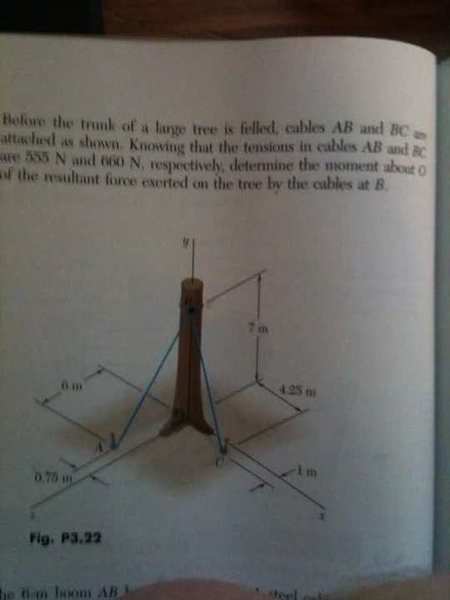
Homework Statement


ak9005.jpg


Homework Equations


MO= τ = r X F

The Attempt at a Solution


Well, I found that the resultant F = 288.55 i + 985.97 j + 437 k .
The resultant is CORRECT. I can not figure out how to get the distance of this vector in respect to x, y , z for r so I can use the cross product to figure out the moment....Or perhaps I have approached the problem all wrong? Is there a different way to solve the problem? ( please do not use any numbers just to make it easier on you)

The book makes no mention of how to solve this problem and it is so so frustrating because even the professor has not done any problems pertaining to this question.
 
Last edited:
Physics news on Phys.org
fordrew said:
Hey guys... This problem is driving me bonkers. I really am not asking you to calculate anything but I only ask how to figure out how to get r to use τ = r x F . My professor did not even teach us anything about resultants and 3-d moments

Homework Statement


ak9005.jpg


Homework Equations


MO= τ = r X F

The Attempt at a Solution


Well, I found that the resultant F = 288.55 i + 985.97 j + 437 k .
The resultant is CORRECT. I can not figure out how to get the distance of this vector in respect to x, y , z for r so I can use the cross product to figure out the moment.


...Or perhaps I have approached the problem all wrong? Is there a different way to solve the problem? ( please do not use any numbers just to make it easier on you)

The book makes no mention of how to solve this problem and it is so so frustrating because even the professor has not done any problems pertaining to this question.

If you are to find the torque about the origin, then the r vector would just be from the origin to the point that the force is applied (where the ropes are attached). It's a little hard to read the picture, but that would be my impression.
 
So the r vector will just be 0i + 7j + 0k? I will test it out right now if it works... the answer is in the back of the book.. So I will get back with the results in a sec
 
well, the answer to the problem is:

3080 i - 2070 k

however my answer is:

- 3059 i - 2019 kmaybe my resultant vector is slightly off? And cross product makes i negative =-\
 
fordrew said:
well, the answer to the problem is:

3080 i - 2070 k

however my answer is:

- 3059 i - 2019 k


maybe my resultant vector is slightly off? And cross product makes i negative =-\

Can you show us your cross product math?
 
fordrew said:
Hey guys... This problem is driving me bonkers. I really am not asking you to calculate anything but I only ask how to figure out how to get r to use τ = r x F . My professor did not even teach us anything about resultants and 3-d moments

Homework Statement


ak9005.jpg


Homework Equations


MO= τ = r X F

The Attempt at a Solution


Well, I found that the resultant F = 288.55 i + 985.97 j + 437 k .
The resultant is CORRECT. I can not figure out how to get the distance of this vector in respect to x, y , z for r so I can use the cross product to figure out the moment.


...Or perhaps I have approached the problem all wrong? Is there a different way to solve the problem? ( please do not use any numbers just to make it easier on you)

The book makes no mention of how to solve this problem and it is so so frustrating because even the professor has not done any problems pertaining to this question.

XX Take your moment about point O caused by one of the forces and sum it with the moment about point O caused by the other forces
 

Similar threads

  • · Replies 1 ·
Replies
1
Views
2K
  • · Replies 1 ·
Replies
1
Views
3K
  • · Replies 6 ·
Replies
6
Views
3K
  • · Replies 2 ·
Replies
2
Views
2K
  • · Replies 3 ·
Replies
3
Views
2K
  • · Replies 27 ·
Replies
27
Views
4K
  • · Replies 6 ·
Replies
6
Views
4K
  • · Replies 9 ·
Replies
9
Views
3K
  • · Replies 2 ·
Replies
2
Views
2K
  • · Replies 1 ·
Replies
1
Views
4K