Find the second smallest element

  • Context:
  • Thread starter Thread starter evinda
  • Start date Start date
  • Tags Tags
    Element
Join the discussion
Ask a follow-up here, or get your own question answered by working scientists, mathematicians and engineers — people, not an autocomplete.
Real named experts · corrections over time · the nuance an AI answer skips
58 replies · 9K views
evinda
Gold Member
MHB
Messages
3,741
Reaction score
0
Hi! (Nerd)

Show that,given a set of numbers $S$,we can count the second smallest element of $S$ with $n+ \lceil \lg n \rceil-2$ comparisons at the worst case.

Hint: Find the smallest element,considering a tournament tree for its finding.

I don't really know how to use the hint.. (Sweating) Could you help me? (Blush)
 
on Phys.org
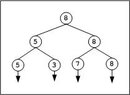
Build a tournament tree by first pairing the $n$ elements together, and the smaller element of the pair advances to the next round of the tournament. This will yield a binary tree of height $\left\lceil{\log_2 n}\right\rceil$.

Also, the number of comparisons needed to create this tree would be defined by the recurrence $T(n) = T(n/2) + \frac n2$, and $T(1)=0$. because at each round, we do $\frac n2$ comparisons and move onto the next round. That recurrence has a solution of $T(n) = n - 1$.

After $n-1$ comparisons to build the tree, we know the root of the tree (the winner) is the smallest element. All we need now is to go to each depth of the tree and find out the element that the winner beats. There will be $\left\lceil{\log_2 n}\right\rceil$, we can find the minimum of this set with $\left\lceil{\log_2 n}\right\rceil - 1$ comparisons (linear scan).

Total number of comparisons is $n-1 + \left\lceil{\log_2 n}\right\rceil - 1$.
 
evinda said:
Hi! (Nerd)

Show that,given a set of numbers $S$,we can count the second smallest element of $S$ with $n+ \lceil \lg n \rceil-2$ comparisons at the worst case.

Hint: Find the smallest element,considering a tournament tree for its finding.

I don't really know how to use the hint.. (Sweating) Could you help me? (Blush)
Hey! (Happy)

Let's pick an example.

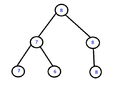
Suppose we have the following tournament tree:
View attachment 3136

What is $n$?
What is the number of comparisons to find the winner?
And what is the number of additional comparisons we need to find number 2? (Wondering)
 

Attachments

  • Tournament.jpg
    Tournament.jpg
    4.4 KB · Views: 148
I like Serena said:
Hey! (Happy)

Let's pick an example.

Suppose we have the following tournament tree:
View attachment 3136

What is $n$?
$n=4$,right? (Wasntme)

I like Serena said:
What is the number of comparisons to find the winner?

And what is the number of additional comparisons we need to find number 2? (Wondering)

Number of comparisons=3
Is it maybe like that:
Number of additional comparisons=Number of comparisons-1=2 ? (Thinking)
 
evinda said:
$n=4$,right? (Wasntme)

Right!

Number of comparisons=3

Good!
Can you express that as a relationship with $n$?

Is it maybe like that:
Number of additional comparisons=Number of comparisons-1=2 ? (Thinking)

Sorry, but no.

Perhaps we should look at an example with $n=8$... (Thinking)
 
I like Serena said:
Good!
Can you express that as a relationship with $n$?

It is equal to $n-1$..

I like Serena said:
Sorry, but no.

Perhaps we should look at an example with $n=8$... (Thinking)

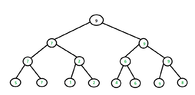
I created a turnament tree for $n=8$:

View attachment 3140

But..how can I find the number of additional comparisons we need to find number 2? (Thinking)
 

Attachments

  • com.png
    com.png
    5.6 KB · Views: 128
evinda said:
It is equal to $n-1$..

Yep!
I created a turnament tree for $n=8$:

But..how can I find the number of additional comparisons we need to find number 2? (Thinking)

Which contenders might be second best? (Wondering)

Starting at the left, could contender 5 be second best?
 
I like Serena said:
Which contenders might be second best? (Wondering)

Starting at the left, could contender 5 be second best?

No,because $5<7<9$,right? (Thinking)
 
I like Serena said:
Correct.
From the position in the tree, you already know that $5$ cannot be second, but $7$ might be.
Which others are there? (Wondering)
The possible numbers that could be second are these: $7,2,6,7$.

Then,these: $7,7$.

And,then,this: $7$.

Right? (Thinking)
 
evinda said:
The possible numbers that could be second are these: $7,2,6,7$.

Then,these: $7,7$.

And,then,this: $7$.

Right? (Thinking)

From the tournament tree, we have already had a match between $7$ and $2$, and $7$ came out on top.
So $2$ cannot be second. At best he is third.

We haven't had a match between $6$ and $7$ though. So both are still contenders for second place.

Btw, you have a duplicate $7$ in the bottom right. (Doh)
Was that intentional?
Or should it really be for instance $8$? (Wondering)
 
I like Serena said:
From the tournament tree, we have already had a match between $7$ and $2$, and $7$ came out on top.
So $2$ cannot be second. At best he is third.

We haven't had a match between $6$ and $7$ though. So both are still contenders for second place.

Btw, you have a duplicate $7$ in the bottom right. (Doh)
Was that intentional?
Or should it really be for instance $8$? (Wondering)

I replaced $7$ by $8$:

View attachment 3145

So,now do we have to find the greatest number,less than $9$,from the right subtree and compare it with $7$?
So,the number of comparisons is $4=\frac{n}{2}$ ,right? (Thinking)
 

Attachments

  • lll.png
    lll.png
    5.6 KB · Views: 124
evinda said:
So,now do we have to find the greatest number,less than $9$,from the right subtree and compare it with $7$?
So,the number of comparisons is $4=\frac{n}{2}$ ,right? (Thinking)

The second best will come out on top everywhere - except when compared with number one.
There are three numbers that are on top, but that lose from number one: $\enclose{circle}7$, $\enclose{circle}6$, and $\enclose{circle}8$.
These are the candidates for second best.

The number of these candidates corresponds to the height of the tree minus 1.
What is the height of a binary tree with $n$ leafs? (Wondering)
Hint: it is not $\frac n 2$.

Now suppose we have $m$ candidates for number two.
Then we can create a new tournament tree, for which we already know that we need $m-1$ comparisons.
 
I like Serena said:
The second best will come out on top everywhere - except when compared with number one.
There are three numbers that are on top, but that lose from number one: $\enclose{circle}7$, $\enclose{circle}6$, and $\enclose{circle}8$.
These are the candidates for second best.

The number of these candidates corresponds to the height of the tree minus 1.
What is the height of a binary tree with $n$ leafs? (Wondering)
Hint: it is not $\frac n 2$.

Isn't the height of a binary tree with $n$ leafs equal to $\lfloor \lg n\rfloor$ ? Or am I wrong? (Thinking)

But..in our case, $ \lg n-1=\lg 8-1=\lg {2^3}-1=3-1=2$,and there are $3$ candidates..or not? (Sweating)
I like Serena said:
Now suppose we have $m$ candidates for number two.
Then we can create a new tournament tree, for which we already know that we need $m-1$ comparisons.

So,is it like that? (Thinking)

View attachment 3162
 

Attachments

  • tourn.png
    tourn.png
    2.6 KB · Views: 128
evinda said:
Isn't the height of a binary tree with $n$ leafs equal to $\lfloor \lg n\rfloor$ ? Or am I wrong? (Thinking)

But..in our case, $ \lg n-1=\lg 8-1=\lg {2^3}-1=3-1=2$,and there are $3$ candidates..or not? (Sweating)

Let's see... if we have $n=1$ leafs, what is the height of the tree?
If we have $n=2$, what is the height of the tree?
If we have $n=4$, what is the height of the tree?
If we have $n=8$, what is the height of the tree?
If we have $n=16$, what is the height of the tree?
If we have $n=15$, what is the height of the tree?
If we have $n=9$, what is the height of the tree? (Wondering)
So,is it like that? (Thinking)

Yep. That's the tree for second best.
So it takes 2 comparisons. (Smile)
 
I like Serena said:
Let's see... if we have $n=1$ leafs, what is the height of the tree?
If we have $n=2$, what is the height of the tree?
If we have $n=4$, what is the height of the tree?
If we have $n=8$, what is the height of the tree?
If we have $n=16$, what is the height of the tree?
If we have $n=15$, what is the height of the tree?
If we have $n=9$, what is the height of the tree? (Wondering)

If we have $n=1$, height=1.
If we have $n=2$, height=1.
If we have $n=4$, height=2.
If we have $n=8$, height=3.
If we have $n=16$, height=4.
If we have $n=15$ ,height=4.
If we have $n=9$, height=3.

Right? (Thinking)

I like Serena said:
Yep. That's the tree for second best.
So it takes 2 comparisons. (Smile)

(Nod)
 
I like Serena said:
In this case we have 2 leaves and 1 root.

View attachment 3163

That means there are 2 levels.
Or in other words, the height of the tree is 2 instead of 1. (Worried)

I thought that,if there is just one node,the root node,the height is equal to $0$,if there are $2$ levels of nodes,the height is equal to $1$ and so on. Am I wrong? (Thinking)
 
evinda said:
I thought that,if there is just one node,the root node,the height is equal to $0$,if there are $2$ levels of nodes,the height is equal to $1$ and so on. Am I wrong? (Thinking)

I have just looked it up and I see conflicting information.

In binary tree on wiki, the height is the same as the number of levels.

But in tree (data structure) on wiki, the height is the number of levels minus one.

So I don't know! (Doh)
I'll just refer to levels from now on to avoid the confusion.

So with your interpretation, you are (almost) right!Still...
If we have $n=8$, height=3.
If we have $n=9$, height=3.

With $n=8$ leaves we have a full binary tree with 4 levels.
With $n=9$ we need one more level, so we have 5 levels! (Worried)

Can you find the formula for the number of levels based on the number of leaves? (Wondering)
 
I like Serena said:
I have just looked it up and I see conflicting information.

In binary tree on wiki, the height is the same as the number of levels.

But in tree (data structure) on wiki, the height is the number of levels minus one.

So I don't know! (Doh)
I'll just refer to levels from now on to avoid the confusion.

So with your interpretation, you are (almost) right!Still...With $n=8$ leaves we have a full binary tree with 4 levels.
With $n=9$ we need one more level, so we have 5 levels! (Worried)

So, is it of this form, for $n=8$? (Thinking)

View attachment 3164

If so,why do we need one more level for $n=9$ ? (Thinking)
 

Attachments

  • tourn.png
    tourn.png
    2.1 KB · Views: 132
Last edited:
I like Serena said:
That tree has $n=5$ leaves... :confused:

Oh yes,right! (Blush)

I like Serena said:
So it has one level more than a tree with $n=4$ leaves.

So, is it like that? Or have I done something wrong? (Thinking)

number of leaves =1, number of levels=2

number of leaves =2, number of levels=2

number of leaves =4, number of levels=3

number of leaves =8, number of levels=4

number of leaves=16, number of levels=5

number of leaves=15, number of levels=5

number of leaves=9, number of levels=5
 
evinda said:
So, is it like that? Or have I done something wrong? (Thinking)

Almost!

number of leaves =1, number of levels=2

If we have 1 leaf, there is only 1 node, and only 1 level.

How about a formula? (Wondering)
 
I like Serena said:
If we have 1 leaf, there is only 1 node, and only 1 level.

So, does the tree have to be complete? (Thinking)

I like Serena said:
How about a formula? (Wondering)
number of leaves =$n$, number of levels= $\lceil \lg n \rceil+1$

Right? (Thinking)
 
evinda said:
So, does the tree have to be complete? (Thinking)

That is the way to set up a tournament tree, so let's do it that way. (Mmm)
number of leaves =$n$, number of levels= $\lceil \lg n \rceil+1$

Right? (Thinking)

Right! (Nod)That brings us to how many candidates we have for second place. (Thinking)
And finally how many comparisons we need in total. (Thinking)
 
I like Serena said:
That is the way to set up a tournament tree, so let's do it that way. (Mmm)

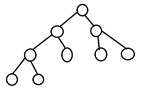
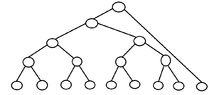
A ok... So, if at the beginning, $n$ is equal to an odd number,for example, $9$, is it then like that?

View attachment 3170
I like Serena said:
Right! (Nod)That brings us to how many candidates we have for second place. (Thinking)
And finally how many comparisons we need in total. (Thinking)

So, in order to find the first place, we need $n-1$ comparisons and then, in order to find the second place, we need $\lceil \lg n \rceil+1-1= \lceil \lg n \rceil$ comparisons.

Therefore, we need in total $n+ \lceil \lg n \rceil -1$ comparisons, right? (Thinking)

But..the exercise asks to show that we need $n+ \lceil \lg n \rceil−2$ comparisons... :eek:
 

Attachments

  • graph3.png
    graph3.png
    5.9 KB · Views: 132
evinda said:
A ok... So, if at the beginning, $n$ is equal to an odd number,for example, $9$, is it then like that?

It is not a complete binary tree, but yes, we can also do it like that.
So, in order to find the first place, we need $n-1$ comparisons and then, in order to find the second place, we need $\lceil \lg n \rceil+1-1= \lceil \lg n \rceil$ comparisons.

Therefore, we need in total $n+ \lceil \lg n \rceil -1$ comparisons, right? (Thinking)

But..the exercise asks to show that we need $n+ \lceil \lg n \rceil−2$ comparisons... :eek:

Let's do this carefully to avoid any plus-or-minus-one mistakes. (Worried)
Take a look at our tree with $n=8$ leaves.
It has $\lceil \lg n \rceil + 1 = 4$ levels yes?
How many candidates for second place does that make?
Is it the same or is it different? (Wondering)
 
I like Serena said:
Let's do this carefully to avoid any plus-or-minus-one mistakes. (Worried)
Take a look at our tree with $n=8$ leaves.
It has $\lceil \lg n \rceil + 1 = 4$ levels yes?

(Nod)

I like Serena said:
How many candidates for second place does that make?
Is it the same or is it different? (Wondering)

There are $\lceil \lg n \rceil=3$ candidates for the second place, right? (Thinking)
 
I like Serena said:
Right! (Smile)

How many comparisons do we need to find number two? (Thinking)

We need $\lceil \lg n \rceil-1=2$ comparisons, to find number two, right? (Thinking)