Find the volume of the parallelepiped

  • Thread starter Thread starter chwala
  • Start date Start date
  • Tags Tags
    Volume
Click For Summary
SUMMARY

The discussion centers on calculating the volume of a parallelepiped using vector operations in three-dimensional space. Participants confirm that for any vectors \( u \), \( v \), and \( w \), the equation \( w \cdot (u \times v) = v \cdot (w \times u) = u \cdot (v \times w) \) holds true. The form \( [i \times j = k, k \times i = j, j \times k = i] \) is deemed inapplicable for this context. The conversation emphasizes the relationship between the dot product and the cross product in vector calculus.

PREREQUISITES
  • Understanding of vector calculus concepts
  • Familiarity with dot product and cross product operations
  • Knowledge of determinants in linear algebra
  • Basic grasp of three-dimensional geometry
NEXT STEPS
  • Study the properties of determinants and their applications in geometry
  • Learn about the geometric interpretation of the cross product
  • Explore advanced vector calculus techniques
  • Investigate the applications of parallelepiped volume in physics and engineering
USEFUL FOR

Students and professionals in mathematics, physics, and engineering who are looking to deepen their understanding of vector operations and their applications in three-dimensional space.

chwala
Gold Member
Messages
2,827
Reaction score
415
Homework Statement
see attached
Relevant Equations
vector calculus
Am refreshing on this; see attached below
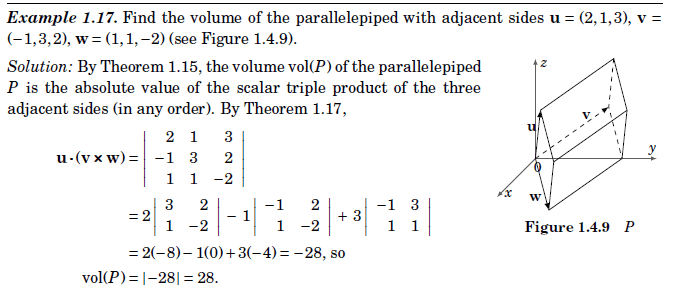
1643256849273.png
ok we can also use the form ##[i×j=k, k×i=j , j×k=i]## right?

to give us say, ##w⋅(u ×v)=v⋅(w ×u)## in realizing same solution.
 
Physics news on Phys.org
Please elaborate on what you mean by "the form ##[i×j=k, k×i=j , j×k=i]##".
 
I wanted to indicate,
For any vectors in 3-dimensional space it follows that,
##w⋅(u ×v)=v⋅(w ×u)=u⋅(v ×w)##... yap with this, i should realize the same value of the required volume... the form ##[i×j=k, k×i=j , j×k=i]## is not applicable here...
 
chwala said:
the form ##[i×j=k, k×i=j , j×k=i]## is not applicable here...
Thank you for your reply.
 
Nice sysprog...I am refreshing on this area, its long since I looked at vector calculus...of course I should be able to check and prove (some of the questions that I ask) the concept given, I just want to be certain that it's mathematically acceptable from the great minds here...cheers
 
It seems to me that you're trying to solidify your understanding of the relation that the dot product has to the cross product.

It's true that if ##u##, ##v## and ##w##, are vectors in 3-space, then ##w · (u × v) = v · (w × u) = u · (v × w)##.

Interchanging two rows changes the sign of a determinant, so interchanging two rows twice results in the same-sign determinant.
 
Question: A clock's minute hand has length 4 and its hour hand has length 3. What is the distance between the tips at the moment when it is increasing most rapidly?(Putnam Exam Question) Answer: Making assumption that both the hands moves at constant angular velocities, the answer is ## \sqrt{7} .## But don't you think this assumption is somewhat doubtful and wrong?

Similar threads

  • · Replies 5 ·
Replies
5
Views
2K
Replies
1
Views
1K
  • · Replies 7 ·
Replies
7
Views
2K
  • · Replies 2 ·
Replies
2
Views
3K
  • · Replies 1 ·
Replies
1
Views
2K
Replies
8
Views
2K
  • · Replies 1 ·
Replies
1
Views
2K
Replies
1
Views
1K
  • · Replies 16 ·
Replies
16
Views
3K
  • · Replies 4 ·
Replies
4
Views
2K