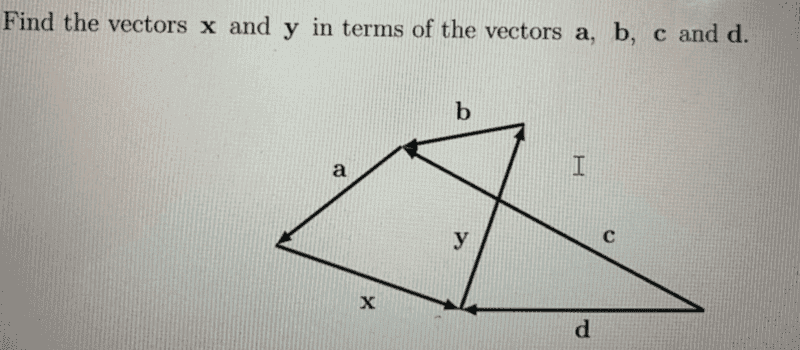
Find vector ##x## and ##y## by considering the vector diagram

  • Thread starter Thread starter chwala
  • Start date Start date
  • Tags Tags
    Diagram Vector
Click For Summary
SUMMARY

The discussion focuses on finding vectors ##\vec x## and ##\vec y## using vector diagrams and algebraic manipulation. The primary solution presented is ##\vec x = -\vec a + \vec d - \vec c## and ##\vec y = -\vec d + \vec c - \vec b##. An alternative approach is suggested, emphasizing the importance of identifying loops that contain ##\vec x## but not ##\vec y## for potential optimization. The consensus is that while the current solution is effective, exploring different loops can enhance problem-solving efficiency.

PREREQUISITES
  • Understanding of vector notation and operations
  • Familiarity with vector diagrams
  • Knowledge of algebraic manipulation of vectors
  • Experience with loop analysis in vector problems
NEXT STEPS
  • Explore advanced vector manipulation techniques
  • Study loop analysis in vector diagrams
  • Learn about alternative methods for solving vector equations
  • Investigate the application of vector diagrams in physics problems
USEFUL FOR

Students and professionals in mathematics, physics, and engineering who are working with vector analysis and seeking to improve their problem-solving strategies.

chwala
Gold Member
Messages
2,828
Reaction score
420
Homework Statement
Find vector ##x## and ##y## by considering the vector diagram
Relevant Equations
Vectors
This is the problem,
1629341898405.png


I managed to solve it, i just want to check if there is an alternative approach. Find my solution below;

##\vec x= -\vec a-\vec b-\vec y##
##\vec y= -\vec d+\vec c-\vec b## therefore,
##\vec x= -\vec a-\vec b+\vec d-\vec c+\vec b##
##\vec x= -\vec a+\vec d-\vec c##
 
Physics news on Phys.org
Your answer seems the unique way to express them by a b c d.
 
  • Like
Likes   Reactions: chwala
chwala said:
Homework Statement:: Find vector ##x## and ##y## by considering the vector diagram
Relevant Equations:: Vectors

This is the problem,
View attachment 287753

I managed to solve it, i just want to check if there is an alternative approach. Find my solution below;

##\vec x= -\vec a-\vec b-\vec y##
##\vec y= -\vec d+\vec c-\vec b## therefore,
##\vec x= -\vec a-\vec b+\vec d-\vec c+\vec b##
##\vec x= -\vec a+\vec d-\vec c##
You could improve the solution slightly by using a different loop to find ##\vec x##.

Can you see the loop containing ##\vec x## but not contianing ##\vec y##?
 
  • Like
Likes   Reactions: jim mcnamara
Steve4Physics said:
You could improve the solution slightly by using a different loop to find ##\vec x##.

Can you see the loop containing ##\vec x## but not contianing ##\vec y##?
Hey, I will look at it over the weekend...cheers
 
It would just be direct from the diagram...

##\vec x= -\vec a+\vec d-\vec c##

1630720937379.png
 
  • Like
Likes   Reactions: Steve4Physics
chwala said:
It would just be direct from the diagram...

##\vec x= -\vec a+\vec d-\vec c##
Yes. It doesn't save much work in this particular problem, but it's still a good idea to look for the 'best' loop(s).
 
  • Like
Likes   Reactions: chwala

Similar threads

  • · Replies 20 ·
Replies
20
Views
3K
Replies
18
Views
2K
  • · Replies 16 ·
Replies
16
Views
2K
Replies
1
Views
2K
Replies
4
Views
2K
Replies
56
Views
6K
  • · Replies 10 ·
Replies
10
Views
2K
  • · Replies 7 ·
Replies
7
Views
2K
  • · Replies 9 ·
Replies
9
Views
2K
Replies
2
Views
2K