Finding charge on a capacitor given potential difference across two points

Click For Summary
SUMMARY

The discussion focuses on calculating the charge on capacitors in a series configuration, specifically addressing a problem where the total charge is given as Q_total = 363 × 10-6 C. The user correctly identifies that for capacitors in series, the charge remains constant across each capacitor, leading to Q_1 = 181.5 × 10⁻⁶ C for the upper capacitor. The voltage across the upper capacitor is calculated as 21V, resulting in a charge stored by C_3 of Q_3 = 4.2 × 10⁻⁵ C. The confusion arises from the notation used for charges and the understanding that capacitors in series share the same charge.

PREREQUISITES
  • Understanding of capacitor configurations, specifically series and parallel arrangements.
  • Familiarity with the formula for charge (Q = C × V) in relation to capacitors.
  • Basic knowledge of electrical units such as coulombs (C) and volts (V).
  • Ability to perform calculations involving scientific notation.
NEXT STEPS
  • Study the principles of capacitors in series and parallel configurations.
  • Learn how to apply the formula Q = C × V to different capacitor arrangements.
  • Explore examples of charge distribution in complex capacitor networks.
  • Investigate the impact of varying capacitance values on total charge and voltage in circuits.
USEFUL FOR

Students and professionals in electrical engineering, physics enthusiasts, and anyone looking to deepen their understanding of capacitor behavior in circuits.

member 731016
Homework Statement
Please see below
Relevant Equations
Please see below
For this part(b) of this problem,
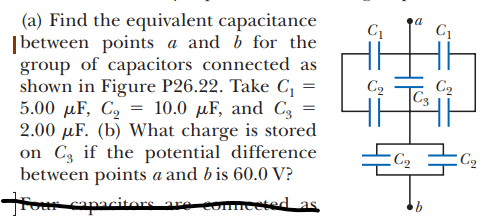
1675993341801.png


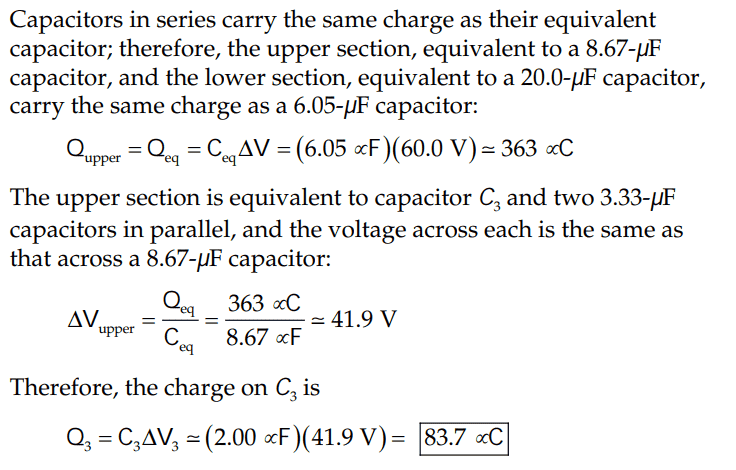
The solution is
1675993422576.png

However, I tried solving (b) like this:

Since ##Q_{total} = 363 \times 10^{-6} C## then ##Q_1 = 181.5 \times 10^{-6} C ## since the equivalent upper capacitor is in series with the equivalent bottom capacitor so should store the same amount of charge.

Since ##C_{upper} = 8.67 \times 10^{-6} C## then voltage across upper equivalent capacitor is ##\frac {181.5}{8.67} = 21V ## then charged stored by ##C_3## is ##Q_3 = 2 \times 10^{6} \times 21 = 4.2 \times 10^{-5} ##

I don't understand why they use the total charge for the upper capacitors when they only store half the charge.
Many thanks!
 
Physics news on Phys.org
What do you label as Q1?
 
  • Like
Likes   Reactions: member 731016
nasu said:
What do you label as Q1?
Thank you for your reply @nasu!

I'm not sure, just some notation for the upper equivalent capacitors charge.
 
Then this is already labeled as Q total. This is the charge on the upper group of capacitors. And the same charge is on the lower group, which is in series with the upper group.
.
 
  • Like
Likes   Reactions: member 731016
nasu said:
Then this is already labeled as Q total. This is the charge on the upper group of capacitors. And the same charge is on the lower group, which is in series with the upper group.
.
Thank you for your reply @nasu! I forgot capacitor in series have the same charge!
 

Similar threads

  • · Replies 30 ·
2
Replies
30
Views
3K
  • · Replies 6 ·
Replies
6
Views
3K
  • · Replies 11 ·
Replies
11
Views
3K
  • · Replies 7 ·
Replies
7
Views
2K
  • · Replies 4 ·
Replies
4
Views
4K
  • · Replies 14 ·
Replies
14
Views
2K
  • · Replies 3 ·
Replies
3
Views
2K
Replies
3
Views
2K
  • · Replies 2 ·
Replies
2
Views
2K
  • · Replies 6 ·
Replies
6
Views
2K