Finding Electric Field and Speed of Electron in a Parallel-Plate Capacitor

Click For Summary
SUMMARY

The discussion focuses on calculating the electric field and the speed of an electron in a parallel-plate capacitor. The initial speed of the electron is given as 5.25 x 10⁶ m/s, and it is deflected by 0.626 cm. The correct magnitude of the electric field is determined to be 3881 N/C, while the final speed of the electron upon exiting the capacitor is calculated to be approximately 5.258 x 10⁶ m/s. The participants identified computational errors in their calculations, particularly in time and acceleration, which affected their results.

PREREQUISITES
  • Understanding of Newton's second law (F=ma)
  • Knowledge of electric field calculations (E=F/q)
  • Familiarity with kinematic equations for motion
  • Basic concepts of charge and mass of an electron
NEXT STEPS
  • Review the derivation of electric field strength in capacitors
  • Practice kinematic equations involving acceleration and velocity
  • Explore the relationship between force, charge, and electric fields
  • Investigate common computational errors in physics problems
USEFUL FOR

Students and educators in physics, particularly those studying electromagnetism and kinematics, as well as anyone involved in solving problems related to electric fields and particle motion.

tony873004
Science Advisor
Gold Member
Messages
1,753
Reaction score
143
Figure 19-38 shows an electron entering a parallel-plate capacitor with a speed of v = 5.25 106 m/s. The electric field of the capacitor has deflected the electron downward by a distance of d = 0.626 cm at the point where the electron exits the capacitor.
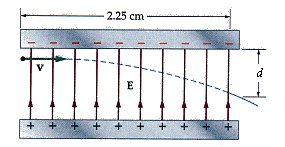
19-38alt.gif


(a) Find the magnitude of the electric field in the capacitor.
b) Find the speed of the electron when it exits the capacitor.


Part A:
E=F/q, but q is not given
F=ma, but m is not given
F=kQq/r2
I don't know where to start.

Part B:
Compute time:
<br /> \begin{array}{l}<br /> t = \frac{d}{v} \\ <br /> \\ <br /> t = \frac{{0.025m}}{{5.25 \times 10^6 m/s}} = 4.2857 \times 10^{ - 8} s \\ <br /> \end{array}<br />

Compute acceleration:
<br /> \begin{array}{l}<br /> y_f = y_i + v_i t + 0.5at^2 \\ <br /> \\ <br /> a = \frac{{y_f - y_i - v_i t}}{{0.5t^2 }} \\ <br /> \\ <br /> a = \frac{{0.626m - 0 - 0t}}{{0.5t^2 }} \\ <br /> \\ <br /> a = \frac{{0.00626m}}{{0.5\left( {4.2857 \times 10^{ - 8} s} \right)^2 }} = 6.81644 \times 10^{12} m/s^2 \\ <br /> \end{array}<br />

Compute velocity:
<br /> \begin{array}{l}<br /> v_{y,f} = v_{y,i} + at \\ <br /> \\ <br /> v_{y,f} = 0 + 6.81644 \times 10^{12} \times 4.2857 \times 10^{ - 8} \\ <br /> \\ <br /> v_{y,f} = 292133.33 \\ <br /> \\ <br /> v_f = \sqrt {v_{y,f}^2 + v_x^2 } \\ <br /> \\ <br /> v_f = \sqrt {(292133.33m/s)^2 + (5.25 \times 10^6 m/s)^2} \\ <br /> \\ <br /> v_f = 5.258122 \times 10^6 m/s \\ <br /> \end{array}<br />
But this answer is wrong.
 
Last edited:
Physics news on Phys.org
What are the question sof part A and B?
 
Oops. Maybe that's why I'm confused. I don't know what they're asking :).

I edited the post to include the questions. Thanks for pointing that out.
 
1.)

F=ma where m is the mass of an electron.
E=F/q where q is the charge of the electron

I'll have a look at 2.)
 
Kurdt said:
F=ma where m is the mass of an electron.
Thanks, that's what I was thinking, but I can't trust my answer since I seem to have gotten acceleration wrong in part b, unless my mistake in part b comes after my computation of acceleration.
 
To be honest part b looks ok to me. Do you have the real answer and perhaps I could work backwards? Probably the fact its past midnight here is not helping me think straight ;)
 
Is the answer 6x10^6 m/s? If so I'll tell you how I arrived at that.
 
I don't know what the answer is. The online grading system gave me the red x on the answer I put. In fact, I'm out of guesses, so I can't try 6e6. But I'd still like to know how to do it, and I still need a good value for acceleration for the f=ma part.

Just curious. If you think it's 6e6, then where did we depart in methods?

Thanks for your help so far.
 
To calculate the velocity i used:

V^2=u^2+2as

That was all really as far as acceleration was concerned I concur with yourself. The final answer was 5.99... some other bunch of numbers so i rounded it up.
 
  • #10
What is u and what is s?

For part A, it gives the units for the answer as N/C.

I used my acceleration value of 6.81644e12 with the mass of an electron, 9.11e-31, and the charge of an electron 1.6e-19 C.

6.81644e12 m/s2* 9.11e-31 kg / 1.6e-19 C
-38.11 N/C

But it says this is wrong too. This problem looks so simple.
 
  • #11
tony873004 said:
Part B:
Compute time:
<br /> \begin{array}{l}<br /> t = \frac{d}{v} \\ <br /> \\ <br /> t = \frac{{0.025m}}{{5.25 \times 10^6 m/s}} = 4.2857 \times 10^{ - 8} s \\ <br /> \end{array}<br />
Redo this calculation. It's off by a factor of 10.
 
  • #12
Thanks for catching that. It's off by more than that. Now I get
4.76E-09

I'll blame it on the calculator :)
 
  • #13
u is initial velocity and s is displacement. With the numbers for part a that you've quoted i get 38.81 N/C. I fear perhaps there are just a few computational errors. As far as I can see the method for A is fine just computational errors perhaps (remember it says magnitude aswell) and if you do part b with the formula i used that should be alright.
 
  • #14
Oh well there you are how did I not spot that!
 
  • #15
Typos galore in this one! Where I wrote 0.025 should read 0.0225, which is the number I used in the calculator. So I am off by exactly 1 magnitude like Doc Al said, and not more like I thought I was.

The answer for part A is 3881. This is exactly 2 magnitudes off of the answer we were getting, which is not surprising since time was off by 1 magnitude and it gets squared.

Thanks Kurdt and Doc Al. Now I understand :)
 
  • #16
Was doc al mainly I have to say but its weird cos I tried the time numbers myself and because it was an exact order of magnitude out I did not notice. Apologies.
 

Similar threads

  • · Replies 2 ·
Replies
2
Views
657
  • · Replies 6 ·
Replies
6
Views
2K
  • · Replies 2 ·
Replies
2
Views
2K
  • · Replies 10 ·
Replies
10
Views
2K
Replies
6
Views
1K
  • · Replies 3 ·
Replies
3
Views
2K
Replies
4
Views
1K
Replies
3
Views
9K
  • · Replies 6 ·
Replies
6
Views
2K
  • · Replies 3 ·
Replies
3
Views
1K