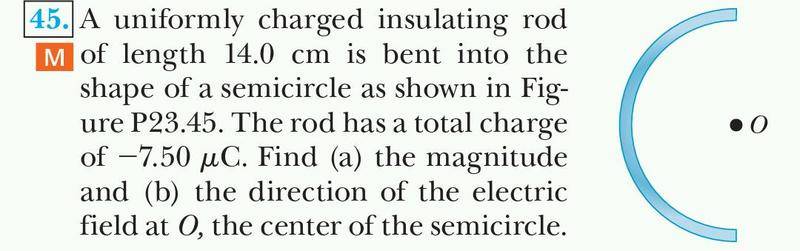
Finding electric field of a bent uniform charged rod.

Click For Summary

Homework Help Overview

The discussion revolves around calculating the electric field generated by a bent uniform charged rod, specifically a semicircular rod. Participants explore the relationships between charge density, length, and the geometry of the setup.

Discussion Character

  • Exploratory, Conceptual clarification, Mathematical reasoning, Assumption checking

Approaches and Questions Raised

  • Participants discuss the expression for the differential charge element dq and its relation to the length element dL. There are attempts to express dq in terms of polar coordinates and the geometry of the semicircle. Questions arise regarding the correct interpretation of the radius R in relation to the length L of the rod, and how to set up the integral for the electric field.

Discussion Status

Several participants provide insights on integrating the electric field components and clarify the relationship between R and L. There is an ongoing exploration of the direction of the electric force, particularly in relation to the charge of the rod. Some guidance is offered regarding the integration bounds and the setup of the equations, but no consensus has been reached on the final calculations.

Contextual Notes

Participants note the complexity of integrating over a semicircular shape and the potential confusion regarding the signs of the charges involved. There are references to the book's answer, which prompts further verification of calculations.

freshcoast
Messages
185
Reaction score
1
1. Problem statement.
2h52yrt.jpg


2. Known equations.
E = k § dq/r^2

Lamda = Q/L

3. Attempt.

I am having trouble figuring out the dq in this situation. I know that lamda = Q/L, and since those 2 are the variables that are changing I take the derivative of them so it looks like

Lamda = dq/dL

I solve for dq giving me dq = lamda * dL

Which is where I am stuck. When I enter the new dq into the integral for the electric field, I do not know what to use for the r^2, I am aware that L=R(theta) but I am having trouble being able to manipulate R in terms of L since the only way is having a theta into the integral, but I can't integrate it because the bounds are going to be the length of the rod..

Any input is much appreciated, thanks!
 
Physics news on Phys.org
Try dq = lambda*r*d(theta) and integrating in polar coordinates. You will integrate over a half circle, i.e. from 0 to pi. R=r=constant because of the semicircle shape. You can use geometry to find the radius since the length of the rod is 1/2 the circumference of a full circle.
 
Consider an element of length dl at angle θ .Now dq=λdl and dl=rdθ .The electric field due to this tiny part dl will be dE as shown in the figure.The component of dE in horizontal direction is dEsinθ and that in vertical direction is dEcosθ.This component dEcosθ is canceled by a similar component of electric field due to element which is symmetric to this in the lower half of the semicircle.

So essentially we have,E=∫dEsinθ where dE=k(dq)/r2
 

Attachments

  • rod.GIF
    rod.GIF
    11 KB · Views: 1,238
Last edited:
Hmm, I am still having trouble figuring out what R is,

from what Ampere is saying, I can set L = 2*pi*r, and since it is a semi circle, L = pi*r, and I can solve for R,

so far my integral looks like this

[tex]E = k∫λ r dθ /r<sup>2</sup> (sinθ) (i)[/tex]

after some simplification it ended up as

[tex]E = kλ/r * ∫sinθdθ (i)[/tex]

lambda then turns into Q/L

[tex]E = [kq/L* R] * ∫sinθdθ (i)[/tex] integral bounds would be from 0 to pi

after integration I get,

[tex]E = kq/L*R * (-cos(pi) - (-cos(0)) (i)[/tex]

[tex]E = kq/L * R * (-(-1) - (-(1)) (i)[/tex]

[tex]E = 2kq/L*R[/tex]

but when I plug everything I don't get the correct answer. the answer in the book is 2.16 N/C

btw I have another question about the direction, why is the direction of the force is pushing the point away instead of towards it, since the rod is negatively charged, doesn't that mean it should be an attraction force?
 
freshcoast said:
Hmm, I am still having trouble figuring out what R is

R and r are the same thing.They are the distance of the point O from each tiny bit of the rod ,equal to the radius of the semi circular rod.

freshcoast said:
btw I have another question about the direction, why is the direction of the force is pushing the point away instead of towards it, since the rod is negatively charged, doesn't that mean it should be an attraction force?

Yes...the direction should be opposite to what i have shown in the figure.I didnt notice the rod was having negative charge.
 
Last edited:
R and r are the same thing.They are the distance of the point O from each tiny bit of the rod ,equal to the radius of the semi circular rod.

yes but I am having trouble finding the value of R given only L, since I know that R is related to L because length is equal to circumference of the circle, is it safe to say that R = L / pi ?
 
∏r =L → r=L/∏
 
freshcoast...Please recheck the answer .The answer I am getting is 2.16 *107 N/C.
 
freshcoast said:
after some simplification it ended up as

[tex]E = kλ/r * ∫sinθdθ (i)[/tex]

lambda then turns into Q/L

[tex]E = [kq/L* R] * ∫sinθdθ (i)[/tex] integral bounds would be from 0 to pi

...
[tex]E = 2kq/L*R[/tex]

but when I plug everything I don't get the correct answer. the answer in the book is 2.16 N/C

You multiplied by R instead of dividing by it, I am afraid. It should be [tex]E = \frac{2kq}{L*R}[/tex]

ehild
 
  • #10
Oh, that must be why, since I downloaded the pdf version of the book I guess it is not showing most of the answer, so the correct answer is 2.16 x 10^7 N/C, which is what I got, cool thanks!
 
  • #11
Well done :thumbs:
 

Similar threads

  • · Replies 13 ·
Replies
13
Views
1K
Replies
6
Views
2K
  • · Replies 1 ·
Replies
1
Views
2K
  • · Replies 6 ·
Replies
6
Views
2K
  • · Replies 9 ·
Replies
9
Views
2K
  • · Replies 11 ·
Replies
11
Views
6K
  • · Replies 25 ·
Replies
25
Views
3K
Replies
3
Views
2K
  • · Replies 5 ·
Replies
5
Views
2K
  • · Replies 11 ·
Replies
11
Views
4K