Finding Internal Loadings on a Cantilevered Beam

  • Thread starter Thread starter newbphysic
  • Start date Start date
  • Tags Tags
    Internal Statics
Click For Summary
SUMMARY

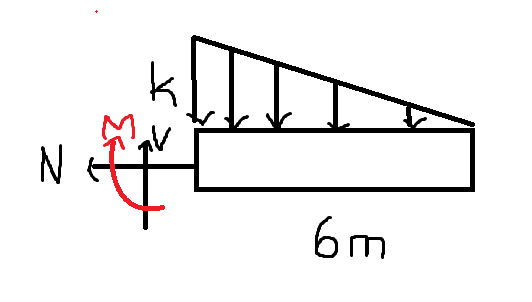
The discussion focuses on calculating the internal loadings at cross section C of a cantilevered beam subjected to a triangular distributed load of 270 N/m. The resultant force is determined to be 540 N, calculated as the area under the load curve. The bending moment at point C is found to be -1080 Nm, indicating an anti-clockwise moment due to the applied load. The relationship between shear force and bending moment is clarified, emphasizing that shear force contributes to the bending moment in the beam.

PREREQUISITES
  • Understanding of cantilever beam mechanics
  • Knowledge of shear force and bending moment diagrams
  • Familiarity with centroid calculations for triangular loads
  • Proficiency in static equilibrium equations (ΣV = 0, ΣM = 0)
NEXT STEPS
  • Study the derivation of shear force and bending moment diagrams for cantilever beams
  • Learn about the centroid location for various shapes, particularly triangles
  • Explore the implications of negative moments in structural analysis
  • Investigate advanced loading scenarios on cantilever beams, including varying distributed loads
USEFUL FOR

Structural engineers, civil engineering students, and professionals involved in beam analysis and design will benefit from this discussion, particularly those focusing on cantilever structures and load calculations.

newbphysic
Messages
39
Reaction score
0
Determine the resultant internal loadings acting on the cross section
at C of the cantilevered beam
http://imgur.com/Q4ZUTOq
1. Homework Statement

F = 270 N/m

Homework Equations


ΣV = 0
ΣM = 0
ΣN = 0

The Attempt at a Solution


section CB[/B]
6JVrME0.png

k/6 = 270/9
k = 180 N/m

resultant force = area under the curve = 1/2 * 180 * 6 = 540 N

ΣN = 0
-N = 0
N = 0

ΣV = 0
V - resultant = 0
v = resultant = 540 N

How can i find M ?
 
Physics news on Phys.org
newbphysic said:
Determine the resultant internal loadings acting on the cross section
at C of the cantilevered beam
http://imgur.com/Q4ZUTOq
1. Homework Statement

F = 270 N/m

Homework Equations


ΣV = 0
ΣM = 0
ΣN = 0

The Attempt at a Solution


section CB[/B]
6JVrME0.png

k/6 = 270/9
k = 180 N/m

resultant force = area under the curve = 1/2 * 180 * 6 = 540 N

ΣN = 0
-N = 0
N = 0

ΣV = 0
V - resultant = 0
v = resultant = 540 N

How can i find M ?
You can calculate the shear force diagram for this beam given the loading as shown.

What's the relationship between the bending moment and the shear force?
 
You have already determined the resultant force of the load . At what point does it act? Then sum moments and watch directions.
 
SteamKing said:
You can calculate the shear force diagram for this beam given the loading as shown.

What's the relationship between the bending moment and the shear force?
both occur because of force perpendicular to beam ?
PhanthomJay said:
You have already determined the resultant force of the load . At what point does it act? Then sum moments and watch directions.
center of the beam ?
 
newbphysic said:
both occur because of force perpendicular to beam ?

That's not the relationship which is useful in calculating M.

At the free end of the cantilever, M = 0. What must M be at point C for that segment of the beam to remain in equilibrium?
 
[QUOTE="newbphysic, post: 5400435, member: 557120]center of the beam ?[/QUOTE] in the free body diagram you have drawn, the resultant of the triangularity distributed load acts at the cg of that load. Where's that?
 
SteamKing said:
That's not the relationship which is useful in calculating M.

At the free end of the cantilever, M = 0. What must M be at point C for that segment of the beam to remain in equilibrium?
the relationship between M and shear force is shear force causes bending moment ?

Since M=0 at the end of cantilever that means M must be 0 at C to remain equilibrium

PhanthomJay said:
center of the beam ? in the free body diagram you have drawn, the resultant of the triangularity distributed load acts at the cg of that load. Where's that?
if the beam is uniform then cg will be length / 2 = 6/2 = 3m from C
 
newbphysic said:
the relationship between M and shear force is shear force causes bending moment ?

Since M=0 at the end of cantilever that means M must be 0 at C to remain equilibrium

The only problem is, M can't be zero at point C, 'cuz of that applied force. What's the moment due to the applied force?
 
if the beam is uniform then cg will be length / 2 = 6/2 = 3m from C
in your diagram, the loading on the beam is not uniform; it is triangular. The centroid of a triangle is not at its center.
 
  • Like
Likes   Reactions: newbphysic
  • #10
SteamKing said:
The only problem is, M can't be zero at point C, 'cuz of that applied force. What's the moment due to the applied force?
The moment is the sum of all forces from B to C = 540 N
PhanthomJay said:
in your diagram, the loading on the beam is not uniform; it is triangular. The centroid of a triangle is not at its center.
centroid of triangle is 1/3 * 6 = 2
 
  • #11
newbphysic said:
The moment is the sum of all forces from B to C = 540 N

That's not what a moment is.
centroid of triangle is 1/3 * 6 = 2

How do you use the centroid of the applied load to calculate the moment due to that load?
 
  • #12
newbphysic said:
centroid of triangle is 1/3 * 6 = 2
Yes , 2 m from where? Now place the resultant force at that point and sum moments about the left end of your section to find the internal moment at that end.
 
  • #13
SteamKing said:
That's not what a moment is.
moment is force times distance.
so it's 540 times the distance to the left side of the beam
Is that what you mean ?

SteamKing said:
How do you use the centroid of the applied load to calculate the moment due to that load?
total force times the distance from centroid to C

PhanthomJay said:
Yes , 2 m from where? Now place the resultant force at that point and sum moments about the left end of your section to find the internal moment at that end.
2m from zero reference point means from the left of the beam.
so moment = force * distance = 540 *2 = 1080 Nm

ΣM = 0

M + 1080 Nm = 0

M = -1080 Nm
 
  • #14
newbphysic said:
2m from zero reference point means from the left of the beam.
so moment = force * distance = 540 *2 = 1080 Nm

ΣM = 0

M + 1080 Nm = 0

M = -1080 Nm
Yes, but can you explain the meaning of the minus sign in front of your answer?
 
  • #15
PhanthomJay said:
Yes, but can you explain the meaning of the minus sign in front of your answer?
M is anti - clockwise

Thanks a lot phantom
 
  • #16
newbphysic said:
M is anti - clockwise

Thanks a lot phantom
OK!
 

Similar threads

Replies
3
Views
2K
  • · Replies 1 ·
Replies
1
Views
2K
  • · Replies 5 ·
Replies
5
Views
2K
Replies
3
Views
2K
Replies
2
Views
1K
  • · Replies 5 ·
Replies
5
Views
2K
  • · Replies 1 ·
Replies
1
Views
3K
  • · Replies 1 ·
Replies
1
Views
2K
  • · Replies 5 ·
Replies
5
Views
4K
  • · Replies 3 ·
Replies
3
Views
4K