Finding Partial Derivatives of a Multivariable Function

Click For Summary

Homework Help Overview

The discussion revolves around finding partial derivatives of a multivariable function, specifically focusing on the calculation of second partial derivatives and the application of the chain rule in a multivariable context.

Discussion Character

  • Exploratory, Conceptual clarification, Mathematical reasoning

Approaches and Questions Raised

  • The original poster attempts to find the first partial derivative ∂u/∂x and expresses uncertainty about calculating the second partial derivative ∂/∂z(∂u/∂x). Some participants question the correctness of the original poster's calculation of ∂u/∂x, while others suggest using the chain rule to express derivatives in terms of other variables.

Discussion Status

Participants are actively engaging with the problem, with some providing guidance on how to approach the calculation of second partial derivatives. There is an acknowledgment of the need to clarify initial calculations, and the discussion appears to be progressing towards a deeper understanding of the relationships between the variables involved.

Contextual Notes

There is mention of potential errors in the calculation of the first partial derivative, as well as the need to express certain derivatives in terms of other variables due to the dependencies involved. The original poster's task is framed within the constraints of a homework assignment.

geekba
Messages
4
Reaction score
0
Hi!
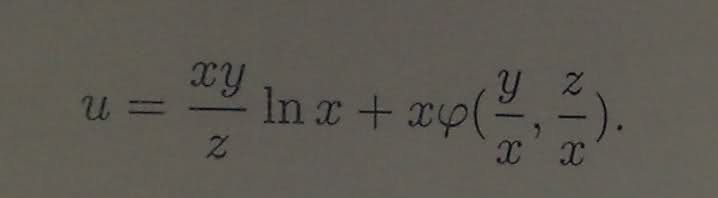
Here is my function:

2ag2fia.jpg


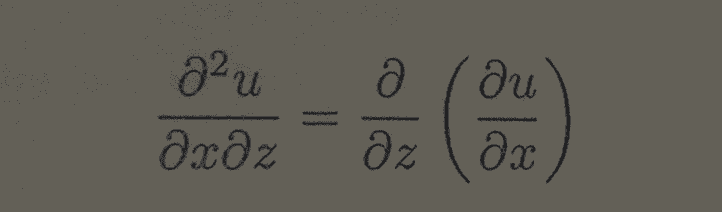
My task is to find:

206irmv.jpg


I think I know how to find ∂u/∂x, but I have no idea how to find ∂/∂z(∂u/∂x). Here is how I found ∂u/∂x:

http://oi48.tinypic.com/prsly.jpg

Does someone know how to find ∂/∂z(∂u/∂x)?
I appreciate any help :)
 
Last edited by a moderator:
Physics news on Phys.org
Before the second partial derivative, you should fix the error in your calculation of ∂u/∂x, specifically ∂([itex]\frac{xy}{z}[/itex])/∂x.
 
What's wrong with ∂(xy/z)/∂x? I checked it and it seems correct to me...
 
It's very important so all suggestions are welcome :)
 
geekba said:
What's wrong with ∂(xy/z)/∂x? I checked it and it seems correct to me...

Never mind. I hadn't scrolled all the way down, it is correct.

I believe you are having trouble calculating [itex]\frac{∂}{∂z}[/itex]([itex]∂\rho/∂s[/itex]) and [itex]\frac{∂}{∂z}[/itex]([itex]∂\rho/∂t[/itex]) (Let me know if this is not the case).
To simplify this, get rid of s and t by writing [itex]∂\rho/∂s[/itex] and [itex]∂\rho/∂t[/itex] as partial derivatives of [itex]\rho[/itex] w.r.t. x, y and z, using the chain rule. Since you know how s and t depend on x, y and z, this can be done.

Once you have done this, calculating [itex]\frac{∂}{∂z}[/itex]([itex]∂\rho/∂s[/itex]) and [itex]\frac{∂}{∂z}[/itex]([itex]∂\rho/∂t[/itex]) would be straightforward.
 
I got it finally :smile: Thaks a lot!
 

Similar threads

Replies
4
Views
1K
  • · Replies 3 ·
Replies
3
Views
2K
  • · Replies 3 ·
Replies
3
Views
3K
Replies
9
Views
2K
Replies
26
Views
4K
  • · Replies 6 ·
Replies
6
Views
2K
  • · Replies 12 ·
Replies
12
Views
2K
  • · Replies 5 ·
Replies
5
Views
1K
Replies
5
Views
4K
Replies
10
Views
3K