Finding Scale Reading with New Resistor in Circuit

Click For Summary

Homework Help Overview

The discussion revolves around a circuit problem involving resistors and their effect on a scale reading. The original poster seeks to determine the scale reading when an additional 2000Ω resistor is added to the circuit, which already includes a configuration of resistors.

Discussion Character

  • Mixed

Approaches and Questions Raised

  • Participants explore the configuration of resistors, questioning whether they are in series or parallel. There are attempts to calculate the resultant resistance and current for different setups, with some participants providing calculations and others challenging the assumptions made.

Discussion Status

The conversation includes various calculations and interpretations of the circuit's behavior. Some participants have offered guidance on how to approach the problem, while others express uncertainty about the arrangement of the resistors and the implications for the scale reading. Multiple interpretations of the circuit configuration are being explored.

Contextual Notes

There is a mention of imposed homework rules, indicating that participants are encouraged to work through the problem rather than receive direct answers. Some participants express confusion about basic concepts related to parallel resistors.

franklinear
Messages
9
Reaction score
0
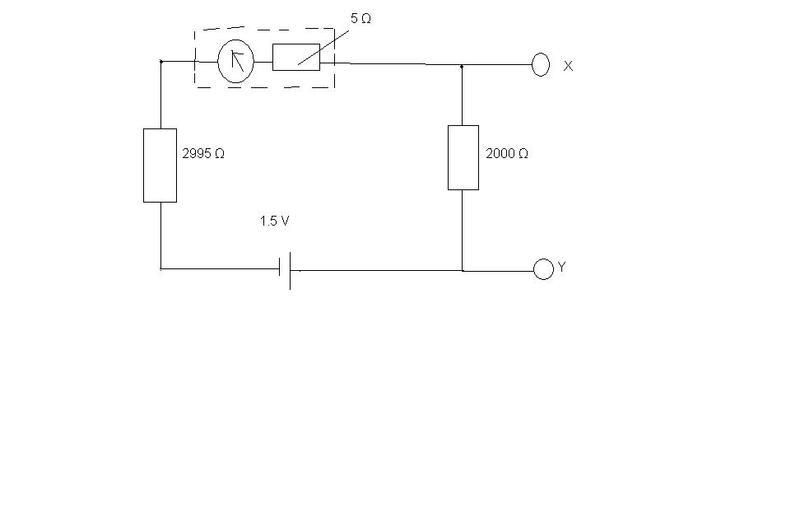
The meter in the circuit shown in the image has an uncalibrated linear scale. With the circuit as shown, the scale reading is 20. Find the scale reading when another 2000Ω resistor is connected across XY.

ss.JPG
 
Physics news on Phys.org
in the diagram given 2995 and 5 are in series ad they add up to 3000

3000 and 2000 are in parallel so give a resistance of 1200 ohms as a result

and voltage is 1.5 V

there fore i=v/r =1.5/5000=3x10^(-4)

now when a resistance of 2000 is attached across X and Y

then 3000,2000,2000 seem to be in parallel

resultant resistance of these is which give 751.8 ohmsi=1.5/751.8=2x10^-3

there fore scale will show a reading of 6.66
 
Work out the currents for each setup. Initially, all components are in series.

1) 1.5 volts / ( 3000 ohms + 2000 ohms) =


Now, 2000 ohms in parallel with 2000 ohms = 1000 ohms.

2) 1.5 volts / ( 3000 ohms + 1000 ohms ) =

Then, if the first current = "20" on the linear scale, what does the second current read?
It will read more, won't it?
 
hey vk6kroarent the 3000,2000,2000 allt hree in parallel?

u have taken the 3000 to be in series with parallel arrangement of 2000,2000
 
No.

Follow the path of the current from the battery +ve to the battery -ve.

You go through the resistors one after the other, don't you? So they are in series.
 
vk6kro said:
Work out the currents for each setup. Initially, all components are in series.

1) 1.5 volts / ( 3000 ohms + 2000 ohms) =


Now, 2000 ohms in parallel with 2000 ohms = 1000 ohms.

2) 1.5 volts / ( 3000 ohms + 1000 ohms ) =

Then, if the first current = "20" on the linear scale, what does the second current read?
It will read more, won't it?

i agree with you.

By comparison,
I1/I2=20/x
We get x= 25.
 
No.

Work out the two values with your calculator.

What does this equal:
1) 1.5 volts / ( 3000 ohms + 2000 ohms) =
Add 3000 and 2000 and divide 1.5 by this total.

What does this equal:
2) 1.5 volts / ( 3000 ohms + 1000 ohms ) =
Add 3000 and 1000 and divide 1.5 by this total.

You should get two currents in Amps.

Now the meter reading will be 20 times the ratio of (current 2 / current 1)

I agree with your answer but I don't think you know how you got it.
This is clearly course work, so we can't just do it for you.
 
i've got it correct already.

A few hours ago,
I posted I1/I2=20/x
Thus x=20 x I2/I1
It's just the same...
 
Hey vk6kro, is the total resistance of parallel resistors equal to the highest resistance resistor divided by the number of resistors in parallel?

I am not a physics major or anything but I do like to toy around with equations. I am sure this is a basic question in your realm.
 
  • #10
vk6kro said:
No.

Work out the two values with your calculator.

What does this equal:
1) 1.5 volts / ( 3000 ohms + 2000 ohms) =
Add 3000 and 2000 and divide 1.5 by this total.

What does this equal:
2) 1.5 volts / ( 3000 ohms + 1000 ohms ) =
Add 3000 and 1000 and divide 1.5 by this total.

You should get two currents in Amps.

Now the meter reading will be 20 times the ratio of (current 2 / current 1)

I agree with your answer but I don't think you know how you got it.
This is clearly course work, so we can't just do it for you.

This is exactly what franklinear showed. Neither of you showed how you came up with 1000 ohms though.
 
  • #11
elbeasto said:
Hey vk6kro, is the total resistance of parallel resistors equal to the highest resistance resistor divided by the number of resistors in parallel?

I am not a physics major or anything but I do like to toy around with equations. I am sure this is a basic question in your realm.


Parallel resistance, [itex]R_P[/tex] is found using the following formula:<br /> <br /> [tex]R_P = \frac{1}{\frac{1}{R_1} + \frac{1}{R_2}}[/tex]<br /> <br /> and, for instances where [itex]R_1 = R_2[/tex] you can simplify this by just taking [itex]R_P = \frac{1}{2}R_1[/tex][/itex][/itex][/itex]
 
  • #12
Another way of getting the total of resistors in parallel, especially if they are not the same, is this:

Rtotal = R1 * R2 / (R1 + R2)

So, if you have a 39 ohm resistor and a 56 ohm resistor in parallel, you would get the following:

Rtotal = 39 * 56 / (39 + 56) = 29.99 ohms

Or, you can just get 1/39 + 1/56 and take the reciprocal of it.If you have two 2000 ohm resistors in parallel,
Rtotal = 2000 * 2000 / (2000 + 2000) = 1000 ohms

Or, using the other method,
1 / 2000 + 1 / 2000 = 0.001
take the reciprocal to get 1000 ohms.

This still works if you have any number of identical resistors in parallel.
So, if you had 7 resistors all 56 ohms, you would get this:
1/56 + 1/56 + 1/56 + 1/56 + 1/56 + 1/56 + 1/56 = 0.125
The reciprocal of this is 8 ohms.
So the result is 56 / 7 or 8 ohms.

Makes sense because 7 resistors across a power source will draw 7 times as much current as one resistor if they are all identical. So, the combination has 1/7th as much resistance as one resistor.
 
  • #13
vk6kro said:
Another way of getting the total of resistors in parallel, especially if they are not the same, is this:

Rtotal = R1 * R2 / (R1 + R2)

This is completely true (and it is derived from the formula I posted). The reason I didn't mention it, is that this formula only works for 2 resistors in parallel at a time, whereas the one I gave can be extended to any number of resistors in parallel, by:

[tex]R_{total} = \frac{1}{\frac{1}{R1} + \frac{1}{R2} + ... + \frac{1}{Rn}}[/tex]

where n represents the number of resistors.

Example:
R1 = 10 [itex]\Omega[/tex]<br /> R2 = 5 [itex]\Omega[/tex]<br /> R3 = 8 [itex]\Omega[/tex]<br /> R4 = 12 [itex]\Omega[/tex]<br /> <br /> Then,<br /> [tex]R_{total} = \frac{1}{\frac{1}{10} + \frac{1}{5} + \frac{1}{8} + \frac{1}{12}} \approx 1.967 \Omega[/tex]<br /> <br /> This is easily entered into a calculator using the following key sequence:<br /> (if you have a reciprocal key, either [itex]1/x[/tex] or [itex]x^{-1}[/tex])<br /> 10<br /> [itex]1/x[/tex]<br /> +<br /> 5<br /> [itex]1/x[/tex]<br /> +<br /> 8<br /> [itex]1/x[/tex]<br /> +<br /> 12<br /> [itex]1/x[/tex]<br /> =<br /> [itex]1/x[/tex]<br /> (Done)<br /> <br /> <br /> <br /> Of course, the version of the formula that vk6kro offered will work as well, but you would have to take many more steps. You would first have to find the equivalent resistance of R1 parallel to R2 (call the result R5), then find the equivalent resistance of R5 parallel to R3 (call this result R6). Finally, you would find the equivalent resistance of R6 parallel to R4.<br /> <br /> Plus, if I was going to memorize a formula for parallel resistors, I'd choose the more versatile one. Besides, it's easy to confuse the numerator and the denominator of the two-resistor formula. (Do I divide the sum by the product, or the product by the sum?)[/itex][/itex][/itex][/itex][/itex][/itex][/itex][/itex][/itex][/itex][/itex]
 
  • #14
I use the simple formula when I have only two resistors in parallel (which is the usual situation) and I don't happen to have my very nice Scientific calculator with me.

With a simple 4 function calculator it is a lot easier to multiply two numbers together and divide by their sum than it is to muck around with reciprocals.

I even use it for times when there is no calculator around and I have to work it out with mental arithmetic.
 

Similar threads

  • · Replies 9 ·
Replies
9
Views
2K
Replies
2
Views
2K
  • · Replies 6 ·
Replies
6
Views
2K
  • · Replies 45 ·
2
Replies
45
Views
4K
  • · Replies 4 ·
Replies
4
Views
2K
  • · Replies 17 ·
Replies
17
Views
2K
Replies
5
Views
2K
  • · Replies 31 ·
2
Replies
31
Views
5K
  • · Replies 3 ·
Replies
3
Views
1K
  • · Replies 1 ·
Replies
1
Views
2K