Finding the air cavity resonance of a propane tank for a drum.

Click For Summary

Discussion Overview

The discussion revolves around determining the resonant frequency of a propane tank intended to be used as a drum. Participants explore methods for calculating resonance, the relationship between tongue dimensions and frequency, and the implications for tuning the instrument. The scope includes theoretical considerations, experimental approaches, and practical applications related to sound and resonance in musical contexts.

Discussion Character

  • Exploratory
  • Technical explanation
  • Experimental/applied
  • Debate/contested

Main Points Raised

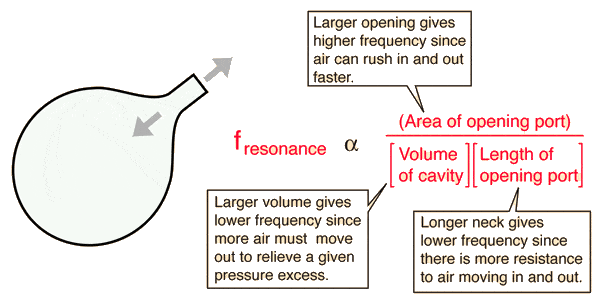
  • One participant proposes using a cavity resonance formula to find the resonant frequency of the propane tank and suggests that tuning should avoid extremely damped frequencies.
  • Another participant questions the feasibility of having seven unrelated resonant frequencies in the drum design and suggests using a microphone and marble to measure resonance.
  • A different approach is suggested involving a speaker to perform a frequency sweep within the cavity to identify prominent frequencies, with a focus on nodes and wavelengths.
  • One participant reflects on the potential independence of the air cavity's resonant frequency from the mechanical resonance of the steel shell, noting that the most effective drumming effect may occur when these frequencies coincide.
  • Another idea involves using both a microphone and a speaker to create feedback oscillation, which could indicate the resonant frequency of the cavity, although it may not reveal multiple resonant frequencies.

Areas of Agreement / Disagreement

Participants express various methods for determining resonant frequencies, but there is no consensus on the effectiveness of these methods or the nature of the resonant frequencies themselves. Multiple competing views remain regarding the relationship between the air cavity and the tank's material properties.

Contextual Notes

Participants mention limitations in their current setups, such as the absence of a microphone or oscilloscope, and the potential complexity of measuring multiple resonant frequencies. There are also unresolved questions about the relationship between tongue dimensions and resonant frequency.

great_sushi
Messages
30
Reaction score
0
I am going to build a drum out of a propane tank. I think it will be handy to find the resonant frequency of the tank and choose the tuning accordingly so not to pick frequencies that are extremely damped.

I have a cavity resonance formula found on hyper physics
cav.gif


I am not going to build a drum with only one note, there will be approximately 7. 7 notes in most scales. http://muzmaker.ru/uploads/posts/2009-04/1240604374_717ff323216270166.jpg
If you look at the image you'll see the notes, I am going to refer to them as tongues.

Once I find the resonant frequency I can decide on the tuning. Another problem is choosing the dimensions of the tongues at the top. I've been trying to find another formula so that I can determine the size of the tongues, so a larger tongue results in a slower oscillation producing a lower note and vice versa. But I will need to relate the tongue dimensions to the resonant frequency of the tank.

Im curious to know how to calculate the resonant frequency of something steel with particular dimensions.

Once I have that relation I can move forward. Also, fine tuning will be done by either bending the tongue downward/upward permanently as to result in a lower/higher frequency respectively.

Thankyou, If all goes well, my drummer sister will have another present for christmas.
 
Physics news on Phys.org
Do you have an oscilloscope on which to measure frequency, if you were to use a microphone? (You might also need an amplifier.) If you held a microphone at the mouth of the cavity, and dropped a marble inside, you'd record a decaying echo which would be the frequency of resonance. I don't quite understand how something like this could simultaneously have 7 unrelated resonant frequencies, but maybe that is possible. I don't claim to understand much about the mysteries of music.
 
I don't have a microphone but I could introduce a speaker into the cavity and do a frequency sweep. Noting the frequencies that 'stand out'. I imagine that there will be one natural frequency and perhaps 'n' integer values of the wavelength.
Say having one wave with (i think its nodes where you hear maximum intensity) nodes at both ends, (only two). Then one whole wavelength with 3 nodes, then 4 nodes, then 5.
I might not be explaining it very well and I may be wrong.

It would be great if someone could explain it properly
 
On further reflection, I guess the air cavity could have a resonant frequency that is independent of the mechanical resonance of the steel shell. I expect drumming effect would be most impressive when the design sees these two frequencies coincide.

You certainly could try sweeping the speaker frequency and listening for a peak, but when I tried this using a column of glass tube as a class demo, the peak was as good as imperceptible.

An idea that could hold promise involves introducing both a microphone and a speaker into the cavity, the speaker delivering an amplified version of what the mic picks up. As the gain is turned up, feedback should see the system begin to oscillate and show feedback squeal. I expect that frequency of oscillation would be the resonant frequency of the cavity. You might be able to press into service the mic and earpiece from a discarded cell phone for this. This isn't going to reveal multiple resonant frequencies, though.
 
Last edited:

Similar threads

  • · Replies 12 ·
Replies
12
Views
4K
  • · Replies 10 ·
Replies
10
Views
10K
Replies
9
Views
3K
  • · Replies 10 ·
Replies
10
Views
4K
Replies
4
Views
3K
  • · Replies 1 ·
Replies
1
Views
2K
  • · Replies 1 ·
Replies
1
Views
3K
  • · Replies 12 ·
Replies
12
Views
6K
  • · Replies 1 ·
Replies
1
Views
3K
  • · Replies 7 ·
Replies
7
Views
2K