Finding the Angle to Hit a Window 10m Away and 5m High

  • Thread starter Thread starter blaziken's_charizard
  • Start date Start date
  • Tags Tags
    Angle Window
Click For Summary

Homework Help Overview

The problem involves determining the angle at which a boy must throw a stone to hit a window located 10 meters away horizontally and 5 meters above the ground, given an initial throw speed of 14 m/s. The context includes kinematics and projectile motion principles.

Discussion Character

  • Exploratory, Mathematical reasoning, Assumption checking

Approaches and Questions Raised

  • Participants discuss using kinematic equations and trigonometric identities to relate horizontal and vertical motion. There are attempts to express time in terms of horizontal displacement and velocity, and to substitute this into vertical motion equations. Questions arise about the correctness of initial assumptions and the setup of equations.

Discussion Status

Participants are actively exploring different approaches to manipulate the equations and trigonometric identities involved. Some have suggested specific methods for expressing time and substituting variables, while others are questioning the implications of their calculations and the relationships between the variables.

Contextual Notes

There is mention of potential confusion due to the absence of units in calculations, and participants are encouraged to simplify coefficients and apply trigonometric identities to derive a single equation in terms of one trigonometric function. The discussion includes considerations of gravitational effects in hypothetical scenarios.

blaziken's_charizard
Messages
33
Reaction score
0
1. A boy can throw a stone at 14 m/s. At what angle must he throw it in order to hit a window which is 10m away horizontally and 5m above the ground?
2. I would assume we have to use trig ratios and the kinematics equations.

v = u + a.t
v^2 = u^2 + 2.a.s
s = u.t + 1/2.a.t^2


3. Diagram:
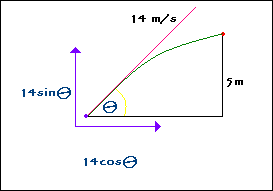
img.png

(see attachment or http://img377.imageshack.us/my.php?image=imgwn9.png )I know that time is a constant for both the horizontal and vertical components, so I presume that it would not affect the equations.

My info:
-Vertical motion
(t=0)
s = 5m
u = 14 m/s sin.(theta)
a = +9.8 m/s^2

-Horizontal motion
(t=0)
s = 10m
u = 14 m/s cos.(theta)
a= 0

So how do I find theta? Am I missing any equations? Is my diagram correct? Is u = 14 m/s sin.(theta) and u = 14 m/s cos.(theta) correct? Thanks :)

I'm thinking of using some equation in theta... but what those equations are is beyond me =[

 
Last edited:
Physics news on Phys.org
you should write how horizontal and vertical distances depend on t, then express t from one equation (horizontal makes it easier), and put it in other.
 
There is more manipulation of trigonometric identities involved in this question than actually using formulas.
You have the horizontal velocity vector. Now you want to find how long it will take the projectile to hit the window. This won't be a direct answer, but in terms of [tex]\theta[/tex].
Use [tex]t=\frac{s_x}{u_x}[/tex]
where,
sx=horizontal displacement
ux=horizontal velocity vector

Then from here you can substitute the time into:
[tex]s_y=u_yt+\frac{1}{2}a_yt^2[/tex]
where,
sy=vertical displacement
uy=vertical velocity vector
ay=acceleration due to gravity (make sure this is negative, since it is acting opposite to the velocity vector and the displacement) i.e. -9,8ms-2

You will now find that you have an equation all in terms of [tex]\theta[/tex]. Now comes the manipulation. You will be surprised to find that there are two possible angles to throw the projectile at :smile:
 
If you're curious to know, I made some calculations and found for this scenario, but instead being under the influence of stronger gravity (being on another planet); the gravity can only go as high as [tex]g=\frac{49(1-\sqrt{5})}{5} \approx -12.11ms^{-2}[/tex] until the rock would never be able to reach the window. (not taking into account that higher gravity will slow the initial velocity of the throw).
At this gravity, the precise angle to throw the rock at would be [tex]tan^{-1}(\frac{\sqrt{5}+1}{2}) \approx 58^o17'[/tex]
 
Mentallic said:
There is more manipulation of trigonometric identities involved in this question than actually using formulas.
You have the horizontal velocity vector. Now you want to find how long it will take the projectile to hit the window. This won't be a direct answer, but in terms of [tex]\theta[/tex].
Use [tex]t=\frac{s_x}{u_x}[/tex]
where,
sx=horizontal displacement
ux=horizontal velocity vector

Then from here you can substitute the time into:
[tex]s_y=u_yt+\frac{1}{2}a_yt^2[/tex]
where,
sy=vertical displacement
uy=vertical velocity vector
ay=acceleration due to gravity (make sure this is negative, since it is acting opposite to the velocity vector and the displacement) i.e. -9,8ms-2

You will now find that you have an equation all in terms of [tex]\theta[/tex]. Now comes the manipulation. You will be surprised to find that there are two possible angles to throw the projectile at :smile:

t = s/u
s = 10m
u = 14cos.[tex]\theta[/tex] m/s [horizontal velocity vector]

so, t = 10 / 14cos.[tex]\theta[/tex]

then, s = u.t + 1/2.a.t^2

5 = (14sin[tex]\theta[/tex] * 10/14cos[tex]\theta[/tex]) + 1/2.(-9.8).(10/14cos[tex]\theta[/tex])(10/14cos[tex]\theta[/tex])

Please excuse the absence of units- including them would make it so much more confusing.

I will deal with each part of that equation separately:


ut:
(14sin[tex]\theta[/tex] * 10/14cos[tex]\theta[/tex])
= 140sin[tex]\theta[/tex] / 14cos[tex]\theta[/tex]
Right? I don't know how to continue frome here...

1/2 * a:
1/2.(-9.8)
= -.49

t^2
(10/14cos[tex]\theta[/tex])(10/14cos[tex]\theta[/tex])
= 100 / 14cos^2[tex]\theta[/tex]
Don't know how to continue from here either...

So, I have:

5 = (140sin[tex]\theta[/tex] / 14cos[tex]\theta[/tex]) + (-4.9)(100 / 14cos^2[tex]\theta[/tex])

I guess my problem now is working with the trig identities now...
 
ok first we will simplify the equation (just the coefficients at first. i.e. the numbers).

[tex]5=14sin\theta(\frac{10}{14cos\theta})+\frac{1}{2}(-9.8)(\frac{10}{14cos\theta})^2[/tex]

simplified: [tex]5=\frac{10sin\theta}{cos\theta}-4.9(\frac{25}{49cos^2\theta})[/tex]

Now the trig identities you should be aware of are as follows. If you want to know the proofs for them, just ask :smile:

1) [tex]tan\theta=\frac{sin\theta}{cos\theta}[/tex]
thus [tex]tan^2\theta=\frac{sin^2\theta}{cos^2\theta}[/tex]

2) [tex]sin^2\theta+cos^2\theta=1[/tex]

3) [tex]sec^2\theta=1+tan^2\theta[/tex] N.B. [tex]sec\theta=\frac{1}{cos\theta}[/tex]

See if you can apply these formulas in a variety of ways to get an equation all in terms of the same trig ratio. tangent, cosine or sine. Good luck!
 

Similar threads

  • · Replies 20 ·
Replies
20
Views
3K
Replies
6
Views
4K
  • · Replies 21 ·
Replies
21
Views
5K
  • · Replies 5 ·
Replies
5
Views
3K
  • · Replies 9 ·
Replies
9
Views
3K
Replies
4
Views
2K
Replies
3
Views
2K
  • · Replies 3 ·
Replies
3
Views
2K
  • · Replies 11 ·
Replies
11
Views
2K
  • · Replies 7 ·
Replies
7
Views
2K