LuigiAM
- 55
- 7
Member advised to use the provided formatting template when starting a new thread in a homework forum.
Hi everyone, sorry for bothering y'all again but here is another problem that I'm struggling with!
This is the question and the professor's solution guide:
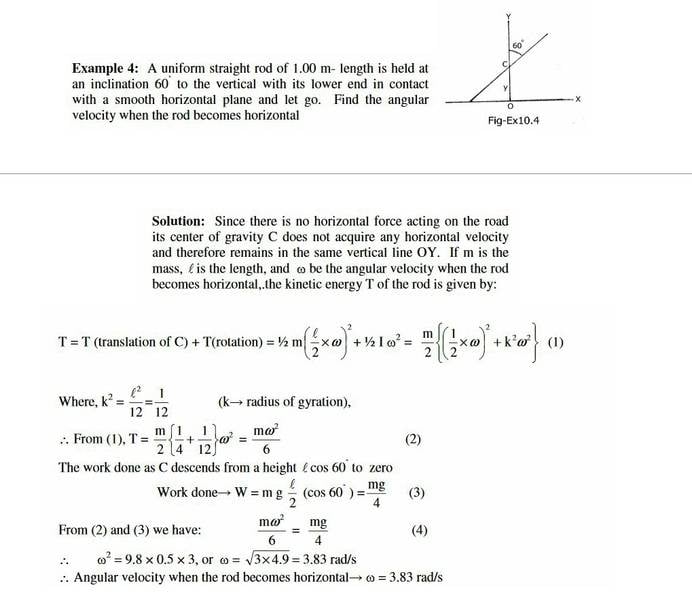
When I solve the problem, I always end up getting 7.67 rad/s instead of 3.83 rad/s.
My understanding of the solution is this:
This is a conservation of energy problem.
When the rod is suspended at 60 degrees, it has potential energy (U = m g h). When it is released from its position, the potential energy turns into kinetic energy. The potential energy has completely turned into kinetic energy when the rod is horizontal. So, at the horizontal, the potential energy has turned into rotational kinetic energy Ek = I w2.
So I have:
m g h = 1/2 I w2
The moment of inertia for a rod is 1/12 m L2. Plugging it in the equation:
m g h = 1/2 (1/12 m L2) w2
I can cancel out m from both side and remove L2 since L = 1. The equation becomes:
g h = 1/24 w2
w2 = 24(9.8)(h)
h is the height at which the rod is raised. Since half of the rod is 0.5 meters and it is at a 30 degree angle to the horizontal, the height h will be 0.5 times the sine of 30 degrees, so h will be 0.25 m.
Plugging that in for h:
w2 = 24(9.8)(0.25)
w2 = 58.8
w = 7.67 rad/s
I know I'm doing something wrong but I'm not sure where I'm going off track. I suppose it's probably when I'm solving for h?
I have a lot of difficulty understanding the professor's solution, but at the end he has the equation:
w2 = 9.8(0.5)(3)
I understand he gets a different number, but I don't see where that comes from? I read the solution 20 times but I don't understand his process. I remember that in class we did a rotating rod problem and the idea was just a conservation of energy from potential energy to kinetic energy.
I also don't see where he calculates the value for h in the solution? I looks like something that should be an easy problem but I feel lost here :(
This is the question and the professor's solution guide:
When I solve the problem, I always end up getting 7.67 rad/s instead of 3.83 rad/s.
My understanding of the solution is this:
This is a conservation of energy problem.
When the rod is suspended at 60 degrees, it has potential energy (U = m g h). When it is released from its position, the potential energy turns into kinetic energy. The potential energy has completely turned into kinetic energy when the rod is horizontal. So, at the horizontal, the potential energy has turned into rotational kinetic energy Ek = I w2.
So I have:
m g h = 1/2 I w2
The moment of inertia for a rod is 1/12 m L2. Plugging it in the equation:
m g h = 1/2 (1/12 m L2) w2
I can cancel out m from both side and remove L2 since L = 1. The equation becomes:
g h = 1/24 w2
w2 = 24(9.8)(h)
h is the height at which the rod is raised. Since half of the rod is 0.5 meters and it is at a 30 degree angle to the horizontal, the height h will be 0.5 times the sine of 30 degrees, so h will be 0.25 m.
Plugging that in for h:
w2 = 24(9.8)(0.25)
w2 = 58.8
w = 7.67 rad/s
I know I'm doing something wrong but I'm not sure where I'm going off track. I suppose it's probably when I'm solving for h?
I have a lot of difficulty understanding the professor's solution, but at the end he has the equation:
w2 = 9.8(0.5)(3)
I understand he gets a different number, but I don't see where that comes from? I read the solution 20 times but I don't understand his process. I remember that in class we did a rotating rod problem and the idea was just a conservation of energy from potential energy to kinetic energy.
I also don't see where he calculates the value for h in the solution? I looks like something that should be an easy problem but I feel lost here :(

